
A blog post from this very site has been picked up by Allegory. Ironically, Cracking the code, the first piece that I have ever gotten published, is a rant about not getting published.
Thank goodness the editor has a sense of humor.
-James
A blog post from this very site has been picked up by Allegory. Ironically, Cracking the code, the first piece that I have ever gotten published, is a rant about not getting published.
Thank goodness the editor has a sense of humor.
-James
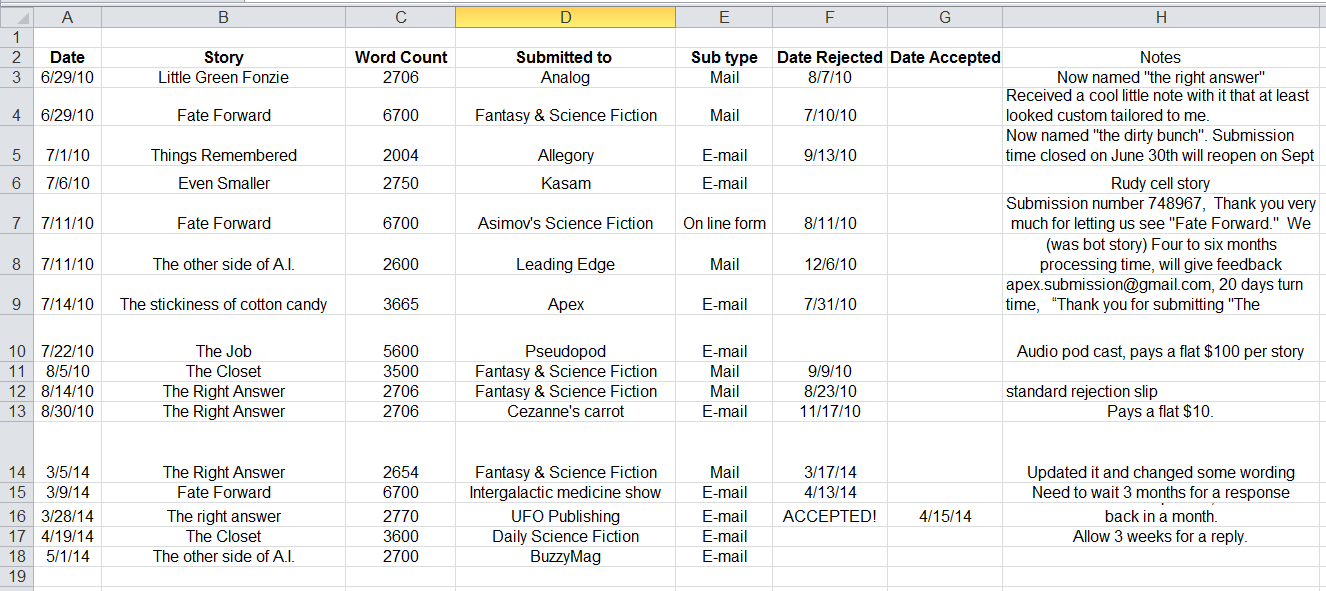
As soon as I began submitting two stories going at a time, I started losing track of when I had sent them, and to where. I am not sure what other writers do to keep track of submissions, but I made an Excel sheet for the task.
The main tab is a chronological list of the each submission.
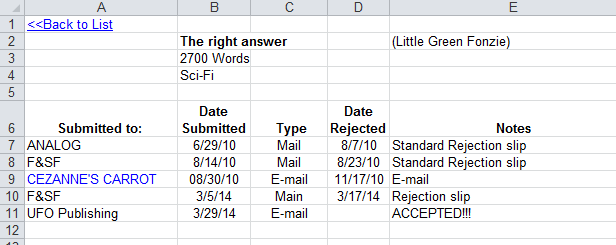
I also have tabs for each of the individual stories to see the chronological history of where they have been submitted. I see on the tab below that I did submit this story to the same place twice, which is really a no-no, but it was after some editing, a name change to the story and after almost four years had elapsed. Unfortunately, they still didn’t like it.
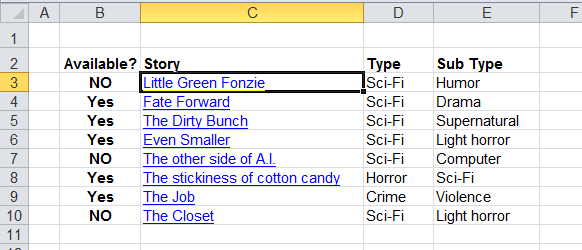
I have another tab that automatically adjusts so I can tell from a quick glance which stories are available to be submitted. I am not sure if there is actually a “sub-type” category for writing. I just do that for my own reference, because, yes, sometimes I do forget what my own stories are about.
If this is something you feel may be useful, feel free to comment with your e-mail and I will send you the template.
-James
It has happened.
Here are excerpts from a recent series of exciting e-mails:
“Your story is one of the top contenders for inclusion into the book”
It’s not like riding a bike.
The creative juices just don’t flow as easily after you have been away for a while. The hamster wheel has a harder time turning and when it does there is this awful squeaking sound every time it goes around.
I have been going through my old idea pile. I am pleased with what I am finding, yet I am unable to pick up where I left off. It seems I am better at doing a rewrite of something finished, polishing the existing rather than creating anew. Part of it is that the house now has four people in it instead of just me, but I know in my heart, most of it is of my own lack of volition.
Here are some sites with articles I enjoyed on how to get the creative juices flowing:
For some reason I let four years slip by since my last Blog post. In that time all writing and submitting went on hiatus. How could I let that happen? Well here are some of the life changers that have been going on since that last post. Please do not construe these as excuses. I have no excuse.
1) I got married
2) I changed jobs
3) We had a baby
The good news is that I am back in the game and have, as of last month, already received two rejection letters. I am in the process of reconstructing a few of my stories. The one advantage of being away from your writing for that long is that it gives you a fresh perspective.
I am also excited because a story I submitted to UFO Publishing has advanced past the initial rounds. I received this via e-mail:
Now that I am getting back on the horse, my time away has also reminded of Mark Twain, who, at one point, put down The adventures of Huckleberry Finn and didn’t return to it until seven years later. Please note that this “fact” is a faint recollection of something my 9th grade English teacher told us. I am certain of the author, but hazy as to whether I have the right book. I also couldn’t find any reference to this lapse in writing anywhere online.
Back in high school seven years seemed like an eternity. It was forever to walk away and then come back to a story. I now understand how easily that can happen. I have a batch of stories that I wrote back in 1991 on an apple II. They are complete crap. I get a real bittersweet visceral sensation when reading those. I enjoy seeing how creative I could be at times, but I am frightened by the naivety and illiteracy that twenty year old had at the time.
At least I am not as naive anymore.
Getting a bead on Stan.
Stanley is the Editor of Analog Magazine.
As you may or may not know, I have been reading some of Stanley Schmidt’s work in order to get a feel for what he might like in a Sci-Fi story. My theory is that all things being equal, learning about the man’s interest and style of writing could help me to tailor my stories toward something he has an interest in.
The biggest thing I have learned about Stanley is that he is really just looking for a good story. My assumption is that there are a lot of those, so I need to hedge my chances by writing in a style and maybe even including content that will catch his fancy.
Here is what I have learned so far:
1) Stanley like music. He includes it as a trait of the Kyyra (Alien race) it in his book “The Sins of the Fathers”. Reading online about Stanley and Analog showed me that Analog magazine employees have also formed an informal band.
2) Stan loves to end a chapter with a hook or cliffhanger for the next chapter.
3) He does a lot of telling in his writing. I am basing this on “The Sins of the fathers” which was written in 1975, so his writing style may have changed a bit since then. But it’s good to know that he probably doesn’t consider telling ( as opposed to showing) as much of a mortal sin as some fiction aficionados do.
I had recently read Issac Asimov’s “Foundation” prior to reading Stan’s book. It could just be the temporal proximity of the two rattling around in my brain, but it seems that Stan’s writing style is very similar to Asimov. It made me think that Asimov may be a mentor of sorts for him. There is also mention of a “Foundation “ in ‘Sins of the fathers” which seemed an awful lot like Stanley’s way of tipping his hat to Asimov.
4) Stanley has a degree of inefficiency in his writing. I think we all do, but the one sentence I really keyed off of was when he used a phrase that was something to the effect of “He changed the subject”, then went on to show the changing of subject in the dialogue. If you show the action happening, you really don’t need to tell about it beforehand.
What I gathered from this is that Stanley should be pretty forgiving if I inadvertently do something like that.
I am sure there is a lot more to learn about this man, but I am probably better off just working on perfecting the stories I have to tell, and not worrying so much about tailoring my stories to please one editor.
James
I have received two more rejections since the last post.
One was for my story “The closet”, which is about a mysterious black void that changes things for both better and worse after they are placed inside it. The rejection came from Science Fiction and Fantasy Magazine Editor Gordon Van Gelder who wrote:
“Many thanks for Submitting “The Closet,” but I’m going to pass on this one. I’m afraid this Twilight Zone-ish story didn’t quite grab me, alas. Thanks anyway for sending it my way and best luck to you with this one.”
At first glance the rejection seems soft and nice, but after getting a few of these you can read between the lines. Let’s break it down:
“Many thanks for Submitting “The Closet,” but I’m going to pass on this one”
First off, I never realized that you put the comma within the quotes, before the conjunction on a sentence like that. I assume he is correct in doing this, the man is an editor after all, so I am going to tuck that grammar tip away for later.
I also like his fun, loose tone in the rejection letter. There is no “Dear sir” from this guy just a “Many thanks,” like he’s wearing sandals and chewing on a beef jerky while responding.
Breaking it down to what this sentence really means, I get:
“I am not going to buy your story”
He then goes on to say:
“I’m afraid this Twilight Zone-ish story didn’t quite grab me, alas.”
Translation:
“You ripped off of the Twilight Zone. It was obvious, and I didn’t like it.”
He did use the word “alas”, and when I read that I first pictured him in a regretful whimsical sigh, but then I realized I am not even sure what “alas” means. I always kind of thought it was like the conjunction “but”, except Gordon used it at the end of a sentence, so I looked it up by typing “Define: alas” into my favorite search engine.
This is what Google had to say:
Alas: Unfortunately: by bad luck; “unfortunately it rained all day”; “alas, I cannot stay”
So the full sentence really translates to:
“You ripped off of the Twilight Zone. It was obvious, and unfortunately I didn’t like it.”
Editor Gordon then ends with:
“Thanks anyway for sending it my way and best luck to you with this one.”
Translation:
“Please don’t send this to me again, or anything like it.”
I also stumbled on “best luck” as I have always heard that phrased as “best of luck”. I wonder if Gordon missed a word or if that’s actually the proper way we should be using the phrase. Maybe the addition of the word “of” is just an idiom we all picked up over time?
I consider if I should start saying ‘Best luck” from here on out and think: What am I the Queen of England? What do I care if I’m not proper?
I decide that I am still going to use it my way, with “of” tucked neatly in between “best” and “luck”.
To drop the “of” would be like calling this guy “Gordon Gelder.” I am pretty sure “van” translates to “of”, and that his last name, Van Gelder, at one time literally meant “of Gelder” or “of Gold” or something like that.
I find a certain degree of pleasurable irony in all that.
Translating the whole thing we get:
“I am not going to buy your story. You ripped off of the Twilight Zone; it was obvious, and unfortunately, I didn’t like it. Please don’t send this to me again, or anything like it”
I would love to get a note so full of refreshing candor like that, but Editors have to maintain all this tact so as not to drive the other unqualified, and much less stable, writers into a gun toting rage.
The second rejection came from Ty Drago, Editor of Allegory E-zine.
OK, is it just me, or is “Ty Drago” the absolutely coolest name ever? I mean that name could pass for either a superhero or a super villain. The Ty part makes him sound warm and friendly, like that guy on the home makeover show, and “Drago” just sounds like, if you did some genealogy research, you may be able to trace his bloodline right back to Satan.
This is what Mr. Coolest-name-ever wrote:
“Thanks for letting us ‘Things Remembered.” I regret to say that it’s just not right for Allegory.
Here’s what our editor had to say:
>
> What I liked: The imaginative plot
>
> Reason for rejection: Could benefit from some editing. Punctuation
> errors (dialogue tags, lack of commas); spelling errors, repetitive
> use of the word ‘it’ and ‘that’. Small stuff, but distracting.
>
I’m sorry. Best of luck with this one in other markets.
– Ty Drago
– Editor
– Allegory
Clearly this was submitted before I boned up on grammar. Or at least did some boning. Er… you know what I mean.
Let’s still break it down and see what Ty really meant:
“Thanks for letting us “Things Remembered.” I regret to say that it’s just not right for Allegory.”
Once again I stumbled while reading, this time it was on the disconnect between “us” and “’Things Remembered’”. It looks like I am supposed to infer the word “see” in between, but I am guessing it’s just an oversight/typo on his part.
It’s also kind of a slap in the face when they go on to rip about my grammar problems.
Translation:
“I am not going to buy your story”
Next line:
“Here’s what our editor had to say”
What? I thought your title was Editor? Wait, are you are a slush pile reader, or a maybe just a guy who knows how to run the e-mail a lot better than the editor? Because I can see the “>” symbols showing me that the editor forwarded an e-mail back to you…. I guess, a filter is probably the best term for you.
But I then realize that may also mean my story made it through one reader, and onto the big chief, before getting the final rejection. That seems kind of cool.
And then I get all “conspiracy theory” and wonder if Ty Drago didn’t just add the >’s himself.
It would work so well; making it look like my story made it’s way through to the editor, and was seriously considered. Plus there is the whole “power of the third party” thing where I can’t really get mad at Drago for things the editor had commented about, and apparently there is no name to this higher up editor, so there is no way for me to go ballistic on him/her.
I then think that maybe Ty is the Editor and someone else runs the e-mail on his behalf, using his name.
I decide that’s what I am going to believe. It’s probably healthier than conspiracy.
I continue to read between the lines.
“> What I liked: The imaginative plot”
At first glance, this comment makes me feel really good about my story. Like there is some hope since I at least have an imaginative plot. But then I realize if you were going to pick one thing that could generically apply to, and flatter, all writers, commenting about how creative the plot is, would be that thing.
No writer who submits a story thinks “I hope my rip off of Star Wars goes over well.” Everyone thinks that they have some unique and original twist in their own story. Even though there is a whole Joseph Campbell-ish mindset out there that there is really only one story and all other stories are spin offs.
Translation:
“There was nothing positive about this story.”
Next lines:
> Reason for rejection: Could benefit from some editing. Punctuation
> errors (dialogue tags, lack of commas); spelling errors, repetitive
> use of the word ‘it’ and ‘that’. Small stuff, but distracting.
Jeez, slow down on using three lines to reject it. I get it already – I are bad at grammar.
Although I was surprised on the “it” and “that” comment. I didn’t realize I had such a problem with it/that.
Translation:
“You fail to grasp English. ”
Next Line:
I’m sorry. Best of luck with this one in other markets.
(~See~ this guy said “Best of luck”)
Mr. Best-name-ever actually spelled out “other” markets to me. So not only does he not want to see this story again, but maybe I should also try to hit the minor leagues with it and the rest of whatever I have to offer him.
Translation:
“I’m laughing at you. Don’t send anything to me again. You are way in over your head.“
When we put it all together this is what Ty really had to say:
“I am not going to buy your story. There was nothing positive about this story. You fail to grasp English. I’m laughing at you. Don’t send anything to me again. You are way in over your head.”
It seems harsh, but I think, pretty accurate. It’s just too bad that editors don’t feel like they are able to write that candidly.
And don’t think for a minute any of this has gotten me down. I just need to polish up another batch of my crap and send it off to annoy yet another league of editors.
James
I have been having a hard time feeling good about writing. I don’t feel good about doing it and I don’t feel good about what I have written.
I know that sounds depressing, like each night I go to bed curled up in the fetal position rocking myself to sleep with the barrel of a gun in my mouth, but that’s not the case at all. It’s really more of a matter of “this is where I am at” kind of thing. I am still in good spirits, I’m just not getting anything worth while done with regard to writing.
Is it writer’s block?
No, I don’t think so. It’s more like writer’s laziness. I still have plenty of ideas; it’s just that none of them seem fleshed out enough to start writing. For example: I have one where I think it would be cool to do a story about a terrorist attack against the Space Elevator . I just love the idea of a carbon nanotube rope leading into space and being held in place by a geosynchronous mass. A Space Elevator could lead to rapid and cost effective deployment of satellites and space missions, not to mention making the prospect of a trip into space within reach of regular Joes, like you and I.
But somehow it just ain’t sexy enough. Maybe because it isn’t really a story idea, but rather a setting with a vague concept.
It’s like I am still waiting for that big “Ah-ha!” idea to hit, and so far I’ve just got a bunch of maybes
I also get sidetracked very easily. I am now fighting an urge to code another video game. I program games using Dark GDK, which works with Microsoft’s C++ Express.
I recently had the idea to take photos of my nephews in various kick and punch poses, and integrate these photos into sort of an 80’s style side-scroller “Super Mario” style game. I think my Nephews would really enjoy playing as themselves in a tailor-made video game.
I so want to be the cool uncle who does stuff like that.
But that’s a huge commitment; probably at least 100 hours of programming time to get something worth playing. And then there is the risk that it may not be that cool to them. The “I’m in the game factor” can only go so far when I’m also competing against the Wii.
Then I get ideas for the game like how I could somehow make it educational, but real subtly so they wouldn’t know. I could do something like putting Classical music in the game instead of the normal techno crap. But I know making it educational is the deathblow to any video game. Ask any kid what the top twenty video games are, and none of them will list anything even remotely close to “Math-blaster”.
I resolve to get something written today, even if it’s crap, but currently find myself looking at cutting edge video cards for a fantasy desktop computer build.
James
OK, maybe “obsessively studying” is a better term.
Stanley Schmidt is the Editor for Analog Science Fiction and Fact Magazine. The Magazine is what I would consider the pinnacle of the Science Fiction short story market.
I have sent off a few short stories, trying my hand at getting into this pro market, and so far have been thwarted… but rightly so. My fiction contained grammatical errors, and probably a lot plot related errors that Editors like Mr. Schmidt are able to spot in an instant.
My goal is to get published, and not in any old “Pay in copies” type publication, I am going for the pro markets; the kind that count toward the three stories you need to get qualified for membership to Science Fiction and Fantasy Writers of America.
So while I am working to better hone the craft of speculative fiction, I thought it might be a good idea to get to know the gatekeeper at Analog. Some people might just give him a phone call, or shoot an E-mail off for virtual meet and greet, but I know how busy Stanley is, and don’t want to be that guy that bugs him at work to pick his brain for publishing tips.
I just can’t imagine that going well.
Besides, studying him from afar is necessary to keep my preconceived illusions intact. I don’t want to risk finding out that the man I put up on an editorial pedestal is anything less than the literary genius I expect him to be. Didn’t we all feel just a little bit bad for Oz when Toto pulled the curtain away?
But why study Stanley?
My first comment on a rejection slip came in the disappointing form of a request to always number my pages. It came from Stan the man himself. It was the sci-fi writer’s equivalent of a message from God, but instead of instructions on how to carry the tablets down from Mt. Sinai, it was more of a “don’t do that or you’ll go blind” sort of thing.
I later read through one of his editorials that are always present in the front of each issue of Analog. A chill went through me when I saw:
“Lately, for reasons that perplex me, I’ve been getting an astounding number of manuscripts with no page numbers, a practice for which I’m hard put to imagine an advantage.”
I knew that that at least two of those page-numberless stories were mine. It felt like an indirect communication. Sort of like if my dog crapped on his lawn and he wrote a letter to the town paper about it.
I suppose this could be a pet peeve of his that is set off by two only occurrences. But an “astounding number” sounded like it must have been on the order of dozens of stores submitted without page numbers for Mr. Schmidt to make such a remark in an editorial like that.
In a strange way, it almost feels as though Editor Schmidt and I have a connection; granted it’s built on my failings, but a connection nonetheless. Like when I do finally get a story published with Analog there will be a wink and a nod in a now you get it kind of way.
So what have I been doing to stalk study Stanley?
First I checked out what Wikipedia had to say about the man, then went on to his Bio on the SFWA site, where there is a great picture of him eating a bowl of noodles, taken by his wife.
From there I bought two of his books: Aliens and Alien Societies: A Writers Guide to Creating Extraterrestrial Life-Forms, and The Sins of the Fathers.
And what have I learned thus far?
I am about halfway through the Aliens and Alien societies book and it is apparent that Editor Schmidt feels that there are a lot of Aliens being created for fiction that are not really plausible.
I think this comes from the dividing line between Science Fiction and Fantasy. In Fantasy almost anything is possible within the rules that are set up in that story’s universe. In Science Fiction, while it is still fiction, there needs to be plausibility to the Aliens. A possibility that, while these creatures may not really exist, in some way or another, there is a logical scientific reason why they could exist and that doesn’t break the laws of nature.
For example: Giant insects 100 feet tall could never exist on Earth as they would collapse under their own weight. Tiny microbial beings wouldn’t really be able to have any sort of intelligence, as there is no room for a thinking brain that small to develop, at least following any sort of rules that we currently know about neurology.
But what I have really learned was something I have known all along.
Stanley Schmidt, like all great Editors, is really just interested in a dammed good story.
Well, I hear you Editor Schmidt, and I am going to do my best to try to knock your socks off.
James
My Mom is good friends with my high school English teacher, Connie. I took advantage of this relationship at our families 4th of July celebration by hitting up Connie to take an editorial look at a few of my stories.
This is, of course, a huge favor to ask, so I was thrilled when she agreed and quickly sent off three stories that I think might be an enjoyable read for her .
This weekend we met at Mom’s house to go over some of Connie’s edits to my writing. Within minutes it was easy to tell that Connie’s a pro. She has been teaching for decades and has the stuff down cold.
The funny part to me was how both my Mom and Connie suggested that I should “start submitting” and “really try to get published.” They were so kind in the way they both went on about how great my stories are, but they didn’t know that I really have been trying to get published for a few months now.
I am sure that I am probably at the point where I am a little better at crafting a story than most High School students, but that’s only because at this point in my life I care about writing. It’s not too hard to stand out against a room full of kids who would rather be texting each other than working on an <ugh!> writing assignment.
And God knows I could scribble out anything and my Mom would want to make forty copies of it for the relatives then put it up on the fridge.
The positive response to my writing was very flattering, and I do think encouragement is crucial to keep a beginning writer from throwing in the towel, but there is also a danger in feeling too confident. That danger lurks as a failure to learn as you go; the danger of thinking you know it all already.
I see a lot of people, some friends even, who have conflict in their lives and choose to blame it on some external cause. They tend to focus on how they have gotten screwed over; their helpless role as the victim of cruel circumstances supposedly beyond their control.
While I disagree with the attitude they have toward their problems, I also pity them. By playing the victim they have stifled their own ability to deal with issues they face.
I have found that if I try to see the role my own hand played in a problem, either through some incorrect action I took, or more often, an action I failed to take, then I can at least be better prepared to face those same types of problems in the future.
Knowledge works the same way. Once you feel you have something mastered, a person tends to get comfortable. You stop learning. And stagnating is dying, my friend.
Of course, I still blame all of my literary stumbling on how dammed picky Editors are.
While writing this post (8/23/10), I received another rejection from Fantasy and Science Fiction magazine for the Little Green Fonzie story (Submitted on 8/14/10).
Of course, after receiving edits from Connie, and Ian, another person I asked to help me, I can understand why an Editor may not be able to get past the first few sentences.
And while it sucks to be rejected, I do really like F&SF’s super fast turn around time. Considering time in limbo traveling around the various USPS offices, nine days is getting right on it.
James
 Breaking Into The Craft