Category Archives: Rejection

Ten Things That Cause Immediate Rejection

If you are submitting short fiction, there are a handful of things that can move a story from the submission pile to the rejection pile almost immediately.

Here are ten that will lose an editor’s interest:

1. Use of AI

If a publication says it does not accept AI-generated fiction, take that requirement seriously.

It is much easier for editors to spot this than you might think. They have years of experience understanding how a story sounds that comes from an actual human. And there are also tools out there that can help identify AI. It is unlikely they will every mention AI in the rejection but, it is likely you will get secretly blacklisted.

I feel that there is an important distinction between using a tool to check grammar and spelling and asking an AI system to write the story for you. But every publication draws that line differently, so read the rules.

2. Incorrect Word Count

If the submission guidelines say stories must be between 1,000 and 5,000 words (like BITC) do not submit a 7,500-word story and hope the editor will love it enough to make an exception. Odds are it will be rejected immediately.

Going 50 words over may not seem like as big of a violation, but it tells us editor types a lot about the way you operate. You have either not read the word-count requirement or feel that it is a loose suggestion rather than a rule. We also wonder if you think it’s impossible to cut 50 words from the story, which tells us something too. For any story over 1,000 words getting rid of 50 should be rather easy.

3. The Wrong Type of Story for the Market

This one should be obvious, but it happens a lot.

If a publication wants lighthearted fantasy, your relentlessly cold-blooded serial-killer story is probably not going to find a home there.

Before submitting, spend a little time looking at what the publication actually publishes. Read several stories they have published (most publications recommend this). Read the submission guidelines.

4. Content That Crosses the Line

Every publication has different boundaries, but some material can quickly make an editor stop reading.

Racial slurs, gratuitous sexual content, misogyny, graphic violence involving minors, or cruelty included purely for shock value may be enough to end consideration. Once again, this can vary by publication.

Writers should also remember that editors are selecting material for an audience. Even if something can be justified as a crucial part of the story, it still may not fit the publication.

I should also mention that you can still cover a lot of disturbing or unpleasant scenes without describing them in detail. Oftentimes implication of a situation can actually be the stronger way to go.

[Warning: disturbing content ahead]

Seeing a child character we have grown to love get into a car with a stranger allows the reader’s mind to fill in the blanks in horrible ways. We don’t necessarily need to see what actually happens.

Sorry about that example, but if you were disturbed by it, it proves the point.

5. No Ending

One of the most frustrating submissions is a promising story that seems to reach the point where the real story is finally beginning, and then it just stops.

These are the worst for me because there is so much hope. I like the story; there is a good chance that, if it ends well, I will get to send out an acceptance email.* But if it instead just drops off, or wraps up in a totally unacceptable way, I am out.

To me it often feels like the authors have not put in the time to really think through what kind of exciting ending they can put on their story. I like the David Mamet approach of having the ending be something that is unexpected and inevitable. Another author (I can’t recall who at the moment) says your approach should be to come up with every possible ending, then pick the one that is the most unusual while still being plausible. This is often the best and most rewarding ending for the reader.

*Yes, despite what it seems, editors are probably more exited than you are when we get to accept a story.

6. Grammar, Spelling, and Punctuation

Editors understand that an occasional typo survives even careful proofreading.

But if the first page is filled with misspellings, missing punctuation, random capitalization, incorrect dialogue formatting, and sentences that have to be read three times to understand them, the story is already in trouble.

You want the editor to be thinking about your characters and what happens next instead of trying to decipher what you meant.

Proofread your work, then proofread it again, then put it aside for a month and proofread it a third time. If you don’t want to wait that long, give it to a friend who is good at that kind of thing, then brace yourself for the embarrassment of everything you missed.

7. Using Someone Else’s Intellectual Property

Be careful when borrowing characters, fictional worlds, distinctive settings, or other creative material belonging to someone else.

Writing a story about your own characters stopping at McDonald’s is one thing, but writing an adventure starring Harry Potter is entirely different.

Fan fiction has enormous communities built around it, but that does not mean a commercial publication can legally publish your unauthorized Spider-Man story or Star Wars sequel.

References to popular culture are common in fiction, but taking someone else’s characters or world and making them the foundation of your story is a no-no.

Create your own world. Create your own characters. They are probably way more interesting anyway.

8. Derogatory Use of Brand Names

Real brands can absolutely appear in fiction. Our characters can drive a Ford, eat at McDonald’s, wash clothes with Tide, or put Goodyear tires on a truck. These kinds of references can actually help establish place, time, and character.

The problem comes when a writer uses a real company as the target of accusations. There is a substantial difference between:

“The Goodyear tire blew out.”

and:

“Goodyear secretly knew these tires were defective and sold them anyway.”

If your plot requires an evil corporation knowingly selling lethal products, you should invent a brand. No editor wants to take the risk of publishing something that carries any defamation risk.

9. No Clear Conflict or Objective

You do not need an explosion on page one.

You do need a reason for me to keep reading.

A short story has very little room to wander around. You need to let the reader know who the protagonist is, what they want, and why they currently can’t have it.

A description of a farmhouse can be beautifully written, but if I am three pages into the story and the farmhouse is still just sitting there while nobody wants anything, nobody fears anything, and nobody needs anything, I am probably going to stop reading.

Always give the reader a reason to keep going.

10. Humor That Is Not Funny

I know that humor is the most subjective item on this list. What makes one reader laugh may leave another rolling their eyes.

There are certain types of humor that lose me very quickly and, I suspect other editors share this view. Flatulence jokes are high on that list for me. Yes, some people find them hilarious. I typically do not.

I also feel that comedy needs to do more than just be there because it is funny.

Good humor usually comes from character, timing, expectation, contradiction, embarrassment, misunderstanding, or an unexpected but perfectly logical reaction. But it’s more important that the action around that comedic event is actually necessary for the story. If you are putting in humor just for humor’s sake, that is often a mistake.

In short, if the entire joke is that somebody farted, you had better have one spectacularly original fart for me to get a kick out of it, and it had better be essential to the story.

The Common Thread

Most of these problems come back to this:

Respect the publication guidelines and respect the reader’s time.

Read the submission guidelines, submit the kind of story the publication actually wants, and proofread it a couple of times.

Give your protagonist something to want, something standing in the way, and an ending that makes the journey worthwhile.

After all of that, there is a good chance the editor will still reject it.

I think we all know that is just part of the writing game.

But at least you have a better chance of them reading all the way through the story because you didn’t give them an easy reason for rejection.

Take care,

-James
Why It’s Good to Be Rejected

Thank you for your submission, but unfortunately it just didn’t grab me…

It is easy to see rejection as a failure. We often assume that the odds simply did not fall in our favor. But there is another possibility that we writers do not like to consider:

Maybe the story simply isn’t ready yet.

You Are Too Close to Your Own Work

Accurately judging the quality of your own work is one of the most difficult parts of writing.

Because you created everything, you inherently know what every character is thinking. You understand the interactions behind every relationship and you can clearly see the setting in your imagination. When you read a scene, your mind automatically fills in details that may not be evident to other readers.

You may have read the story so many times that you are no longer reading what is actually on the page. You are reading the improved version that exists in your mind.

This is why rejection can be valuable.

An editor who turns down your story may be saving you from publishing work that does not yet represent your best abilities. In a way, rejection is protecting your brand.

A Little Pain Can Prevent a Lot of Embarrassment

Receiving a rejection is painful.

Having a weak story published where hundreds or thousands of readers can see it is much worse. I have had one story published that ended up in print that had a typo – my typo. As much as I love that story and getting it into print, I am embarrassed every time I see that. In the annals of this very blog, I often only notice typos and grammatical issues after the post goes live. It is easy to read past those little issues.

A rejection keeps an unfinished story out of that spotlight. It gives you another opportunity to reconsider the opening, strengthen the characters, remove unnecessary scenes, improve the ending, or rewrite the entire piece if necessary.

That editor may not have given you detailed feedback. Most editors do not have the time. Still, the rejection itself contains useful information.

Rejection Is a Chance to Return to the Drawing Board

Instead of immediately sending a rejected story to the next publication on your list, take a moment to reconsider it.

You do not necessarily need to rewrite the story after every rejection. One editor’s opinion is still only one editor’s opinion. However, repeated rejections should eventually trigger a serious review.

Look at the story as critically as you can.

Does the opening create a reason to keep reading?

Is every sentence, or word in flash fiction, necessary? My metric on this is whether the sentence or word in question serves to move the story forward or to develop the character.

Does the main character want something specific and is there a reason they can’t have it (creds to David Mammet)?

Is there enough conflict?

Is the ending satisfying, surprising and inevitable (Mammet again)?

If you haven’t done so already, you should give the story to a trusted reader who has not seen it before and resist the urge to explain what the story is about. Let the reader experience it naturally. When getting feedback from them later, pay close attention to where the reader became confused or where the story felt like it was dragging for them. This is an issue I see in many submissions.

Be Grateful for Rejection

The editor who rejected your story has done you a favor. Instead of allowing a less-than-stellar version of your work to appear in front of thousands of readers, that editor gave you an opportunity to improve yourself and your work.

If you allow the sting of rejection to pass take that message for what it is worth – an indication that something needs to change, someday a much better version of that story could be accepted.

When that happens, it will feel so much better because you used rejection to improve your story and yourself. You will be proud of the work knowing it is the best you can put forth.

Let me know what you think in the comments below.

-James

Rejectomancy, where have you been all my life?

Wow, I can’t believe it has taken me this long to find Aeryn Rudel’s wonderful site Rejectomancy

I’m a guy who landed his first published piece by blogging about the hidden meaning in all the rejection letters I was getting so it amazes me I haven’t come across Aeryn’s site earlier.

Aeryn has this super fun concept of Rejections as a way to show how you are leveling up your skill as a writer. 

You basically score points for rejection letters, acceptance letters and the situations around them — like getting two rejections in one day or whether or not the rejection was a personal rejection or a form letter.

The XP points correlate to different levels which correlate to “spells” (which appear to be still under construction) and to Resistance levels, which have fun names like “Baby Bunny”  and “Adamantium.” 

I love the way Aeryn has taken something like rejection letters, a thing that can be negative on a personal and emotional level, and gamified it into something fun and motivating.  This tells me a lot about how he must handle adversity. I wish I had that kind of attitude!

He also shares his rejection stats < >and has other helpful writing advice such as his Pro or Not Pro, that is the question post.

Go check out his site and leave a comment if you have been a follower or have similar experiences you want to share

  • James

It’s possible I might not be that funny

After several submissions to places that publish funny stuff, and the corresponding rapid-fire rejections, I am starting to come to the realization that I might not be that funny.

I feel like there was a time when I was funny. Like, back in high school… maybe. But that was a long time ago and thinking back, it’s probably more likely people were just too polite to tell me that I was annoying.

Or it could be the soul-crushing life-sentence of working a regular eight-to-five job that took the wind out of the sails of the good ship Fun Times.  You would think an Engineer with a sense of humor would be a breath of fresh air for most companies, but in reality people just think you’re weird when you tell a joke while holding a schematic.

Or maybe I am weird. I’m a grown man with a Steam account who can quote Rick and Morty and I also built my own robot arm making parts via my 3D printer. Yes, that’s all cool stuff, but not when you’re old. And no, I’m not telling you my age, but for reference, I took my daughter to Open Sauce last year (a YouTube “maker” event) and I didn’t think I was that much over the average age until someone congratulated my daughter on getting her grandpa to come.

I used to go out of my way to be funny at work. I remember a time when I bought one of those monstrously oversized Valentine’s Day cards, signed it “Love, Richard” and left it for Tony our IT guy. Richard was our salesman that always reminded me of the desperate guy on Glenn Gary Glenn Ross who rambled on about the leads, which made the joke even funnier to me.  I think Richard was actually kind of pissed about the whole thing. That also made it funnier.

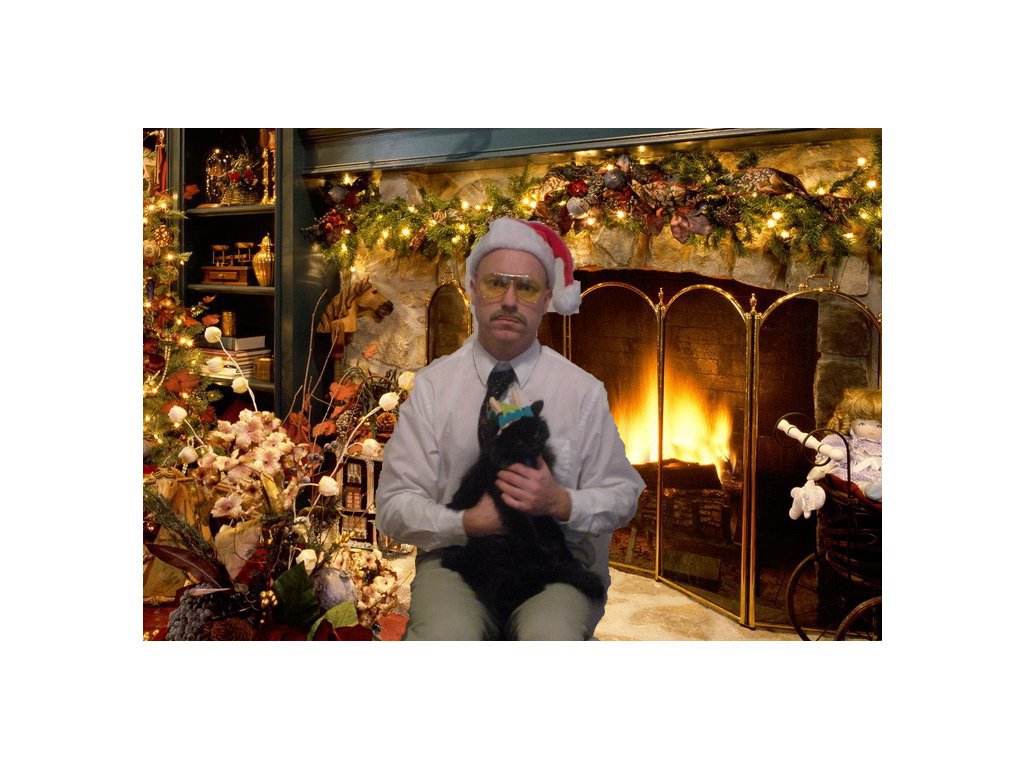
Or there was the time I sent out a Christmas card that was just a sad picture of me with my cat, where I wore shooter glasses and had on a fake mustache and intentionally did a bad job of photo-shopping in a background that was way too nice to be my house.  The day after people got the card in the mail, I received a standing ovation at work.  So, yes, that was funny. Okay, weird funny, but funny.  At least to everyone but my future wife. We were dating at the time, so I sent a card to her.  She didn’t think it was funny at all and later told me she was questioning going out with me after that.

And just when I am rethinking my ability to be funny, wouldn’t you know it, one of my humorous pieces gets picked up by Chortle: Things my lawnmower does better than me.

So the whole point of this is that everyone has doubts. We just need to keep pushing through and trust we are doing the right things. And if we find out we’re not, hey, at least we are learning something along the way.

Let me know what you think in the comments below.

-James


200 Submissions Later

Lessons from the Long Game of Getting Published

I’m approaching 200 submissions. It sounds like a lot, but I started in 2010, so that only averages to a little over 13 submissions per year.

Note that I am only counting acceptances where I got paid for my story and not places like CAB Theater that picked up one of my comedic pieces for free and performed it on stage.  I didn’t get to cash in on that one, but I did get to sit in the audience while the actors performed my words, soaking it in as they got the biggest laugh of the night out of one of my jokes. And, honestly, that was way better than getting paid.

My acceptance rate is about 5.8%. While that isn’t quite stellar, it does seem to be better than averages reported by the Submission Grinder for many of the markets I stalk.

This gives you a feel of how difficult it can be to land a piece. Just looking at the odds for every 100 stories you submit you can expect to land less than two. There are some markets, like Anotherealm, and BSF Horizons that have nice fat acceptance rates of 12.5% and 33.33% respectively. But these appear to be the exceptions to the rule.

I would also be remiss if I didn’t mention Allegory, which has an acceptance rate of a little over 2% and UFO publishing (They are closed now, no acceptance rate is listed at the Grinder). I was a first reader for several years at both of those publications.

 I have also noticed a dip in acceptance over my last 50 submissions or so. If I calculate everything preceding those 50, I have a nearly 8% acceptance rate.  Either I am getting worse (entirely possible, if not likely) or the market for short fiction is getting tighter. For the benefit of my own morale, I am going to choose to believe it’s the latter.

So what can we do to hedge against the ever increasing odds?

We do the only thing that has ever worked: create more content and hone our skills along the way.

And continue to have a lot of patience.   

From the odds I can only expect to land fewer than 2% of the stories I submit, but improving the quality of my writing should give me an edge.

Or we can take the Han Solo approach — Never tell me the odds!

Comment below to let me know what your submission journey has been like.  I’d love to hear from other writers grinding it out.

-James

Two more rejections

I have received two more rejections since the last post.

One was for my story “The closet”, which is about a mysterious black void that changes things for both better and worse after they are placed inside it. The rejection came from Science Fiction and Fantasy Magazine Editor Gordon Van Gelder who wrote:

“Many thanks for Submitting “The Closet,” but I’m going to pass on this one. I’m afraid this Twilight Zone-ish story didn’t quite grab me, alas. Thanks anyway for sending it my way and best luck to you with this one.”

At first glance the rejection seems soft and nice, but after getting a few of these you can read between the lines.  Let’s break it down:

“Many thanks for Submitting “The Closet,” but I’m going to pass on this one”

First off, I never realized that you put the comma within the quotes, before the conjunction on a sentence like that.  I assume he is correct in doing this, the man is an editor after all, so I am going to tuck that grammar tip away for later.

I also like his fun, loose tone in the rejection letter. There is no “Dear sir” from this guy just a “Many thanks,” like he’s wearing sandals and chewing on a beef jerky while responding.

Breaking it down to what this sentence really means, I get:

“I am not going to buy your story”

He then goes on to say:

“I’m afraid this Twilight Zone-ish story didn’t quite grab me, alas.”

Translation:

“You ripped off of the Twilight Zone. It was obvious, and I didn’t like it.”

He did use the word “alas”, and when I read that I first pictured him in a regretful whimsical sigh, but then I realized I am not even sure what “alas” means.  I always kind of thought it was like the conjunction “but”, except Gordon used it at the end of a sentence, so I looked it up by typing  “Define: alas” into my favorite search engine.

This is what Google had to say:

Alas: Unfortunately: by bad luck; “unfortunately it rained all day”; “alas, I cannot stay”

So the full sentence really translates to:

“You ripped off of the Twilight Zone.  It was obvious, and unfortunately I didn’t like it.”

Editor Gordon then ends with:

“Thanks anyway for sending it my way and best luck to you with this one.”

Translation:

“Please don’t send this to me again, or anything like it.”

I also stumbled on  “best luck” as I have always heard that phrased as “best of luck”.  I wonder if Gordon missed a word or if that’s actually the proper way we should be using the phrase.  Maybe the addition of the word “of” is just an idiom we all picked up over time?

I consider if I should start saying ‘Best luck” from here on out and think:  What am I the Queen of England?  What do I care if I’m not proper?

I decide that I am still going to use it my way, with “of” tucked neatly in between “best” and “luck”.

To drop the “of” would be like calling this guy “Gordon Gelder.” I am pretty sure “van” translates to “of”, and that his last name, Van Gelder, at one time literally meant “of Gelder” or “of Gold” or something like that.

I find a certain degree of pleasurable irony in all that.

Translating the whole thing we get:

“I am not going to buy your story. You ripped off of the Twilight Zone; it was obvious, and unfortunately, I didn’t like it.  Please don’t send this to me again, or anything like it”

I would love to get a note so full of refreshing candor like that, but Editors have to maintain all this tact so as not to drive the other unqualified, and much less stable, writers into a gun toting rage.

The second rejection came from Ty Drago, Editor of Allegory E-zine.

OK, is it just me, or is “Ty Drago” the absolutely coolest name ever?  I mean that name could pass for either a superhero or a super villain. The Ty part makes him sound warm and friendly, like that guy on the home makeover show, and “Drago” just sounds like, if you did some genealogy research, you may be able to trace his bloodline right back to Satan.

This is what Mr. Coolest-name-ever wrote:

“Thanks for letting us ‘Things Remembered.” I regret to say that it’s just not right for Allegory.


Here’s what our editor had to say:

>

> What I liked: The imaginative plot

>

> Reason for rejection:   Could benefit from some editing. Punctuation

> errors (dialogue tags, lack of commas); spelling errors, repetitive

> use of the word ‘it’ and ‘that’.  Small stuff, but distracting.

>


I’m sorry. Best of luck with this one in other markets.


– Ty Drago

– Editor

– Allegory

Clearly this was submitted before I boned up on grammar.  Or at least did some boning. Er…  you know what I mean.

Let’s still break it down and see what Ty really meant:

“Thanks for letting us “Things Remembered.” I regret to say that it’s just not right for Allegory.”

Once again I stumbled while reading, this time it was on the disconnect between  “us” and “’Things Remembered’”.  It looks like I am supposed to infer the word “see” in between, but I am guessing it’s just an oversight/typo on his part.

It’s also kind of a slap in the face when they go on to rip about my grammar problems.

Translation:

“I am not going to buy your story”

Next line:

“Here’s what our editor had to say”


What? I thought your title was Editor?  Wait, are you are a slush pile reader, or a maybe just a guy who knows how to run the e-mail a lot better than the editor?  Because I can see the “>” symbols showing me that the editor forwarded an e-mail back to you…. I guess, a filter is probably the best term for you.

But I then realize that may also mean my story made it through one reader, and onto the big chief, before getting the final rejection. That seems kind of cool.

And then I get all “conspiracy theory” and wonder if Ty Drago didn’t just add the >’s himself.

It would work so well; making it look like my story made it’s way through to the editor, and was seriously considered. Plus there is the whole “power of the third party” thing where I can’t really get mad at Drago for things the editor had commented about, and apparently there is no name to this higher up editor, so there is no way for me to go ballistic on him/her.

I then think that maybe Ty is the Editor and someone else runs the e-mail on his behalf, using his name.

I decide that’s what I am going to believe.  It’s probably healthier than conspiracy.

I continue to read between the lines.

“> What I liked: The imaginative plot”


At first glance, this comment makes me feel really good about my story. Like there is some hope since I at least have an imaginative plot.  But then I realize if you were going to pick one thing that could generically apply to, and flatter, all writers, commenting about how creative the plot is, would be that thing.

No writer who submits a story thinks “I hope my rip off of Star Wars goes over well.”   Everyone thinks that they have some unique and original twist in their own story.  Even though there is a whole Joseph Campbell-ish mindset out there that there is really only one story and all other stories are spin offs.

Translation:

“There was nothing positive about this story.”

Next lines:

> Reason for rejection:   Could benefit from some editing. Punctuation

> errors (dialogue tags, lack of commas); spelling errors, repetitive

> use of the word ‘it’ and ‘that’.  Small stuff, but distracting.

Jeez, slow down on using three lines to reject it. I get it already – I are bad at grammar.

Although I was surprised on the “it” and “that” comment.  I didn’t realize I had such a problem with it/that.

Translation:

“You fail to grasp English. ”

Next Line:

I’m sorry. Best of luck with this one in other markets.


(~See~ this guy said “Best of luck”)

Mr. Best-name-ever actually spelled out “other” markets to me.  So not only does he not want to see this story again, but maybe I should also try to hit the minor leagues with it and the rest of whatever I have to offer him.

Translation:

“I’m laughing at you. Don’t send anything to me again. You are way in over your head.“

When we put it all together this is what Ty really had to say:

“I am not going to buy your story. There was nothing positive about this story.  You fail to grasp English. I’m laughing at you. Don’t send anything to me again. You are way in over your head.”

It seems harsh, but I think, pretty accurate.  It’s just too bad that editors don’t feel like they are able to write that candidly.

And don’t think for a minute any of this has gotten me down.  I just need to polish up another batch of my crap and send it off to annoy yet another league of editors.

James

Why I am stalking Stanley Schmidt

OK,  maybe “obsessively studying” is a better term.

Stanley Schmidt is the Editor for Analog Science Fiction and Fact Magazine.  The Magazine is what I would consider the pinnacle of the Science Fiction short story market.

I have sent off a few short stories, trying my hand at getting into this pro market, and so far have been thwarted… but rightly so.  My fiction contained grammatical errors, and probably a lot plot related errors that Editors like Mr. Schmidt are able to spot in an instant.

My goal is to get published, and not in any old “Pay in copies” type publication, I am going for the pro markets; the kind that count toward the three stories you need to get qualified for membership to Science Fiction and Fantasy Writers of America.

So while I am working to better hone the craft of speculative fiction, I thought it might be a good idea to get to know the gatekeeper at Analog.  Some people might just give him a phone call, or shoot an E-mail off for virtual meet and greet, but I know how busy Stanley is, and don’t want to be that guy that bugs him at work to pick his brain for publishing tips.

I just can’t imagine that going well.

Besides, studying him from afar is necessary to keep my preconceived illusions intact. I don’t want to risk finding out that the man I put up on an editorial pedestal is anything less than the literary genius I expect him to be.   Didn’t we all feel just a little bit bad for Oz when Toto pulled the curtain away?

But why study Stanley?

My first comment on a rejection slip came in the disappointing form of a request to always number my pages. It came from Stan the man himself.  It was the sci-fi writer’s equivalent of a message from God, but instead of instructions on how to carry the tablets down from Mt. Sinai, it was more of a “don’t do that or you’ll go blind” sort of thing.

I later read through one of his editorials that are always present in the front of each issue of Analog.  A chill went through me when I saw:

“Lately, for reasons that perplex me, I’ve been getting an astounding number of manuscripts with no page numbers, a practice for which I’m hard put to imagine an advantage.”

I knew that that at least two of those page-numberless stories were mine.  It felt like an indirect communication. Sort of like if my dog crapped on his lawn and he wrote a letter to the town paper about it.

I suppose this could be a pet peeve of his that is set off by two only occurrences.  But an “astounding number” sounded like it must have been on the order of dozens of stores submitted without page numbers for Mr. Schmidt to make such a remark in an editorial like that.

In a strange way, it almost feels as though Editor Schmidt and I have a connection; granted it’s built on my failings, but a connection nonetheless.  Like when I do finally get a story published with Analog there will be a wink and a nod in a now you get it kind of way.

So what have I been doing to stalk study Stanley?

First I checked out what Wikipedia had to say about the man, then went on to his Bio on the SFWA site, where there is a great picture of him eating a bowl of noodles, taken by his wife.

From there I bought two of his books: Aliens and Alien Societies: A Writers Guide to Creating Extraterrestrial Life-Forms, and The Sins of the Fathers.

And what have I learned thus far?

I am about halfway through the Aliens and Alien societies book and it is apparent that Editor Schmidt feels that there are a lot of Aliens being created for fiction that are not really plausible.

I think this comes from the dividing line between Science Fiction and Fantasy. In Fantasy almost anything is possible within the rules that are set up in that story’s universe. In Science Fiction, while it is still fiction, there needs to be plausibility to the Aliens. A possibility that, while these creatures may not really exist, in some way or another, there is a logical scientific reason why they could exist and that doesn’t break the laws of nature.

For example: Giant insects 100 feet tall could never exist on Earth as they would collapse under their own weight.  Tiny microbial beings wouldn’t really be able to have any sort of intelligence, as there is no room for a thinking brain that small to develop, at least following any sort of rules that we currently know about neurology.

But what I have really learned was something I have known all along.

Stanley Schmidt, like all great Editors, is really just interested in a dammed good story.

Well, I hear you Editor Schmidt, and I am going to do my best to try to knock your socks off.

James

Fate Forward

Fate Forward is a story I wrote about a private investigator type guy searching for a mysterious device. It’s later discovered that the device can manipulate luck. The story goes on to reveal how this man beats the odds to retrieve the device and his internal battle as to whether he should return it or use it improve his own station in life.

I submitted this 6700 word story to Asimov’s Science Fiction Exactly one month ago, 7/11/10, via their online form.  Here is the e-mail rejection I received today:

Thank you very much for letting us see "Fate Forward."  We appreciate your taking the time to send it in for our consideration.  Although it does not suit the needs of the magazine at this time, we wish you luck with placing it elsewhere.

Please excuse this form letter.  The volume of work has unfortunately made it impossible for us to respond to each submission individually, much as web

Sincerely,

Sheila Williams, Editor
Asimovb

Sheila, what kind of ending is “much as web”?  You must REALLY have a volume of work to end the e-mail so abruptly.

Did you find out the bacon was burning while typing and just hit the “send” button anyway?

The sad part is that the letter refers to itself as a “form” letter, so this is apparently what everybody who failed to place a story is getting.

I am not sure what “asimovb” means at the closing either. Perhaps some sort of secret code?  Maybe I made it to grade “b” in the rejection pile or something.

The part I did think was cute was how the letter wished me “luck” in placing it elsewhere. I am sure it’s just a coincidence, but the story I sent in revolved entirely around the concept of luck.

James

Fonzie gets rejected

On 6/29/10 I sent off a 2700 word Sci-Fi story called “Little green Fonzie” to ANALOG magazine.

I had a lot of hope for this story as it was about and Alien dressed as The Fonz, that comes down to earth to bestow knowledge onto the human race, provided the person he picks can explain why we are worthy.

The story contained a good amount of humor, which I thought would buy me some browine points with the Editor, but unfortunately, this Saturday (8/7/10) I received back my SASE with the default rejection slip inside.

And no personal note of any kind.

It makes me wonder if a story is accepted and they cut you a check, do they would still use the SASE I provided?

I am guessing that payment probably happens via accounting and they use their own envelopes for that.

I really want to see one of those envelopes in my mail box.

Genesis

I have been writing for about four months now (since about May of 2010).

In that time I have submitted nine short stories to various magazines with each story averaging about 4000 words. Of those, I have received back three rejections.

The highlight was when I received a rejection slip from ANALOG magazine. At the bottom of the page there was a handwritten note signed with the initials “S.S.”

Being an avid reader of ANALOG, I of course knew that the note was from Stanley Schmidt, editor of the magazine since 1978.  The head cheese himself.   To fill you in, this is a man who had taken the torch from the great Ben Bova.  And this is the magazine that published such literary giants as Arthur C. Clark, Issac Asimov, Robert Heinlein, Frank Herbert, Ray Bradbury and one of my favorite authors Orson Scott Card.

I shuddered with excitement. Sure it was a rejection, but Stanley Schmidt had taken the time to write a note to ME about MY story.  I was certain it would be something to the tune of “I really liked this, trying changing “X” and send it to me again.” or “Develop the main character a bit more and I think you really have something here.”

Instead it read:

“Always number your pages! S.S.”

It said exactly that and only that.  And yes, even with that angry exclamation mark on the end.

If I had made an impression on the Editor, it was to show him what novice I am by not numbering my pages.

And that little exclamation mark told me it had also pissed him off.

I could only imagine how many manuscripts this man must read through each month, religiously searching for that needle in the haystack, that one gem of a story that speaks to him like God to Moses, and how my story was just another turd for him to trip over on his quest for yet another Holy Grail of Science Fiction.

Well Stanley, I am sorry about that.

But I do learn from my mistakes. I read manuscript preparation by Vonda McIntyre and now submit using her advice, unless of course, the magazine specifies otherwise.

So while my future will undoubtedly hold a few more rejection slips, I am hoping to avoid the dreaded exclamation mark.

James