Tag Archives: Rejected Fiction

Ten Things That Cause Immediate Rejection

If you are submitting short fiction, there are a handful of things that can move a story from the submission pile to the rejection pile almost immediately.

Here are ten that will lose an editor’s interest:

1. Use of AI

If a publication says it does not accept AI-generated fiction, take that requirement seriously.

It is much easier for editors to spot this than you might think. They have years of experience understanding how a story sounds that comes from an actual human. And there are also tools out there that can help identify AI. It is unlikely they will every mention AI in the rejection but, it is likely you will get secretly blacklisted.

I feel that there is an important distinction between using a tool to check grammar and spelling and asking an AI system to write the story for you. But every publication draws that line differently, so read the rules.

2. Incorrect Word Count

If the submission guidelines say stories must be between 1,000 and 5,000 words (like BITC) do not submit a 7,500-word story and hope the editor will love it enough to make an exception. Odds are it will be rejected immediately.

Going 50 words over may not seem like as big of a violation, but it tells us editor types a lot about the way you operate. You have either not read the word-count requirement or feel that it is a loose suggestion rather than a rule. We also wonder if you think it’s impossible to cut 50 words from the story, which tells us something too. For any story over 1,000 words getting rid of 50 should be rather easy.

3. The Wrong Type of Story for the Market

This one should be obvious, but it happens a lot.

If a publication wants lighthearted fantasy, your relentlessly cold-blooded serial-killer story is probably not going to find a home there.

Before submitting, spend a little time looking at what the publication actually publishes. Read several stories they have published (most publications recommend this). Read the submission guidelines.

4. Content That Crosses the Line

Every publication has different boundaries, but some material can quickly make an editor stop reading.

Racial slurs, gratuitous sexual content, misogyny, graphic violence involving minors, or cruelty included purely for shock value may be enough to end consideration. Once again, this can vary by publication.

Writers should also remember that editors are selecting material for an audience. Even if something can be justified as a crucial part of the story, it still may not fit the publication.

I should also mention that you can still cover a lot of disturbing or unpleasant scenes without describing them in detail. Oftentimes implication of a situation can actually be the stronger way to go.

[Warning: disturbing content ahead]

Seeing a child character we have grown to love get into a car with a stranger allows the reader’s mind to fill in the blanks in horrible ways. We don’t necessarily need to see what actually happens.

Sorry about that example, but if you were disturbed by it, it proves the point.

5. No Ending

One of the most frustrating submissions is a promising story that seems to reach the point where the real story is finally beginning, and then it just stops.

These are the worst for me because there is so much hope. I like the story; there is a good chance that, if it ends well, I will get to send out an acceptance email.* But if it instead just drops off, or wraps up in a totally unacceptable way, I am out.

To me it often feels like the authors have not put in the time to really think through what kind of exciting ending they can put on their story. I like the David Mamet approach of having the ending be something that is unexpected and inevitable. Another author (I can’t recall who at the moment) says your approach should be to come up with every possible ending, then pick the one that is the most unusual while still being plausible. This is often the best and most rewarding ending for the reader.

*Yes, despite what it seems, editors are probably more exited than you are when we get to accept a story.

6. Grammar, Spelling, and Punctuation

Editors understand that an occasional typo survives even careful proofreading.

But if the first page is filled with misspellings, missing punctuation, random capitalization, incorrect dialogue formatting, and sentences that have to be read three times to understand them, the story is already in trouble.

You want the editor to be thinking about your characters and what happens next instead of trying to decipher what you meant.

Proofread your work, then proofread it again, then put it aside for a month and proofread it a third time. If you don’t want to wait that long, give it to a friend who is good at that kind of thing, then brace yourself for the embarrassment of everything you missed.

7. Using Someone Else’s Intellectual Property

Be careful when borrowing characters, fictional worlds, distinctive settings, or other creative material belonging to someone else.

Writing a story about your own characters stopping at McDonald’s is one thing, but writing an adventure starring Harry Potter is entirely different.

Fan fiction has enormous communities built around it, but that does not mean a commercial publication can legally publish your unauthorized Spider-Man story or Star Wars sequel.

References to popular culture are common in fiction, but taking someone else’s characters or world and making them the foundation of your story is a no-no.

Create your own world. Create your own characters. They are probably way more interesting anyway.

8. Derogatory Use of Brand Names

Real brands can absolutely appear in fiction. Our characters can drive a Ford, eat at McDonald’s, wash clothes with Tide, or put Goodyear tires on a truck. These kinds of references can actually help establish place, time, and character.

The problem comes when a writer uses a real company as the target of accusations. There is a substantial difference between:

“The Goodyear tire blew out.”

and:

“Goodyear secretly knew these tires were defective and sold them anyway.”

If your plot requires an evil corporation knowingly selling lethal products, you should invent a brand. No editor wants to take the risk of publishing something that carries any defamation risk.

9. No Clear Conflict or Objective

You do not need an explosion on page one.

You do need a reason for me to keep reading.

A short story has very little room to wander around. You need to let the reader know who the protagonist is, what they want, and why they currently can’t have it.

A description of a farmhouse can be beautifully written, but if I am three pages into the story and the farmhouse is still just sitting there while nobody wants anything, nobody fears anything, and nobody needs anything, I am probably going to stop reading.

Always give the reader a reason to keep going.

10. Humor That Is Not Funny

I know that humor is the most subjective item on this list. What makes one reader laugh may leave another rolling their eyes.

There are certain types of humor that lose me very quickly and, I suspect other editors share this view. Flatulence jokes are high on that list for me. Yes, some people find them hilarious. I typically do not.

I also feel that comedy needs to do more than just be there because it is funny.

Good humor usually comes from character, timing, expectation, contradiction, embarrassment, misunderstanding, or an unexpected but perfectly logical reaction. But it’s more important that the action around that comedic event is actually necessary for the story. If you are putting in humor just for humor’s sake, that is often a mistake.

In short, if the entire joke is that somebody farted, you had better have one spectacularly original fart for me to get a kick out of it, and it had better be essential to the story.

The Common Thread

Most of these problems come back to this:

Respect the publication guidelines and respect the reader’s time.

Read the submission guidelines, submit the kind of story the publication actually wants, and proofread it a couple of times.

Give your protagonist something to want, something standing in the way, and an ending that makes the journey worthwhile.

After all of that, there is a good chance the editor will still reject it.

I think we all know that is just part of the writing game.

But at least you have a better chance of them reading all the way through the story because you didn’t give them an easy reason for rejection.

Take care,

-James

Why It’s Good to Be Rejected

Thank you for your submission, but unfortunately it just didn’t grab me…

It is easy to see rejection as a failure. We often assume that the odds simply did not fall in our favor. But there is another possibility that we writers do not like to consider:

Maybe the story simply isn’t ready yet.

You Are Too Close to Your Own Work

Accurately judging the quality of your own work is one of the most difficult parts of writing.

Because you created everything, you inherently know what every character is thinking. You understand the interactions behind every relationship and you can clearly see the setting in your imagination. When you read a scene, your mind automatically fills in details that may not be evident to other readers.

You may have read the story so many times that you are no longer reading what is actually on the page. You are reading the improved version that exists in your mind.

This is why rejection can be valuable.

An editor who turns down your story may be saving you from publishing work that does not yet represent your best abilities. In a way, rejection is protecting your brand.

A Little Pain Can Prevent a Lot of Embarrassment

Receiving a rejection is painful.

Having a weak story published where hundreds or thousands of readers can see it is much worse. I have had one story published that ended up in print that had a typo – my typo. As much as I love that story and getting it into print, I am embarrassed every time I see that. In the annals of this very blog, I often only notice typos and grammatical issues after the post goes live. It is easy to read past those little issues.

A rejection keeps an unfinished story out of that spotlight. It gives you another opportunity to reconsider the opening, strengthen the characters, remove unnecessary scenes, improve the ending, or rewrite the entire piece if necessary.

That editor may not have given you detailed feedback. Most editors do not have the time. Still, the rejection itself contains useful information.

Rejection Is a Chance to Return to the Drawing Board

Instead of immediately sending a rejected story to the next publication on your list, take a moment to reconsider it.

You do not necessarily need to rewrite the story after every rejection. One editor’s opinion is still only one editor’s opinion. However, repeated rejections should eventually trigger a serious review.

Look at the story as critically as you can.

Does the opening create a reason to keep reading?

Is every sentence, or word in flash fiction, necessary? My metric on this is whether the sentence or word in question serves to move the story forward or to develop the character.

Does the main character want something specific and is there a reason they can’t have it (creds to David Mammet)?

Is there enough conflict?

Is the ending satisfying, surprising and inevitable (Mammet again)?

If you haven’t done so already, you should give the story to a trusted reader who has not seen it before and resist the urge to explain what the story is about. Let the reader experience it naturally. When getting feedback from them later, pay close attention to where the reader became confused or where the story felt like it was dragging for them. This is an issue I see in many submissions.

Be Grateful for Rejection

The editor who rejected your story has done you a favor. Instead of allowing a less-than-stellar version of your work to appear in front of thousands of readers, that editor gave you an opportunity to improve yourself and your work.

If you allow the sting of rejection to pass take that message for what it is worth – an indication that something needs to change, someday a much better version of that story could be accepted.

When that happens, it will feel so much better because you used rejection to improve your story and yourself. You will be proud of the work knowing it is the best you can put forth.

Let me know what you think in the comments below.

-James

Rejectomancy, where have you been all my life?

Wow, I can’t believe it has taken me this long to find Aeryn Rudel’s wonderful site Rejectomancy

I’m a guy who landed his first published piece by blogging about the hidden meaning in all the rejection letters I was getting so it amazes me I haven’t come across Aeryn’s site earlier.

Aeryn has this super fun concept of Rejections as a way to show how you are leveling up your skill as a writer. 

You basically score points for rejection letters, acceptance letters and the situations around them — like getting two rejections in one day or whether or not the rejection was a personal rejection or a form letter.

The XP points correlate to different levels which correlate to “spells” (which appear to be still under construction) and to Resistance levels, which have fun names like “Baby Bunny”  and “Adamantium.” 

I love the way Aeryn has taken something like rejection letters, a thing that can be negative on a personal and emotional level, and gamified it into something fun and motivating.  This tells me a lot about how he must handle adversity. I wish I had that kind of attitude!

He also shares his rejection stats < >and has other helpful writing advice such as his Pro or Not Pro, that is the question post.

Go check out his site and leave a comment if you have been a follower or have similar experiences you want to share

  • James

It’s possible I might not be that funny

After several submissions to places that publish funny stuff, and the corresponding rapid-fire rejections, I am starting to come to the realization that I might not be that funny.

I feel like there was a time when I was funny. Like, back in high school… maybe. But that was a long time ago and thinking back, it’s probably more likely people were just too polite to tell me that I was annoying.

Or it could be the soul-crushing life-sentence of working a regular eight-to-five job that took the wind out of the sails of the good ship Fun Times.  You would think an Engineer with a sense of humor would be a breath of fresh air for most companies, but in reality people just think you’re weird when you tell a joke while holding a schematic.

Or maybe I am weird. I’m a grown man with a Steam account who can quote Rick and Morty and I also built my own robot arm making parts via my 3D printer. Yes, that’s all cool stuff, but not when you’re old. And no, I’m not telling you my age, but for reference, I took my daughter to Open Sauce last year (a YouTube “maker” event) and I didn’t think I was that much over the average age until someone congratulated my daughter on getting her grandpa to come.

I used to go out of my way to be funny at work. I remember a time when I bought one of those monstrously oversized Valentine’s Day cards, signed it “Love, Richard” and left it for Tony our IT guy. Richard was our salesman that always reminded me of the desperate guy on Glenn Gary Glenn Ross who rambled on about the leads, which made the joke even funnier to me.  I think Richard was actually kind of pissed about the whole thing. That also made it funnier.

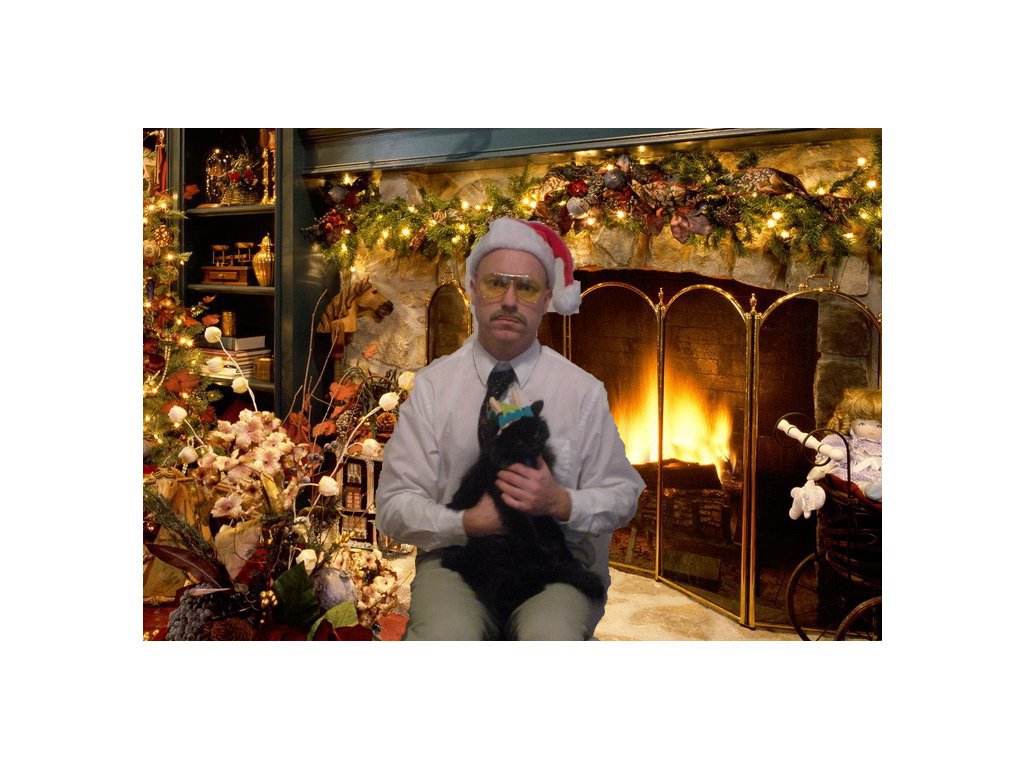
Or there was the time I sent out a Christmas card that was just a sad picture of me with my cat, where I wore shooter glasses and had on a fake mustache and intentionally did a bad job of photo-shopping in a background that was way too nice to be my house.  The day after people got the card in the mail, I received a standing ovation at work.  So, yes, that was funny. Okay, weird funny, but funny.  At least to everyone but my future wife. We were dating at the time, so I sent a card to her.  She didn’t think it was funny at all and later told me she was questioning going out with me after that.

And just when I am rethinking my ability to be funny, wouldn’t you know it, one of my humorous pieces gets picked up by Chortle: Things my lawnmower does better than me.

So the whole point of this is that everyone has doubts. We just need to keep pushing through and trust we are doing the right things. And if we find out we’re not, hey, at least we are learning something along the way.

Let me know what you think in the comments below.

-James


200 Submissions Later

Lessons from the Long Game of Getting Published

I’m approaching 200 submissions. It sounds like a lot, but I started in 2010, so that only averages to a little over 13 submissions per year.

Note that I am only counting acceptances where I got paid for my story and not places like CAB Theater that picked up one of my comedic pieces for free and performed it on stage.  I didn’t get to cash in on that one, but I did get to sit in the audience while the actors performed my words, soaking it in as they got the biggest laugh of the night out of one of my jokes. And, honestly, that was way better than getting paid.

My acceptance rate is about 5.8%. While that isn’t quite stellar, it does seem to be better than averages reported by the Submission Grinder for many of the markets I stalk.

This gives you a feel of how difficult it can be to land a piece. Just looking at the odds for every 100 stories you submit you can expect to land less than two. There are some markets, like Anotherealm, and BSF Horizons that have nice fat acceptance rates of 12.5% and 33.33% respectively. But these appear to be the exceptions to the rule.

I would also be remiss if I didn’t mention Allegory, which has an acceptance rate of a little over 2% and UFO publishing (They are closed now, no acceptance rate is listed at the Grinder). I was a first reader for several years at both of those publications.

 I have also noticed a dip in acceptance over my last 50 submissions or so. If I calculate everything preceding those 50, I have a nearly 8% acceptance rate.  Either I am getting worse (entirely possible, if not likely) or the market for short fiction is getting tighter. For the benefit of my own morale, I am going to choose to believe it’s the latter.

So what can we do to hedge against the ever increasing odds?

We do the only thing that has ever worked: create more content and hone our skills along the way.

And continue to have a lot of patience.   

From the odds I can only expect to land fewer than 2% of the stories I submit, but improving the quality of my writing should give me an edge.

Or we can take the Han Solo approach — Never tell me the odds!

Comment below to let me know what your submission journey has been like.  I’d love to hear from other writers grinding it out.

-James

Traversing the slush pile

The insight I have gained reading slush for Allegory has been amazing.   I already have a list of common mistakes from the story submissions I have read.

Here are things you shouldn’t do if you want me to move your story along for further consideration:

1. Telling instead of showing.

Telling:

Sarah liked Michael.

Showing:

Michael was in the hall. Sarah felt the same lightness in her stomach she had the first day he talked to her. If only he would come talk to her now.

Ok, so I am no romance writer, but hopefully you see the difference.  The first one is a report of what is going on. In the second example, we get to experience what she is feeling.

Telling is not inherently bad, unless you are going to write the whole story that way.  The strength of telling lies in its ability to cover a lot of ground quickly.  Showing typically can’t do that.

The strength of showing is the ability to immerse your reader in the world you have created.  It takes a lot more work, but the reader will enjoy the ride so much more.


2. Lack of clarity

There are too many stories that try to be cute and whimsical by hiding essential information so they can build suspense or use the lack of information for a surprise reveal.

Guess what? the protagonist is actually a ghost!

It’s even worse when syrupy sweet prose clogs up clarity so bad that sentences become barely understandable.  It takes a long time to get to the point where you can turn out high-brow literary prose (I can’t).  In my opinion, there are very few pros who can do it well. The best bet is to focus on clarity and brevity.  Tell me the story and don’t let your words get in the way.

3. It’s not a story.

There is this whole concept of a story arc that is often omitted. I want a story where there is conflict. This usually (but not always) involves a protagonist and  antagonist.   And in the end, I really love it when the protagonist wins by some method where he has grown in some way, or figured something out, or done something clever that I didn’t expect.   This all may sound a bit formulaic, but it works to keep a story interesting. It doesn’t always have to happen this way, but when the main character gets out of a scrape by just running away, or by defeats evil via sheer luck, I can’t help but feel a bit cheated.  I am also not a big fan of  slice-of-life type stories, unless the character is particularly interesting.  If they are just lying on the bed doing their nails, I am probably going to start fast forwarding until I get to something that piques my interest.  If I don’t see it in a few pages, I am going to click the little “x” to close the document.

4. Unrealistic character actions or dialogue

I usually see this when there is a need for something to happen with a plot point. A character will do something like murder another character for a very weak reason, like “they never liked them.”  If that were true to life, I should go on a gun-toting rampage because I have a whole lot of people I need to take out. I would start at the DMV and work my way through to every shitty waiter who has left me with an empty drink glass through my entire meal. Real life  just doesn’t work that way. Unfortunately.

I am also put off by anything unrealistic for the world the author has set up. If your story takes place 1000 years from now, and people are still using Facebook, you may not have the best grasp on how quickly technology can change.

If you absolutely insist that your character to do something atypical, all you have to do is give a sufficient reason or motivation for them to do so.  A God-fearing Nun won’t shoot someone, unless she is already questioning her beliefs, and her life is in danger.


 5. Not beginning at the right place.

I think a lot of pantser writers need a bit of a warm up before they get into a story. Most of the time this warm up can be cut completely without lessening the story.   Here is one of my examples of this:

Searching or creating, that’s all we really want. Even if we don’t know it, it’s what we are working for. We all want enough money for that new car, or new life, enough money to go someplace else, someplace new.

Three million seemed new enough for me, even if they were old bills.

Jen was driving, and I sat in the back. On each side of me were two duffel bags full of cash. There was another bag in the front seat with her, and one more sittin’ between my legs – that one had the guns.

If we were to cut everything before “Jen was driving” nothing critical is lost.

Other times I see stories where I have to go through several unnecessary pages before the plot or conflict becomes clear.  Most of the time these pages can be cut.

6. Not following the submission guidelines.

This is a no-brainer.  If you can’t take the time to read and apply the rules for submission to a publication, how can you expect the publication to take your story seriously?  I won’t penalize a story for improper formatting, or an undesirable font, but I can’t promise you that others won’t, so why even risk it?  My advice is to take the time to properly format one story for submission, then cut and paste other stories into that format for the next time around.

7. The handy plot point.

This occurs when an author needs something to happen, but is so in the middle of the flow of writing that they grab the first thing that comes to mind.  It’s similar to those times we use a steak knife to excitedly cut open a package we have been waiting for, because the knife is right there on the counter and the scissors is all the way inside the junk drawer. For example:

Sarah wasn’t wearing her glasses because she had lost them earlier that day.

If this is the first time in the story that I hear about Sarah’s lost glasses, or her poor eyesight, it will read like this was sloppily tacked on because the author needed a convenient reason.  If authors take the time to think about these seemingly insignificant parts of the story, they can use them to develop their characters much further.  If instead, Sarah choose to not wear her glasses because she thought they made her feel ugly, and we were told this in well in advance of the event that required her to have blurred vision, then it would seem as though the whole thing evolved naturally. It would also tell us how Sarah feels about the way she looks.

The above are just a few from my list of slush reader pet peeves. Please take these with a grain of salt as they may not hold true for other slush readers.


– James


Fate Forward

Fate Forward is a story I wrote about a private investigator type guy searching for a mysterious device. It’s later discovered that the device can manipulate luck. The story goes on to reveal how this man beats the odds to retrieve the device and his internal battle as to whether he should return it or use it improve his own station in life.

I submitted this 6700 word story to Asimov’s Science Fiction Exactly one month ago, 7/11/10, via their online form.  Here is the e-mail rejection I received today:

Thank you very much for letting us see "Fate Forward."  We appreciate your taking the time to send it in for our consideration.  Although it does not suit the needs of the magazine at this time, we wish you luck with placing it elsewhere.

Please excuse this form letter.  The volume of work has unfortunately made it impossible for us to respond to each submission individually, much as web

Sincerely,

Sheila Williams, Editor
Asimovb

Sheila, what kind of ending is “much as web”?  You must REALLY have a volume of work to end the e-mail so abruptly.

Did you find out the bacon was burning while typing and just hit the “send” button anyway?

The sad part is that the letter refers to itself as a “form” letter, so this is apparently what everybody who failed to place a story is getting.

I am not sure what “asimovb” means at the closing either. Perhaps some sort of secret code?  Maybe I made it to grade “b” in the rejection pile or something.

The part I did think was cute was how the letter wished me “luck” in placing it elsewhere. I am sure it’s just a coincidence, but the story I sent in revolved entirely around the concept of luck.

James