Category Archives: writing submissions

Story Arc and Character Arc

One of the most common weak spots I see in submissions is the lack of a real story arc or character arc.

Unfortunately, this is a frequent reason I reject stories.

Often, what I receive is not actually a full story but a scene. Something happens. It may be vividly written. It may even have an interesting premise. But the protagonist is not really challenged, doesn’t (or can’t) struggle against any significant conflict, and does not change in any meaningful way.

The protagonist should want something, face obstacles, and have to figure something out, fight against something, or make a meaningful choice. The plot should put pressure on the protagonist. Their actions should matter. By the end, something should be different: externally, internally, or, hopefully, both.

Many of the submissions I see feature a protagonist who is simply carried through events. Things happen to them, but they do not take part in shaping the outcome. As a result, the piece can feel static, even when the writing and premise are strong.

Story Arc:

To me, a story arc is the shape of the plot that happens around the character. There is a school of thought that there is really only one plot line: the Hero’s journey. I have mentioned the Hero’s journey before and that’s a topic deserving of a whole blog post of its own.

Character Arc:

A character arc is should be thought of in terms of personal growth. How did the events change the character by the end of the story? What did they learn and how are they different? In the Hero’s Journey the hero comes home at the end but is changed and often sees the familiar world they came back to in a different light.

Great stories have both a strong story arc and a strong character arc.

And if I have rejected a story you submitted for one or both of these reasons, don’t feel bad, This is understandable because many stories start getting written when the author has a general scene or idea in mind. But the next step should be to ask more of your creation. What does the protagonist want? What stands in the way? And, most importantly, what will this experience cost them or teach them?

Without that, a piece tends to feel like an interesting scene rather than becoming a fully realized story.

Three Key Questions to Ask yourself about what you just wrote

  1. What does my protagonist want, and why can’t they have it? (Tip of the hat to David Mamet for this one) A story needs desire and opposition to create what I like to call “driving conflict.”
  2. Does my protagonist make choices or take actions that affect the outcome?
    The protagonist should have an opportunity to shape the events of the story. They should not be merely a victim (Note that a lot of horror stories I see end up this way. If you are writing horror make sure your protagonist has at least a glimmer of hope to win.)
  3. How is my protagonist changed by the end of the story?
    Character change does not have to be positive (maybe they become morally worse for the experience) but something about them should change by the end of the story.

Hopefully this helps you to look at your writing from a new perspective. If you take the time to really understand story arc and character arc, it will absolutely make your stories stronger and more engaging.

Let me know what you think in the comments below.

-James

Simultaneous Submissions vs. Multiple Submissions: What’s the Difference?

When I first started learning how to submit fiction, I recall these terms confusing me. For a while I naively thought they were the same thing.

Understanding the difference can save you from annoying an editor or getting your story rejected before it’s even read.

Simultaneous Submissions

A simultaneous submission means sending the same story to more than one market at the same time.

Example: You send your short story The Last Robot at the Party to:

  • Magazine A
  • Magazine B
  • Magazine C

All three markets are considering the same story simultaneously.

This is common and fairly handy because response times can be long for some markets (I just checked Analog on the Submission Grinder and they are averaging 90 days for a rejection and 140 Days for an acceptance).

However, not every market allows this.

Many submission guidelines will say something like:

“Simultaneous submissions are allowed, but please notify us immediately if the story is accepted elsewhere.”

If a magazine does not allow simultaneous submissions, it means they expect you to wait for their response before sending the story anywhere else.

Some editors dislike simultaneous submissions because if they spend time reading and deciding on a story, only to find it has already been accepted somewhere else, their effort was wasted. You don’t want to be remembered as the person causing them this kind of grief.

I actually do not submit simultaneously just to make my submission record keeping easier. I tend to have a lot of stories out at one time.

Multiple Submissions

A multiple submission means sending more than one story to the same market at the same time.

Example: You submit three different stories to the same magazine:

  • The Last Robot at the Party
  • My Neighbor’s Wife’s Time Machine
  • How Not to Build a Dragon

That’s a multiple submission.

Some markets allow this. But many, if not most, restrict writers to one story under consideration at a time.

A typical guideline might read: “Wait until you receive a response before sending another.”

Editors often prefer this because it keeps their submission queue manageable. In my experience, I think it is also a tool for keeping overzealous writers at bay, particularly if they are turning out bad fiction in short order.

The lesson here is to always follow the submission guidelines.

Editors include those policies for a reason. Ignoring them signals that the writer may also ignore other instructions and be someone who is hard to work with, which is certainly not the impression you want to make.

Simultaneous = same story, different markets.

Multiple = different stories, same market.

Maintaining that distinction will help you look like a Pro to editors.

-James

Celebrating 100 Short Story Submissions: Insights and Tips

Breaking Into the Craft hit a milestone of receiving it’s 100th short story submission on 12/16/25. Considering I received the very first submission on July 1st, I feel that is a respectable amount of submissions for the period.

I review all submissions on my own and pride myself in providing at least a modicum of feedback to every author. That takes a bit more time but at the current cadence of a little over 16 a month, I can still swing it – for now at least.

I appreciate the comments readers have been providing for the stories that make it onto this site. BITC still has a rather small footprint, so I have a deep gratitude for any comment someone takes the time to post. Thank you sincerely.

I also want to say that if you have submitted and been rejected, please know that deciding what to publish is a challenging endeavor. I try to accept only what I think the audience will enjoy or find value in, but I am also publishing stories that I, myself, really enjoy. 

As the BITC guidelines indicate, I prefer Sci-Fi and I do enjoy humor when it is done well but admittedly lean away from fantasy and horror. With that being said, the main criteria is that it is a good story, something that is enjoyable to read, with engaging and believable characters being true to their own motivations, with an ending that is rewarding, surprising and inevitable.

One final note – If you are considering submitting, it helps me a great deal to specify the word count of the story in the body of the email.  I log the stories before reading them and it really helps me to know how much time I will need to allocate to a read through.

Thank you to all who have submitted over the past six months and thank you to those who have read the stories that made it through to publication.

-James

Keeping track of writing submissions

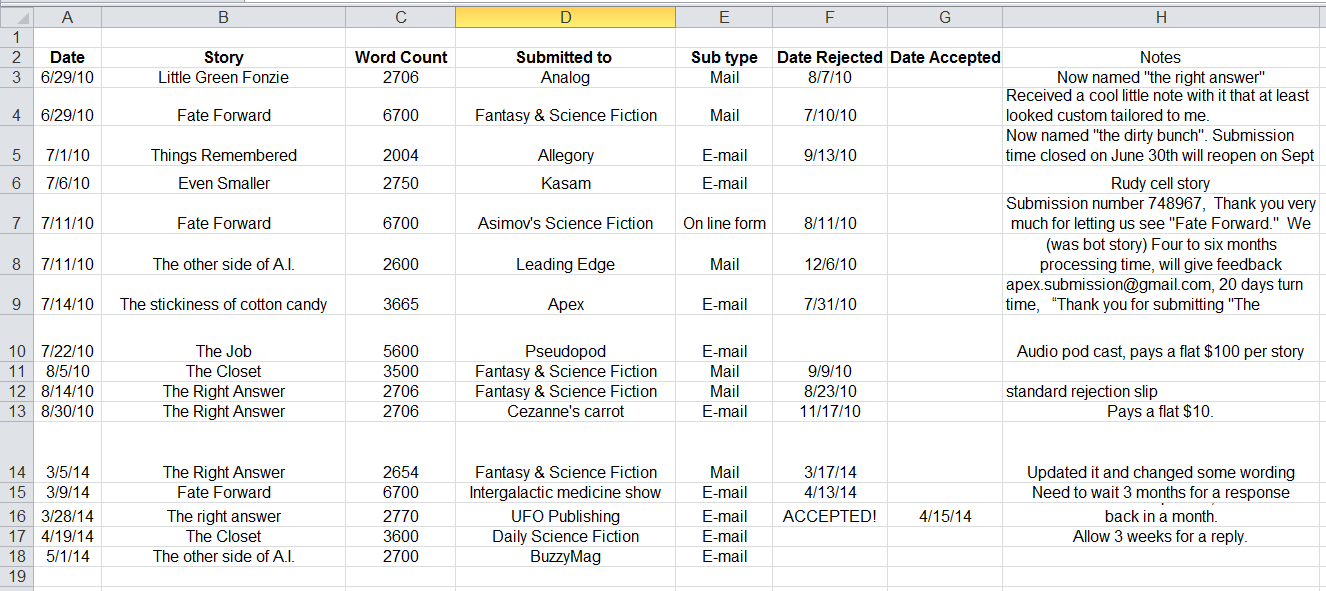
As soon as I began submitting two stories going at a time, I started losing track of when I had sent them, and to where. I am not sure what other writers do to keep track of submissions, but I made an Excel sheet for the task.

The main tab is a chronological list of the each submission.

Chronological writing submissions

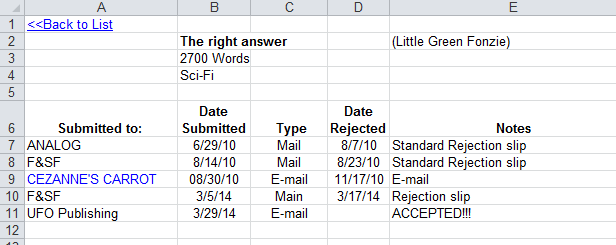
I also have tabs for each of the individual stories to see the chronological history of where they have been submitted.  I see on the tab below that I did submit this story to the same place twice, which is really a no-no, but it was after some editing, a name change to the story and after almost four years had elapsed. Unfortunately, they still didn’t like it.

Writing submissions by story


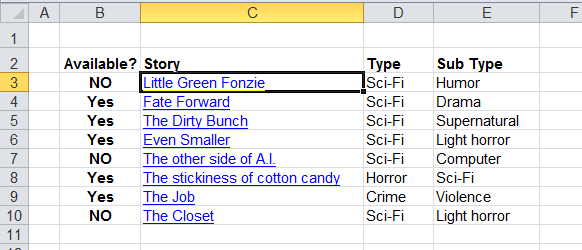
I have another tab  that automatically adjusts so I can tell from a quick glance which stories are available to be submitted. I am not sure if there is actually a “sub-type” category for writing. I just do that for my own reference, because, yes, sometimes I do forget what my own stories are about.

Stories that are able to be submitted

If this is something you feel may be useful, feel free to comment with your e-mail and I will send you the template.


-James