Regular readers of this Blog have probably picked up on my fascination with AI and its impact on writing.
The term AI-Slop is thrown around a lot today. And certainly, there is a lot of it. But this is not AI’s doing. If you believe AI is a tool, like I do, then you can quickly see how it is the improper use of that tool by PEOPLE that creates the slop. The slop comes from people. AI is how they make it.
Imagine if everyone suddenly got a shop full of new power tools and a free supply of lumber and nails. Some wouldn’t have any interest in using the tools at all. But there would still be a lot of people attempting to build furniture and other creations with their new tool set. Unfortunately, only a few of those people would create something truly worthwhile. I suspect those people would likely be the ones who already knew how to build something beautiful. I think this is true with AI as well.
It is never the tool; it’s the craftsperson behind it.
When it comes to AI and writing, I also like to think about the emotional involvement we tend to have in our own stories. Do we care as much about something written in part, or whole, by AI? I suspect not.
My mother has written two books containing various stories about her life and the people she has known through the years. If all of those stories were fed into AI, I suspect AI could have come up with a book as well. I am sure it would read factually and be grammatically perfect.
But I am also certain it could not tell those stories in anywhere close to the same way my mother can tell a story. She is a natural storyteller. In conversation she often leads with a shocking opening:
“I suppose you heard so-and-so was killed by a runaway giraffe at the Zoo.”
OK, that giraffe bit was made up, but this is her exact “shocker” structure. I always found the “I suppose you heard” bit interesting. I think she chooses that opening phrase as it has such a casual, conversational, feel that it heightens how much you get sandbagged by the shocking part.
She also likes to build to a twist or surprise when she can. Here is an example of something she actually told me (Note the name has been changed):
“I suppose you heard your Terri is in Las Vegas getting married.”
“What? When did this happen?”
“We’ll there’s probably a reason she had to get married so quickly”
That there, my friends, is a pro in action.
I am analytical, so my default is to deliver information fast and factual. My tale would have been:
“Terri got pregnant so she and her boyfriend went to Las Vegas to get married.”
Still shocking news but not that sweet double-punch set-up of the natural story teller.
I don’t see AI doing that kind of set-up. Not just yet anyway. Will it be able to in the future? Maybe. Probably, in fact. But it still won’t have the connection. AI doesn’t care who Terri is. It doesn’t care about her current situation nor know how any of that that should impact the audience.
So, while there will undoubtedly be a lot of AI generated content that we will need to to swim through in our collective future, I have faith that the hand of the human author still has a place to write and express in a way AI will never be able to emulate completely.
AI helped me to confirm something I have long suspected: The audience for short story fiction is smaller than other markets. (And, yes, whether you can believe AI is certainly always in question).
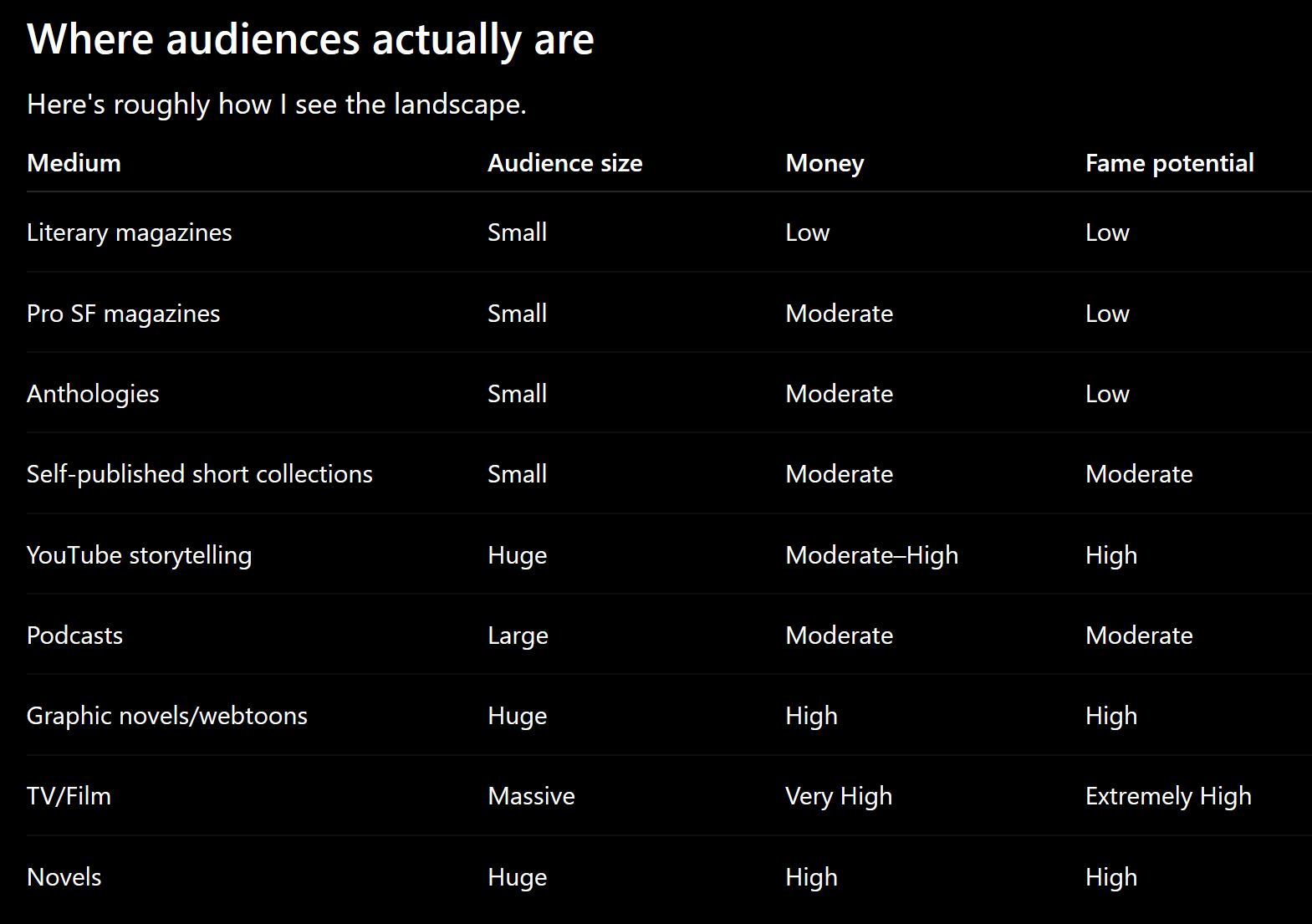
When I asked it what markets and media have the most appetite for fiction it came up with this chart below (note that I also found it interesting how it put in “Money” and “Fame potential” as metrics along side “audience size”):
While I am not sure if this is exactly correct (graphic novels & webtoons ranked way higher than I would have thought), it does confirm my suspicions that people are watching a lot more than reading. The one exception being novels still ranking really high.
This doesn’t mean there is no market for the written word, just that it will be an uphill battle if your goal is to get your short story published in a written format.
Since I am interested in storytelling in general I am working on converting my fiction story Thin Red Linesto a short You Tube video. And, yeah, in order to do that in the most efficient and cost effective way, I am going to use AI.
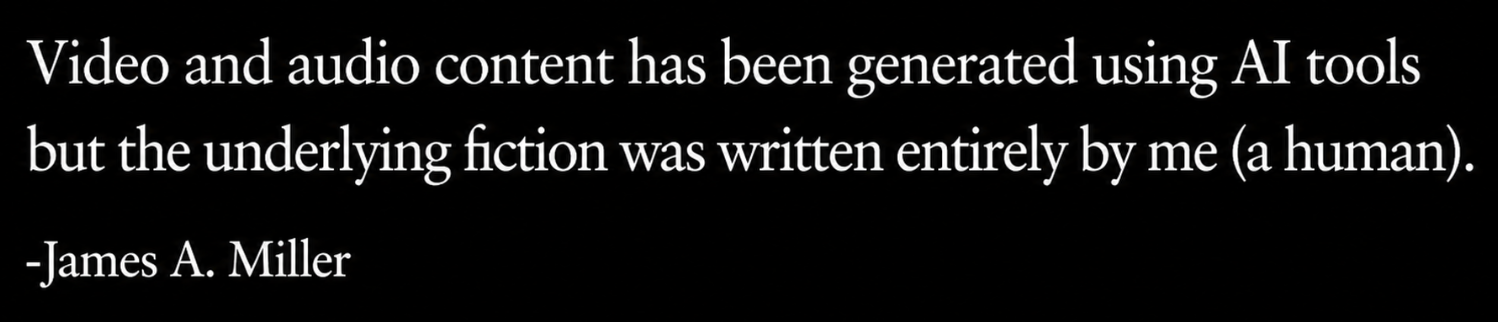
Before you start searching for your pitchforks, know that I draw the line at AI editing or creating any of the story I have written – the words will still be mine – I am having it do the video and audio. And, sure, maybe this is me justifying it to myself.
I am going to include this disclaimer at the beginning of the video:
You should also know that I am not after a quicky, wham-bam AI slop production. Like many of us, this story is my offspring, one of my literary children, so I want the final product to represent the tale I envision.
I can tell you, after a few days of working with Chat GPT for images, Google Flow for visuals and Eleven labs for audio, getting AI to provide anything close to what I envision is proving an exercise in frustration.
I often liken using AI iteratively like this as the same as working with a petulant child – sometimes they do exactly what you want and other times they stubbornly refuse to do what you are after no matter how much you try to persuade, explain, and re-frame.
Let me know if you have ever tried creating AI videos for your stories – or if you ever would?
An onus we writers have is to be very deliberate with our wording.
I was reminded of this recently when I saw one of my favorite pet peeves: the improper use of the word “infinite.”
I am a technical person, so my pet peeve rears its ugly head when I see someone use “infinite” to describe a feature that allows for “continuous” control or adjustment. This is typically when someone is describing a speed control that has a range from zero to 1,000 RPM and can be finely tuned to any speed in between. This, as opposed to a control that only allows for speed control to the nearest hundred RPM – like 100, 200, 300 and so on.
The range of 0 to 1,000 is not the same as infinite– which means “without end.” You can’t set it to 1,001 RPM or -10 RPM for example. There is an upper and lower bound.
Now, it could be argued that there is an infinite number of speeds between zero and 1,000 RPM much in the same way there are infinite decimal numbers between 0 and 1,000. However, that is not true from a practical standpoint. 500 RPM and 500.0000001 RPM likely have no tangible difference in most applications. Or we could take the decimals out to a point where we would hit physical limitations of the motor before we exhaust infinity.
So, my term for this kind of controller situation is “continuous.” That makes a lot more sense to me
Should this bother me? No, probably not.
But should a writer pay attention to details like this? Yes, I think we need to be good stewards of the language and take responsibility for such details.
But there are a couple of ways to look at such a thing:
We should be diligent about using words in the manner in which the dictionary defines them.
We should be faithful to the way in which it is used in practice, by the audience at large and the culture in which our story finds itself.
The first is easy to understand, but what do I mean by the second point? This is basically another way of saying “Write to your audience.” If I find that the group I am writing toward uses the word infinite instead of continuous, I may actually confuse that audience when I use the technically correct term. Note that there is another choice: I could describe the speed control using both terms, such as “…the motor is infinitely adjustable over a continuum of between 0 and 1000 RPM.” A bit wordy, but you get the idea.
There is a 3rd (and probably the most fun) way in which specific words can be selected and that is the manner in which characters in your stories use language. If the word “dog” is redefined to mean something we would never use it for — say, a sunspot — then this builds a lot of interesting dynamics to the world in which your characters find themselves.
Note that word redefinition should not be random, but make sense within that world and have some sort of natural, organic beginning and evolution. For example, maybe in the world in which “dog” means “sunspot” there was a historical event where a scientist determined how to use labradoodles to detect solar activity. OK, I am being a bit silly, but I think you see where this line of thinking is going. There should always be a reason for the words used within a language.
What you think? Should we writers be dogmatic and stick to the dictionary approved usage for words or can we take liberties by using the words the audience may related to or redefine words to mean something else entirely within in our stories?
One of the most common problems I see in newer writers is the idea that mystery automatically creates interest.
It can, of course. Suspense matters. Curiosity matters. The reader absolutely wants a reason to keep turning pages.
But a lot of novice writers end up holding back so much information that it becomes difficult to care about the main character. This makes the whole story hard to care about. The reader becomes confused, and confusion is one of the main reasons readers quit reading.
There is a real difference between making the reader ask, “What happens next?” and making them ask, “What is going on here, and why should I care?”
Driving curiosity
Readers do not keep reading just because information is missing. They keep reading because they have just enough information that they want more.
They need to understand who they are following, what appears to be happening, and what kind of direction the scene is moving in. They do not need every answer right away but they do need enough clarity to form questions that feel meaningful.
If I open a story and a woman runs out of a church crying, clutching a torn envelope, I already have something to hold onto. I may not know what was in the envelope. I may not know why she is crying. But I understand enough about her plight to feel pulled forward. I have some open questions that keep me interested: Why is she crying? What is in the envelope that has her so upset? Why is she fleeing the church?
If, on the other hand, if the woman is crying and she doesn’t understand why or we are not given enough hints to suggest why, then that kind of mystery often creates distance instead of momentum. This is especially true if the reason for the crying remains open for a long time.
Withholding everything is rarely the answer
I think a lot of new writers believe that if they explain too much, they will ruin the suspense but usually the opposite happens.
When writers withhold too much, the story starts to feel evasive. Scenes hint at danger without defining any real stakes or conflict. The reader is expected to stay invested without being given enough reason to keep going.
You only need to hold back the key information
We do not need to hide a lot. We just need to hide the right thing(s).
Let the reader know the scene, the character’s emotional charge, and the general direction. Hold back the one crucial piece that changes how we interpret it.
Good mystery fiction is a great example of this. A detective can arrive at a crime scene, notice the broken watch, the open window, the missing photograph, and the mud on the carpet. This gives us a lot to work with. The writer is not starving us of information. The writer is guiding our attention while withholding the one or more facts that will reframe everything for us later on.
This set up feels satisfying to the reader because they are engaged in active discovery.
Suggest a direction
One of the best ways to keep readers hooked without becoming obscure is to suggest a direction.
Even if the final destination turns out to be different from what the reader expected, that sense of the story “going somewhere” is important. It gives the reader a line to follow.
If the story offers no direction at all, the reader has to do too much work just to understand why the scene exists. Sadly, sometimes a scene like that shouldn’t exist.
A few useful examples
I remember reading Shirley Jackson’s The LotteryIn high school. It’s a great example of controlled withholding. Jackson does not explain everything right away, but instead gives the reader a clear setting, a social ritual, and an ever-growing sense that something isn’t quite right. But she does it in a way where the story doesn’t feel vague. The withheld information is such that we don’t feel lost in the story or confused. She omitted just enough and that kind of precision is what gives the twist ending its force.
You can also see this in film. In Jaws, we do not need endless concealment to feel tension. We know there is a shark. We know the beach town is in danger. We know Brody is heading toward a confrontation. The intrigue comes from escalation and anticipation. There are specific details – in particular the sight of the shark – that is withheld in a way that builds wonderful tension. If you have a chance watch jaws again, it is interesting to see how little of the shark is actually shown. So much is revealed by showing us the effects of the shark but not the shark itself.
Readers want discovery
Readers love putting clues together. They love sensing that there is more beneath the surface. They love the moment when a scene shifts and something clicks into place.
If you want people asking, “What happens next?” then give them just enough to believe the answer will be worth it.
Hold back one or two key pieces but suggest a direction. Then let your story lead the reader into discovery.
A good question to ask while revising
When I am looking at a scene that is supposed to feel suspenseful or curious, I like to ask myself:
Am I causing the reader to leaning forward into the story, or am do I have them confused?
This is a lot trickier to answer than it seems. We know everything about the story so it is hard to fully picture where we might be leaving out too much. We often expect the reader to make bigger jumps and put more together than they often can because we know how it all fits. This is where clarity is once again king. Note that clarity is not the same as revelation. you can be clear and still withhold key information.
If the scene is clear about character, stakes, and objectives (telling us why we should care) , the reader will usually lean into the story. If the scene is built on a hazy reality with a lot of omission, the reader will usually drift away. I see this a lot in stories where the protagonist is unaware of where they are and what they are doing there. Starting with amnesia is a tricky bit. I loved the movie (and the book even more so) Project Hail Marybut I felt that aspect should have been done differently.
Let me know in the comments below what your thoughts are on how to omit key information and still keep the story engaging.
One of the most common weak spots I see in submissions is the lack of a real story arc or character arc.
Unfortunately, this is a frequent reason I reject stories.
Often, what I receive is not actually a full story but a scene. Something happens. It may be vividly written. It may even have an interesting premise. But the protagonist is not really challenged, doesn’t (or can’t) struggle against any significant conflict, and does not change in any meaningful way.
The protagonist should want something, face obstacles, and have to figure something out, fight against something, or make a meaningful choice. The plot should put pressure on the protagonist. Their actions should matter. By the end, something should be different: externally, internally, or, hopefully, both.
Many of the submissions I see feature a protagonist who is simply carried through events. Things happen to them, but they do not take part in shaping the outcome. As a result, the piece can feel static, even when the writing and premise are strong.
Story Arc:
To me, a story arc is the shape of the plot that happens around the character. There is a school of thought that there is really only one plot line: the Hero’s journey. I have mentioned the Hero’s journey before and that’s a topic deserving of a whole blog post of its own.
Character Arc:
A character arc is should be thought of in terms of personal growth. How did the events change the character by the end of the story? What did they learn and how are they different? In the Hero’s Journey the hero comes home at the end but is changed and often sees the familiar world they came back to in a different light.
Great stories have both a strong story arc and a strong character arc.
And if I have rejected a story you submitted for one or both of these reasons, don’t feel bad, This is understandable because many stories start getting written when the author has a general scene or idea in mind. But the next step should be to ask more of your creation. What does the protagonist want? What stands in the way? And, most importantly, what will this experience cost them or teach them?
Without that, a piece tends to feel like an interesting scene rather than becoming a fully realized story.
Three Key Questions to Ask yourself about what you just wrote
What does my protagonist want, and why can’t they have it? (Tip of the hat to David Mamet for this one) A story needs desire and opposition to create what I like to call “driving conflict.”
Does my protagonist make choices or take actions that affect the outcome? The protagonist should have an opportunity to shape the events of the story. They should not be merely a victim (Note that a lot of horror stories I see end up this way. If you are writing horror make sure your protagonist has at least a glimmer of hope to win.)
How is my protagonist changed by the end of the story? Character change does not have to be positive (maybe they become morally worse for the experience) but something about them should change by the end of the story.
Hopefully this helps you to look at your writing from a new perspective. If you take the time to really understand story arc and character arc, it will absolutely make your stories stronger and more engaging.
I have been working with Google’s Antigravity code development tool recently. And while that seems like a strange thing to open with for a writing blog, here is why I think it might matter to us:
Antigravity is a development environment for coding that has AI built in so that instead of writing all of the lines of code yourself, you can “vibe code” which is basically talking with the program in plain language and telling it what you want.
While “programming” with Antigravity I found that the more detailed and deliberate I was with my description, the better the results. This made me realize that our talents as fiction writers will be very useful when working with AI now and in the future.
AI can do a lot of very amazing (and scary) things but it needs us to be able to describe in detail what it is that we want it to do. The better we are at that, the more useful we will be when working with AI, which I suspect will be a very desirable skill in the near future.
As I try to follow the rapidly changing landscape of AI, I find this a refreshing thought that gives me a glimmer of hope.
Here are ten common tropes that have been used so often they’re usually better avoided. Also, I have to admit that most of these are seen more in movies, but I still consider that storytelling so, let’s just go with that and let me get away with it this one time. Thank you.
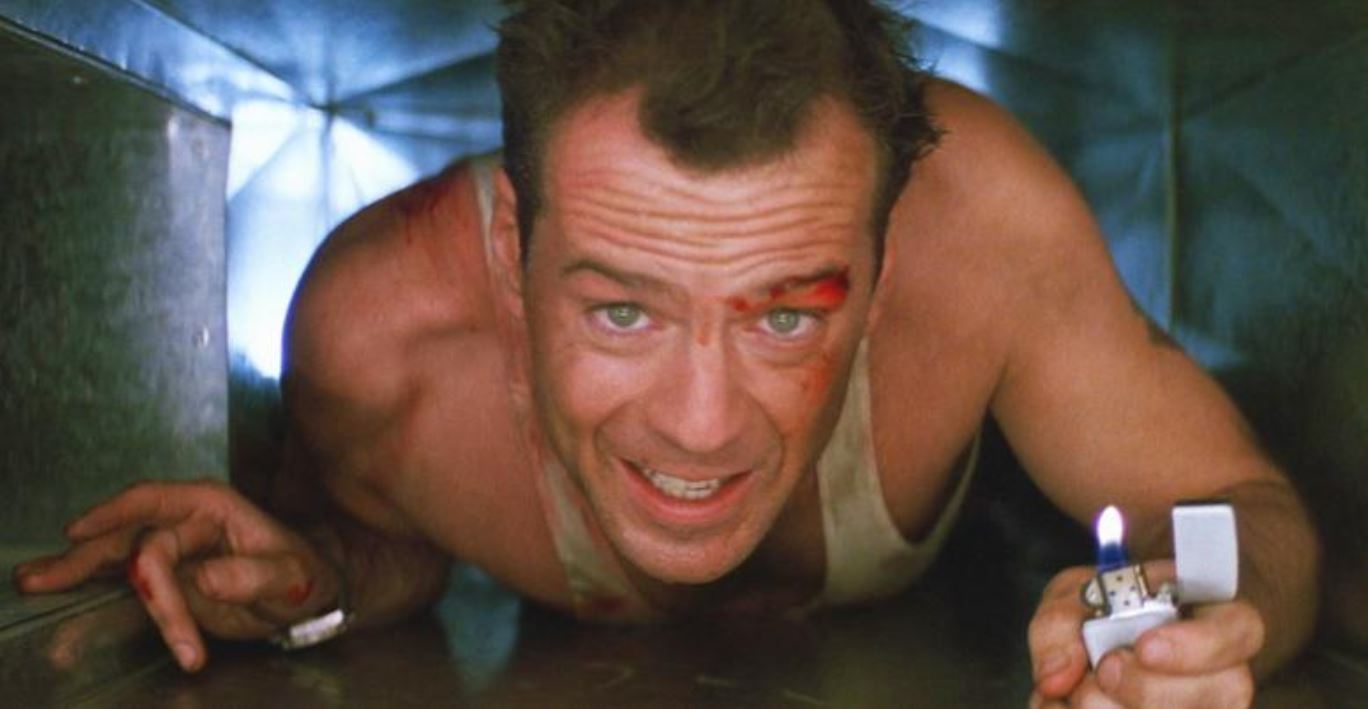
1. Crawling Through Air Vents
This one shows up constantly in action movies and thrillers. A character escapes or infiltrates a building by climbing into the ventilation system and crawling through ducts like they’re made for human travel.
In reality, most air ducts are thin sheet metal that won’t support a person’s weight. They’re also cramped, and if they are heating ducts would get pretty hot and probably cause you to pass out.
Once you think about how unrealistic this trope is, it becomes hard not to laugh when you see it.
2. The “Knock Someone Out for a Few Minutes” Trick
This is where a character knocks the guard unconscious with a punch to the head. The victim wakes up later with nothing worse than disorientation or a mild headache.
In reality, a loss of consciousness lasting more than a few seconds is a serious brain injury. If your character regularly knocks people out this way, they’re probably leaving a trail of permanent neurological damage behind them. I would much rather see some chloroform on a rag get held in front of the guards mouth and nose, or a taser disable them for a moment.
3. The Conveniently Overheard Conversation
Your protagonist just happens to walk past a door just as the villain is revealing his entire plan.
No effort required. No investigation. Just perfect timing. (see also my post on what role luck should play in fiction)
This trope removes agency from the main character and replaces it with coincidence. Information in a story like this should come from effort, not luck.
4. The Villain Explains the Entire Plan
This works for me in the Bond movies because it sort of “is what it is” in those. I feel like those movies define the whole trope and I give them a pass for it. But even then it’s still clear that this kind of exposition exists purely as an information dump. If these were real villains, monologuing their evil plans would be very careless. There is really no advantage to doing that, unless you want to compromise the 4th wall and let the audience (or in our case reader) in on something.
5. The Countdown Clock
A bomb is set to explode in exactly ten minutes. We can tell this from the red LED display conveniently visible to the hero. Being a very technical person, this one has driven me crazy for years. Bomb timers based on old-style alarm clocks where the alarm goes off and there is a physical contact closure built into the bell mechanism, yeah, that makes practical sense. Spending extra money and design time to put a digital LED read-out into something that will blow up seems like a lot of unnecessary cost and work. It’s good to have a metaphorical ticking clock that provides pressure for the protagonist but it’s doesn’t have to be a real one and it rarely makes practical sense to have a LED display.
6. The Instantly Hacked Computer
A character types furiously for ten seconds and announces:
“I’m in.”
Complex computer systems do not collapse instantly under a few keystrokes. Real intrusion involves research, social engineering, and patience.
I also see this kind of instant solution when a character in a movie goes to hotwire a car – they put two wires together and have it running in a matter of seconds. I guess we are just supposed to ignore the fact that it would take more wires than that and the fact that the steering wheel is usually locked.
7. Guns That Never Run Out of Ammo
You see this when characters fire dozens of rounds without ever reloading. I have to admit this has gotten better in movies lately but you do still see it. The new foul is that they change magazine so often now you wonder where they were keeping all of that heavy ammo when the chase scene was happening.
In fiction, running out of bullets is often times more interesting than having an infinite supply.
8. The Totally Useless Security Guards
In many stories, guards exist only to be knocked out or distracted.
They rarely communicate with each other, never notice obvious problems, and seem completely unaware of their surroundings.
A competent security system has multiple guards, cameras, procedures and can create much more interesting obstacles for your characters than the cardboard cut-out guards we usually see.
9. The One-Line Medical Miracle
A character receives a serious injury but is fine after a quick bandage and a few minutes of rest.
Broken ribs, stab wounds, and gunshots tend to have a much longer recovery times than a few minutes. Think about the last time you were injured in anything more than an inconvenient way and how much that slowed you down. I literally had my back go out when I was turned wrong and sneezed one time and I was basically disabled for three days, bordering on tears when I went to put my socks on. I have to imagine being shot in the stomach would slow me down quite a bit more than that.
Injuries that actually affect a character’s abilities make stories much more believable and raise the stakes.
10. The “It Was All a Dream” Ending
Few endings frustrate readers faster than discovering that the entire story didn’t really happen. Now, I did just see the Wizard of Oz at the sphere (which I equate to Disneyland in the expense and “gotta see it at least once” factor) and I am giving that movie a pass at this but for every other piece of fiction, you have to realize that dream endings are a cheat. They erase consequences and invalidate the emotional investment the reader made throughout the story.
Unless the dream itself is the point of the story, this trope almost always a bad idea.
The Real Problem with Tropes
The problem comes when tropes becomes so familiar that the stop feeling like a story choice and start feeling like lazy writing.
Readers enjoy stories where events happen for believable reasons, where characters solve problems through effort and skill and where the world behaves in ways that feel authentic.
If you find yourself reaching for one of these tropes, ask a simple question:
“What Could really happen instead?”
The answer is often surprising and far more interesting than the cliché. Spend a bit more time thinking through potential endings and as David Mamet would say, “make them surprising and inevitable.”
Stories vary in the amount an author receives for publication. One of my stories, The Right Answer, has provided a lot in return for the amount of time it took me to write it. And that return has been more than just financial.
The financial side was good, as far as 3000-word fiction goes anyway. I initially published it in Alex Shvartsman’sUFO 3 anthology (still available on Amazon, BTW) then later as an audio “reprint” on Escape Pod and Tall Tale TV. I received a small payday each time it went live.
This is pretty good considering I wrote the story in one sitting. I did do a bit of editing later and then had to reshape it based on the feedback the market provided but as stories go, this one had a lot less of my time into it than some of my stories that have never been published.
But the most rewarding “return” I got was being able to see the feedback from those who read it. I recall a highlight for me when it was initially published: A woman from Australia emailed me to tell me how much she enjoyed the story. She was eating cereal while reading it and nearly shot milk out of her nose at one funny part. It’s an indescribable experience to know that I tickled the funny bone of some stranger, on the other side of the planet, so much that they felt they needed to reach out to me.
Only recently did I notice that Escape Pod has a discussion forum (and do check this out) for stories they publish. It is thrilling to see people talking about the words I have put together. There were a few people that didn’t like the story, which an author never likes to see, but there are many more who enjoyed it very much. The story is [meant to be] a comedy and tastes can vary quite a bit, so I do expect there to be some that give it a thumbs down.
Let me know in the comments down below what your experiences have been with feedback from those who have read your work.
I have been binge-watching the James Bond movies on Netflix. I am mostly going in sequence, starting with 1962’s Dr. No and having worked my way up to 1979’s Moonraker. Watching these movies in quick succession has allowed me to see how quickly culture changes. In 1962, there were still segregated bathrooms. While that isn’t apparent in the Bond movies (that I could tell, at least), what I did notice was how the attitude toward and portrayal of women changed over those films. Early Bond had no qualms about backhanding a woman across the face, then later making what could most generously be described as aggressive advances toward the same woman, who ultimately gives in to her uncontrollable passion for Bond—cut to post-coital pillow talk.
There is also a feeling of the power of feminine sexuality in those films. I suspect some would say this is an example of objectifying women, but to me it feels more like something empowering.
It is interesting to see how the female roles became more assertive and less passive over time, in my mind culminating with the angry power of Grace Jones as May Day in 1985’s A View to a Kill. Yes, James still takes May Day to bed, but as he goes to do so, she deftly flips him over so she is on top. While I may be reading into things, this felt like a nod to the changing role of women in the Bond films. No longer would they be relegated to serving as handy plot devices that provide 007 with information and titillation.
This seems to continue to hold true in 1979’s Moonraker, as the main female character is a CIA agent, every bit as capable and seen as an equal to Mr. Bond. Old habits die hard, however, and she did carry the suggestive name of “Dr. Holly Goodhead.” According to AI, this is the first mention of a leading female character with a PhD in a Bond movie.
Another interesting bit was how they showed the kill shots of pheasants being hunted in Moonraker, clearly showing the birds being shot and falling from the sky. I suspect this would not be seen in any movie today. Brutally murder 100 guys in an action scene? Yes, please. Show the kill shot during bird hunting? Sorry—way too offensive.
I admit to feeling a sad nostalgia for these times gone by. Those values and norms have changed and will never be seen again. I say this from a mental standpoint of trying to withhold judgment. It is easy for us to look back and decry the unfairness and ignorance with outrage, but for the people of that time, this was the world they lived in. It felt “right” to them at the time. It was the world they knew, whether we like it or not.
I do think we have changed for the better… but then again, I am looking at that from my current mental framework of social values—just like we all are. There is no way around it. I suspect people have always felt the very same way: things are so much better than they used to be.
I also find it interesting to think that the stories we write today will inevitably capture the cultural mores of our time.
Which makes me wonder: will our writing be considered antiquated and offensive later on?
Almost certainly. But when it comes to writing, much like martinis, shaken is better than stirred.
Profanity is one of those tools writers either lean on too hard or avoid like it’s radioactive. But swear words aren’t automatically “bad writing” or “edgy writing.” They’re just words and like any other words, they need to earn their place on the page.
If you’re deciding whether to drop an f-bomb (or like in some of my stories, fifty), here’s some guidelines I go by:
Every word should serve character or plot
A useful gut-check: what does this profanity do?
Does it reveal a character’s temperament, background, stress level, or worldview?
Does it intensify a moment that matters to the plot?
Does it sharpen the rhythm of dialogue in a way that fits the scene?
If the answer is “it just sounds cool” or “it makes this feel more adult,” it’s probably filler. Profanity is strongest when it functions as characterization.
Try this: Remove the swear word. If the line loses meaning, tone, or character truth, you may need it. If nothing changes, omit it.
Profanity comes with a real risk of offending some readers
I do think this is less of an issue than it was say fifty years ago, but it is something to keep in mind.The key is to choose intentionally and ask yourself:
Who is my target audience for this story?
What’s the tone I’m going for here (cozy mystery vs. grim thriller, for example)?
Am I okay with losing some readers because of this?
One thing profanity is good at is a quick way to signal genre and voice. It can also break immersion for readers who don’t like it.
Profanity should be true to the character, not the author
The best profanity usually feels inevitable. In other words the character couldn’t have said anything else.
A few examples of true to character uses:
A character swears when they’re scared, cornered, or losing control.
A character uses profanity casually because it’s part of their everyday speech.
A character never swears… until the moment it finally slips, and that tells us something about what is going on.
On the flip side, try to avoid:
A character who suddenly starts cursing because the author wants the scene to feel “more intense.”
Everyone in the cast swears in the same way (same words, same rhythm), which usually makes it feel like it’s the writer’s voice coming out of all of them.
Can you identify who’s speaking if you remove the dialogue tags? If swearing makes the voices blur together, then it’s really not adding anything of value.
Profanity should also be thought of as a natural byproduct of:
real emotion
real conflict
real character choices
If the scene is already powerful, profanity can add some heat, but if the scene isn’t working to begin with, adding profanity won’t fix it.
The one F-word check. I see this in stories a lot more than you would expect; a story has little to no swearing then, out of nowhere, a character drops the F-bomb.
If you use the F word only once in the entire story, ask yourself whether you really need it. There are two reasons I can think of why, as Ralphie would say, the Queen mother of dirty words would only appear once:
It’s true to the situation. Maybe it lands at the exact right emotional peak, and the rarity makes it hit harder. Sure go ahead and keep it it in.
Shock value. If the profanity exists mainly to jolt the reader, it can feel cheap and manipulative. Readers can can tell when the author is yanking at the steering wheel. It reminds me of a creative writing teacher I had who would always talk about the author “Showing their hand.” His point was that only in rare cases is that a good thing.
Before you submit, ask these questions:
Does this word reveal character or move the plot?
Would this character really say it, right here, right now?
Is it doing more than just trying to sound edgy?
Am I okay with the readers I might lose?
If this is my only F word, is it really needed?
If you can answer “yes” to those, you’re using language with intent.
The goal is to write in a way that is true to the characters and true to the story. Remember a great way to to test is by taking out the “bad words” to see how it affects the story. If, after that you still can’t decide… well, sometimes you just have to say “Fuck it.”