Tag Archives: writing craft

What Can Acrobatics Teach Us About Storytelling?

Storytelling takes many forms. Sometimes it involves a man balancing on a stack of chairs while an entire audience wonders whether they should have signed a waiver.

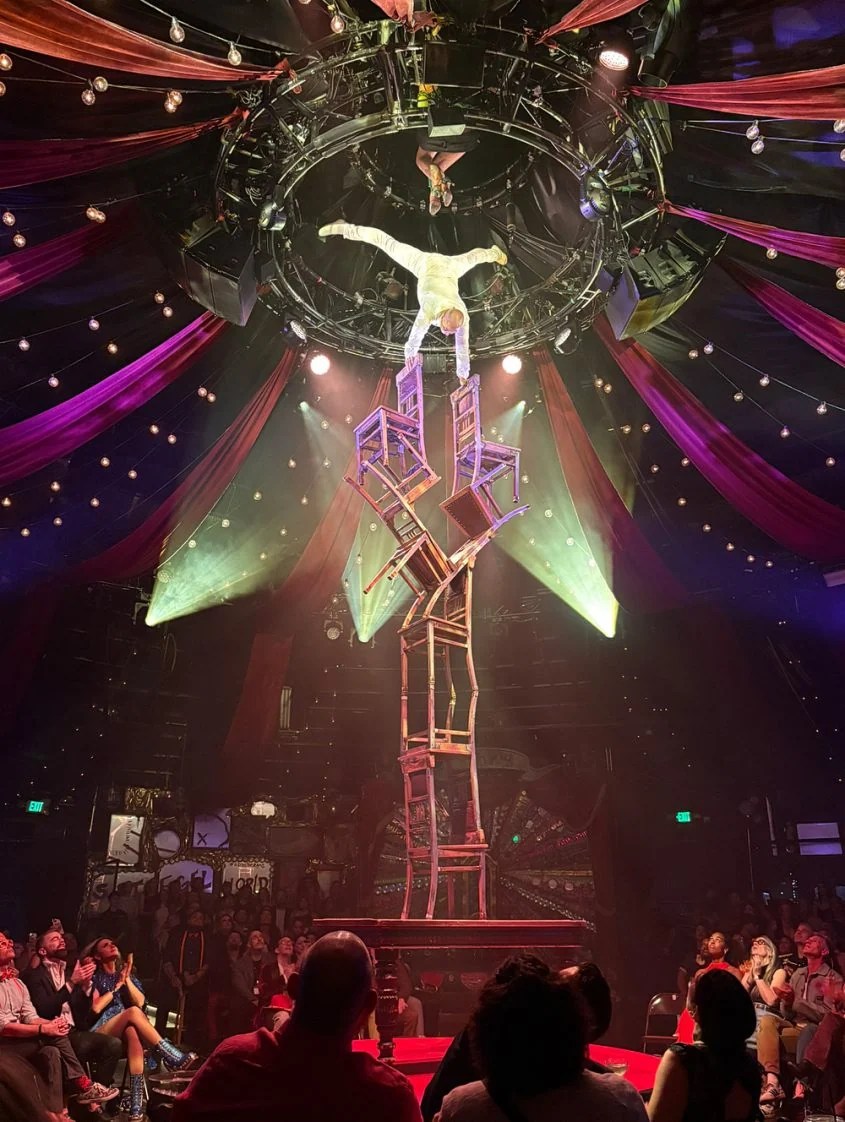
On a recent trip to Las Vegas, I had the opportunity to see Absinthe, an excellent, albeit bawdy, show featuring some amazing acrobatic performances.

As I watched one performer stack chairs beneath himself, I realized his actions were a method of storytelling.

He began with something impressive but manageable: a handstand on the back of a chair.

That was the hook.

Okay, you have my attention. Now what comes next?

Another chair joined the first. Then another. What had seemed impressive a moment earlier was merely his starting point. With each addition, the performer gave me a new reason to watch and a little more reason to worry. Rising action anyone?

Soon, he was 20 feet above the stage on a stack of impossibly interlocked furniture. The chairs rattled and swayed, keeping us on the edge or our seats.

And then he began moving into a one-armed handstand.

By then, he had us. We had followed him all the way up, and nobody was looking away.

How is he going to get down?

It’s what we want in a good story: a character does something that interests us. Their situation grows more difficult. The stakes rise. Each new development builds on what came before, until we reach a moment when everything seems to depend on what happens next and there appears to be no way out.

The performer couldn’t have created the same effect by simply appearing at the top of the stack. By watching him build it, we became participants. We had seen where every chair went and we even felt that wobble halfway up. Was that on purpose? Is he in trouble?

Good stories earn their biggest moments in much the same way.

We need those earlier steps. We need reasons to care, questions we want answered, and enough uncertainty to keep us leaning in. Each complication adds another chair.

At the top, the performer held his position for a few extraordinary seconds while we held our breath. It was just long enough for the applause to swell and for us to take in what he had accomplished. This was the climax of the story.

Then he came down.

He reversed the climb, carefully disassembling the stack by throwing chairs to the stagehands as he descended. With each chair removed, the tension eased. Eventually, his feet reached the stage.

Our hero had made it home.

Watching Absinthe reminded me that a story is also a performance. Whatever ideas we want to explore, we still have an audience trusting us with their attention. We need to keep their curiosity alive and let them feel the tension every step of the way.

They start on the ground with us. Then, chair by chair, we carry them through the unlikely, the improbable, and finally something seemingly impossible.

And when it’s over, our hero is home, back on the ground with an audience grateful for the journey.

-James

How Great Writers Break the Rules of Fiction

I often give tips or advice on the rules of writing, or maybe “best practices” is a better term. The beauty of writing is that there are no hard-and-fast rules. Below are some cases where great storytellers effectively broke from commonly accepted practices.

Show, don’t Tell

One that immediately comes to mind is Orson Scott Card’s Ender’s Game. When I read that fantastic book, I kept thinking that he was doing a lot of telling. Card, in fact, has commented on how he feels about the show-don’t-tell argument. In short, he argues that there is a place for both showing and telling and writer’s need to know when to use each, although he is later quoted in the forum as saying “Most storytelling should be just that, telling.”

Maintain a linear Storyline

Another one that comes to mind is the movie Pulp Fiction and its nonlinear story line. That movie changed the perception that an audience (or reader) needs to be fed events in a linear fashion to understand a story.  It’s structure was not random. Breaking from the chronological structure gave Tarintino the freedom to:

  • Open and close with the same restaurant robbery, giving the film a circular shape.
  • End with Jules’s moral transformation instead of Vincent’s death. I feel this is the larger key aspect; he chose to have the character arc drive the sequence as opposed to showing the events chronologically.
  • Introduce characters before fully explaining how their stories connect.
  • Create suspense by withholding context rather than merely withholding outcomes.
  • Make each short story/video feel like parts of one larger story.

Have One Consistent Narrative Voice

William Faulkner’s As I Lay Dying, breaks the convention of a story being told from a central narrator. A total of fifteen narrators (with wildly different personalities and mannerisms) tell the story of the Bundren family and their journey, including one character who actually narrates after her own death. It is an interesting approach because the point seems to be that the Bundren family members cannot communicate honestly with one another, so no single member can narrate the entire story.

The Narrator Is Honest

J. D. Salinger’s The Catcher in the Rye violates several common practices, but the one that stands out in this book is making the narrator an unreliable one. Holden Caulfield, the protagonist, repeats the same words and expressions, wanders into lengthy digressions, contradicts himself. The story has very little actual plot and seems to be mostly an exercise in getting to understand this narrative character. Holden is judgmental, dishonest, and downright not likable. When I read the book, it felt like Holden was either lying to himself or brutally unaware of reality. It was clear that he failed to look at his own hand in ending up where he was or his own ability to make changes in his life he desired (something I feel still burdens a lot of people today). He calls other people “phonies” and insists that he doesn’t care about things that are obviously causing him pain. These weaknesses created one of the most recognizable voices in American fiction, particularly for that time period. Salinger did a great job of turning an unreliable narrator into a form of indirect characterization. We gradually understand Holden because we learn not to trust him.

The Importance of Grammar and Punctuation

E. E. Cummings* is an interesting example when it comes to punctuation. Here is a summary of the conventions he challenged or outright broke:

  • The omission or repositioning of punctuation.
  • Selective rather than conventional capitalization.
  • Words broken apart or combined in unexpected ways.
  • Fractured sentence structures.
  • White space and line placement used as part of a poem’s meaning.
  • Visual arrangements that allowed readers to experience movement on the page.

*Note that his name is often written “e.e. cummings” but he did actually capitalize his own name.

Keep in mind the writers and storytellers discussed above are masters in their respective crafts. They know where the lines are, what they are risking, and how to tread carefully when they choose to cross them.

For a while, I thought it would be cool to be known for having the gimmick of never naming my main characters in a story. I envisioned how cool it would be for someone later to connect the dots on this in an aha moment and understand it was an intentional thing. Instead, one of the first stories that got rejected had an additional comment along the lines of “And what was the protagonist’s name? It is never mentioned in the story!”

Not that a good writer couldn’t have ever pulled that off, but I learned that people do take notice when you cross that particular line.

How about you? What line have you crossed in your storytelling? What are some boundaries you feel need to be pushed?

-James