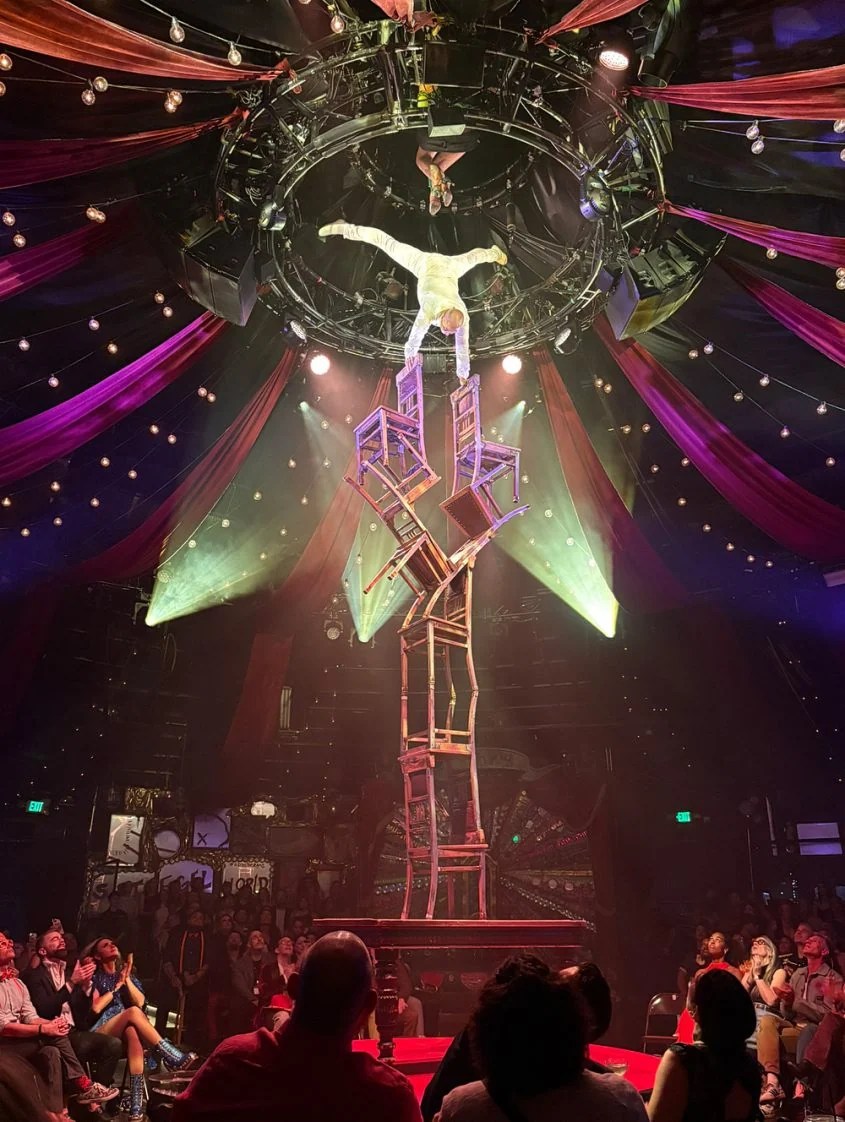
Storytelling takes many forms. Sometimes it involves a man balancing on a stack of chairs while an entire audience wonders whether they should have signed a waiver.
On a recent trip to Las Vegas, I had the opportunity to see Absinthe, an excellent, albeit bawdy, show featuring some amazing acrobatic performances.
As I watched one performer stack chairs beneath himself, I realized his actions were a method of storytelling.
He began with something impressive but manageable: a handstand on the back of a chair.
That was the hook.
Okay, you have my attention. Now what comes next?
Another chair joined the first. Then another. What had seemed impressive a moment earlier was merely his starting point. With each addition, the performer gave me a new reason to watch and a little more reason to worry. Rising action anyone?
Soon, he was 20 feet above the stage on a stack of impossibly interlocked furniture. The chairs rattled and swayed, keeping us on the edge or our seats.
And then he began moving into a one-armed handstand.
By then, he had us. We had followed him all the way up, and nobody was looking away.
How is he going to get down?
It’s what we want in a good story: a character does something that interests us. Their situation grows more difficult. The stakes rise. Each new development builds on what came before, until we reach a moment when everything seems to depend on what happens next and there appears to be no way out.
The performer couldn’t have created the same effect by simply appearing at the top of the stack. By watching him build it, we became participants. We had seen where every chair went and we even felt that wobble halfway up. Was that on purpose? Is he in trouble?
Good stories earn their biggest moments in much the same way.
We need those earlier steps. We need reasons to care, questions we want answered, and enough uncertainty to keep us leaning in. Each complication adds another chair.
At the top, the performer held his position for a few extraordinary seconds while we held our breath. It was just long enough for the applause to swell and for us to take in what he had accomplished. This was the climax of the story.
Then he came down.
He reversed the climb, carefully disassembling the stack by throwing chairs to the stagehands as he descended. With each chair removed, the tension eased. Eventually, his feet reached the stage.
Our hero had made it home.
Watching Absinthe reminded me that a story is also a performance. Whatever ideas we want to explore, we still have an audience trusting us with their attention. We need to keep their curiosity alive and let them feel the tension every step of the way.
They start on the ground with us. Then, chair by chair, we carry them through the unlikely, the improbable, and finally something seemingly impossible.
And when it’s over, our hero is home, back on the ground with an audience grateful for the journey.
-James

