Category Archives: Procrastination

Overcoming Writer’s Block: 5 Ways to Get Writing Again

Yesterday you had ideas, but today you’re staring at a blinking cursor. Here are a few things to try when the words aren’t coming.

Start with something that actually happened.

When I am stuck, I will sometimes get restarted by documenting a nonfiction event that happened to me, or even a story someone else has told me (changing the names, of course).

Then I start thinking about what could have made the situation more interesting or exciting. The end result is always wildly different.

Start as a reporter, then put on the story-teller hat and embellish.

Open your IDEAS file.

You are keeping an IDEAS file, right?

These are the half-formed concepts that aren’t quite stories yet. Mine are often two-sentence summaries of a scene or concept that is nowhere close to a story, but can often provide a starting point, or prime the pump for start down another path.

Something that didn’t interest me six months ago might look different to me today (usually embarrassingly so). Two unrelated entries could even end up in the same story.

Here are some examples from my idea file (and yes, most of these, if not all, are terrible)

  • A company takes keeping data on employees to the extreme. Knowing when they go to the bathroom and how much toilet paper they use, for example.
  • Sci Fi story about how improving athletes by reducing “unnecessary” weight goes too far. Starts with bone shaving and removing vestigial organs to temporarily removing stomach and intestines, skin and ultimately at the end of the story the whole head.
  • Some things only exist to bring other things together. I like to call these things a catalyst, you know, like in chemistry, something that is needed for a reaction, but is never used up itself. A lot of these things are around for dark purposes. Purposes that most of the world never knows, and for good reason. (I have no idea where I was going with this one.)
  • Story that exposes the fact that the government is using flu and colds to inoculate its population against biological warfare.
  • Story about a guy who is using robot(s) to do breaking and entering and hold ups. This creates a difficult to track back to the criminal issue. Could be told from a gumshoe point of view.  Issues would likely be similar to kidnapping money drops where they have to track the robot and the stolen goods. (We may not be far off from actually seeing this happen.)

Write ANYTHING for half an hour.

This is all about getting you ass in the chair and forcing yourself to just write.

For those thirty minutes, the words don’t have to be good or make a lot of sense but you do need to write something. A lot of times this is just enough to get you going. I am often very surprised by what comes out of this.

Screenwriter John August uses a similar approach: he sets a twenty-minute timer and commits to working until it rings, with permission to stop afterward. I think the secret in what he does is that the commitment feels small and manageable.

Do something outside your normal routine.

Visit somewhere unfamiliar or do something outside of your normal routine. This create a new environment for you to see and wakes up your brain to start taking notice.

On Scriptnotes, Craig Mazin describes imagining scenes while walking or showering, then writing once he knows what happens. Thinking through a scene can be useful work, even before you start typing.

Leave some breadcrumbs to make the next start easier.

In my Masterclass post, I mentioned leaving yourself a prompt for the next session, moving past difficult passages with “TBD,” and allowing the first draft to be rough.

Ernest Hemingway described stopping while he still knew what would happen next, giving himself a way back into the story the next morning. Try leaving a few notes about the next scene before closing your current document.

What helps you to start writing again after you’re stuck? Let me know in the comments below.

-James
Never Reject Yourself

Getting rejected is part of submitting fiction. But sometimes we save an editor the trouble by rejecting ourselves before we ever send anything. I got an email from an author who wasn’t sure whether he could submit another story to BITC right after he received a rejection. I understand why he asked, as some markets have that stipulation. I don’t limit submissions that way, but this poor fellow was holding himself back from submitting. I think he just wanted to make sure he didn’t get on the wrong side of the editor, which is always good thinking, but in his mind, he turned a single rejection into a closed door that was never actually closed.

Unless the guidelines specify a waiting period, never assume there is one.

This next one is something I do a lot myself: Deciding the type or style of story isn’t a fit for what the market wants. You do want to be careful and be in the ballpark of what they are asking for in their submission guidelines. A hard-core horror story is not going to fit the likes of Reader’s Digest, but if it’s close to what the market is asking for, why not take a chance? If it’s a good story and at least touches on what they are looking for, an editor will usually give it a fair shake.  That happened to me with The Right Answer. I wasn’t quite sure it was a fit but submitted it to the UFO anthology anyway, and it got picked up.

Another way we self-reject is by deciding our work isn’t “good enough.” Don’t get me wrong, do always err toward making your work better. Most of the submissions I see USUALLY need more work (and recognizing that yourself is part of becoming a better writer). But there is a point where revising becomes a way to avoid actually submitting. We keep polishing because sending the story means letting someone else judge it, which feels like submitting ourselves for judgment. You don’t need to believe you have written a masterpiece before giving an editor a chance to read it, but you should have made an honest effort to make it as good as possible. I am really hoping this paragraph does not create a bunch of subpar submissions for BITC. Please note that this is likely a small category of authors, but a very real group of people who let perpetual refinement keep a story captive for way too long. I have known a few.

I managed to create my own obstacle when submitting The Resignation to 200 CCs. I thought the stories had to be exactly 200 words, and I became so concerned about hitting that number that I nearly gave up on submitting altogether. I finally worked the story to precisely 200 words and sent it off. The editor responded that he liked the story and was impressed that it was exactly 200 words. Apparently, the thing I had treated as a requirement was something he considered an out-of-the-norm accomplishment. I had almost rejected myself over a restriction I had imposed.

Of course, “never reject yourself” doesn’t mean ignoring submission guidelines. If a publication accepts stories up to 2,000 words, sending them 5,000 words is just failing to respect what they asked for. Genre, submission windows, and other stated requirements matter. The careful balance is to understand the actual boundaries without inventing additional ones. Read the guidelines, give your story the attention it deserves, and submit it when it fits. There are plenty of editors who will tell you “No,” but you don’t need to do that for them.

Have you ever rejected yourself? Let me know in the comments below.

-James

Just take the next step

When I think about the vast landscape of what I haven’t written yet it feels daunting.  There are so many authors out there writing way more than me. I can picture them writing away at this very moment outpacing me word by word.

It takes a lot of stories and a lot of submitting for authors to gain even a small presence. Having had some success, I also know that you have to write a lot of bad stories before you finally unearth the good ones.

It’s a lot like the feeling I get when I have a big TODO list. it’d daunting, I just know I will never get through it all.

Martin Luther King Jr. once said, “You don’t have to see the whole staircase, just take the first step.”

That mindset has helped me, no only with my TODO lists, but with writing as well. There is a power to realizing that I really only need to focus on the very next story. After that, I really only need to focus on submitting it. After that, move onto the next one. We eat the cow one hamburger at a time, as the saying goes.

If you are like me and often feel buried under the weight of what you haven’t written, step back from the overwhelming wide view and narrow it down.

It’s not: look at all I have to do!

But rather

What’s next?

Let me know in the comments below what’s next for you.

-James

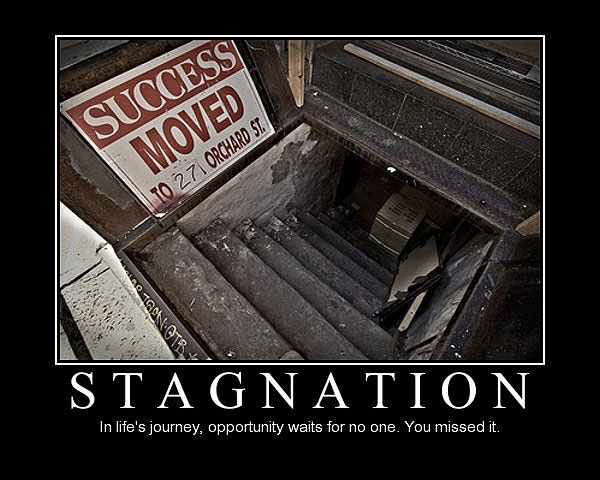
Rampant Stagnation

I have been having a hard time feeling good about writing. I don’t feel good about doing it and I don’t feel good about what I have written.

I know that sounds depressing, like each night I go to bed curled up in the fetal position rocking myself to sleep with the barrel of a gun in my mouth, but that’s not the case at all. It’s really more of a matter of “this is where I am at” kind of thing.  I am still in good spirits, I’m just not getting anything worth while done with regard to writing.

Is it writer’s block?

No, I don’t think so.   It’s more like writer’s laziness.  I still have plenty of ideas; it’s just that none of them seem fleshed out enough to start writing. For example: I have one where I think it would be cool to do a story about a terrorist attack against the Space Elevator .  I just love the idea of a carbon nanotube rope leading into space and being held in place by a geosynchronous mass.  A Space Elevator could lead to rapid and cost effective deployment of satellites and space missions, not to mention making the prospect of a trip into space within reach of regular Joes, like you and I.

But somehow it just ain’t sexy enough.  Maybe because it  isn’t really a story idea, but rather a setting with a vague concept.

It’s like I am still waiting for that big “Ah-ha!” idea to hit, and so far I’ve just got a bunch of maybes

I also get sidetracked very easily. I am now fighting an urge to code another video game.  I program games using Dark GDK, which works with Microsoft’s C++ Express.

I recently had the idea to take photos of my nephews in various kick and punch poses, and integrate these photos into sort of an 80’s style side-scroller “Super Mario” style game.  I think my Nephews would really enjoy playing as themselves in a tailor-made video game.

I so want to be the cool uncle who does stuff like that.

But that’s a huge commitment; probably at least 100 hours of programming time to get something worth playing. And then there is the risk that it may not be that cool to them.  The “I’m in the game factor” can only go so far when I’m also competing against the Wii.

Then I get ideas for the game like how I could somehow make it educational, but real subtly so they wouldn’t know. I could do something like putting Classical music in the game instead of the normal techno crap.  But I know making it educational is the deathblow to any video game.  Ask any kid what the top twenty video games are, and none of them will list anything even remotely close to “Math-blaster”.

I resolve to get something written today, even if it’s crap, but currently find myself looking at cutting edge video cards for a fantasy desktop computer build.

James

TO DO I Didn’t.

I take a nap on Saturday at about 2:00 in the afternoon. Although, I guess you can’t really call it a nap when it lasts six hours.

I end up staying up all night and feeling pretty worthless, partially because I only did two out of twelve things on my weekend “TO DO” list (dishes and laundry), but particularly because I hadn’t written any fiction in a while.

I make a pot of coffee so I don’t go back to sleep, as sleeping would throw off my cycle off so bad that I might not make it into work on Monday.  It’s happened before.

I am about 2/3 of the way through the coffee when something, maybe the hallucinogenic mix of caffeine and over-tiredness, gives me an idea for a story. By 9:00 AM Saturday I’ve banged out a 2300 word short, which makes me feel a lot better about myself. I feel so good in fact that I continue to ignore my TO DO list, and get in two games of Starcraft II before I finally fall asleep about noon.

This time I keep the nap to a more respectable five hours and feel rested enough to mow my lawn (TO DO #3), but not quite good enough to weed trim (TO DO #4).

I read a bit of Terra Lemay’s live journal. She talks about how she keeps a log of the number of words she writes, and even has a cool little graph.  I find that to be a stellar idea and add a worksheet called “Word count” to the Excel writing file I have set up to track my submissions.

I enter in my one word count data point and wonder if this is going to be the type of thing I stick with, or if it will end up like the treadmill, a dusty embarrassing reminder of how, if I were a racehorse, I would be summed up as “good out of the gate but dies at the first turn”.

I feel pretty tired Sunday at midnight, but do manage to get in two more hours of StarcraftII before finally hitting the sack.

James