AI helped me to confirm something I have long suspected: The audience for short story fiction is smaller than other markets. (And, yes, whether you can believe AI is certainly always in question).
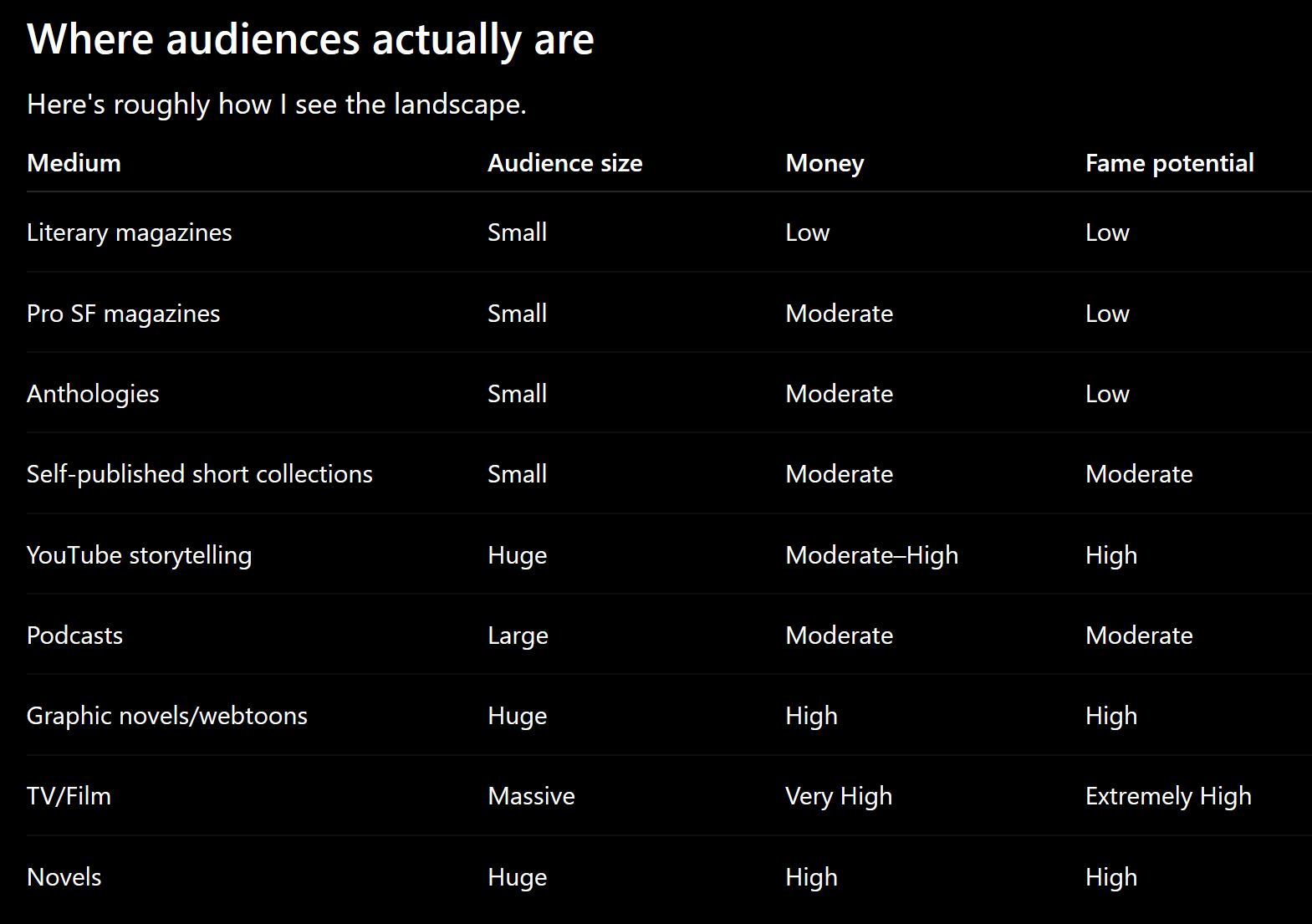
When I asked it what markets and media have the most appetite for fiction it came up with this chart below (note that I also found it interesting how it put in “Money” and “Fame potential” as metrics along side “audience size”):
While I am not sure if this is exactly correct (graphic novels & webtoons ranked way higher than I would have thought), it does confirm my suspicions that people are watching a lot more than reading. The one exception being novels still ranking really high.
This doesn’t mean there is no market for the written word, just that it will be an uphill battle if your goal is to get your short story published in a written format.
Since I am interested in storytelling in general I am working on converting my fiction story Thin Red Linesto a short You Tube video. And, yeah, in order to do that in the most efficient and cost effective way, I am going to use AI.
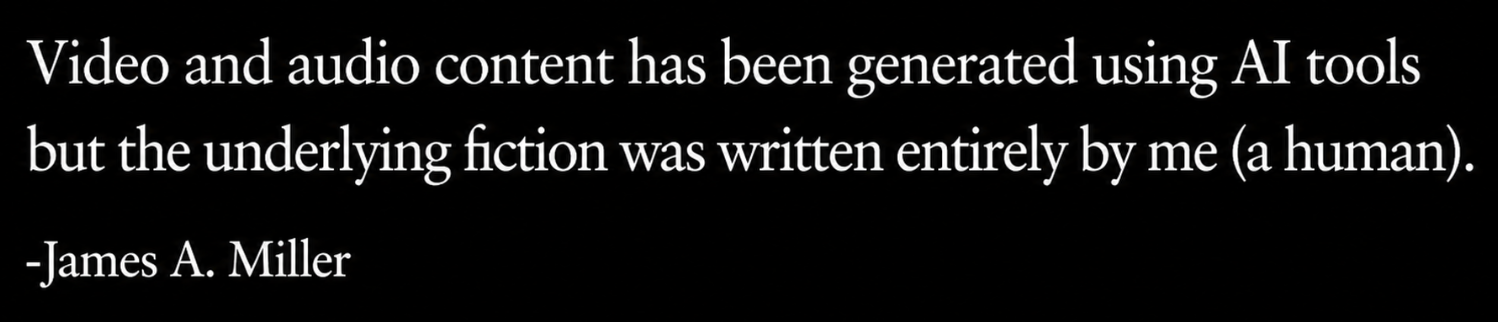
Before you start searching for your pitchforks, know that I draw the line at AI editing or creating any of the story I have written – the words will still be mine – I am having it do the video and audio. And, sure, maybe this is me justifying it to myself.
I am going to include this disclaimer at the beginning of the video:
You should also know that I am not after a quicky, wham-bam AI slop production. Like many of us, this story is my offspring, one of my literary children, so I want the final product to represent the tale I envision.
I can tell you, after a few days of working with Chat GPT for images, Google Flow for visuals and Eleven labs for audio, getting AI to provide anything close to what I envision is proving an exercise in frustration.
I often liken using AI iteratively like this as the same as working with a petulant child – sometimes they do exactly what you want and other times they stubbornly refuse to do what you are after no matter how much you try to persuade, explain, and re-frame.
Let me know if you have ever tried creating AI videos for your stories – or if you ever would?
Today’s story comes to us from Sam Houlker. Sam is a British-born scientist who emigrated to the Czech Republic for love. He writes because it makes his head hurt in a good way.
okay. please hold has been [Mistakenly] rejected by Espace Pod, Foofaraw, Cosmic Roots, EldritchShores, and Translunar Travelers Lounge, amongst others.
When I asked Sam what he loves about the story, this was his response: I love this story because it takes something extraordinary and makes it both ordinary and frustrating. Every time people achieve the impossible, we immediately make it mundane. Flying across the Atlantic should be incredible. Instead, we complain that the airline has swindled us with expensive add-ons, whilst any help is hidden behind an impenetrable complaints department. Everything is turned into a process, then run on the cheap. Why should aliens be different? And why wouldn’t they have an impenetrable customer service hotline for first contact?
okay. please hold, by Sam Houlker
“Should receive confirmation in three—two—one.”
Noah’s hand hovered in mid-air above the console.
Silence.
He swallowed. Come on. Come on.
Telemetry poured in. His fingers danced over the keys—then stopped. His eyes bulged. He’d spent decades chasing this, but if he were honest with himself, he’d more than half expected it to fail. But now here he was, and there it was. Irrefutable.
“Jesus, it worked,” he whispered.
He looked up and everyone in the control room was staring at him. He swallowed again as his gaze flicked from wide eyes to sweaty collars. This meant as much to them as it did to him. More even, he just wanted to prove the technology worked, but they wanted the possibilities it offered. Then, he noticed the bored eyes watching news feeds and practicing speeches—politicians. His eyes narrowed; they were nothing but bluster and self-congratulation, not even skin in the game, as it were. Just money and votes. He sighed.
“Noah, the mic,” muttered Elise as she reached over to unmute his microphone.
He blinked and brought himself back, then leant to it. Elise was right; she always was, time to let them know his baby lived. Her baby too, he corrected himself. It would be nothing more than a pile of parts and a half-baked dream without her—she was a true believer and had kept the team going when nothing seemed to work.
“The Drill worked. We’re receiving telemetry. Nearly five light-years in a few minutes. It work—”
Lights flickered and died. Silence exploded through the room. Noah clapped his hands over his ears. It didn’t help.
Sound returned with a pop, and a translucent orb appeared. A large, glittering ball of light floated in the open space below the ceiling. Elise’s fingernails dug into Noah’s shoulder. He flinched. The orb began to pulse as if it were being scrunched by an invisible fist.
“What is that?!” whispered Elise in his ear, overcoming her shock and voicing the room’s collective thought. “Is it something we did?” Both pairs of eyes followed the rippling surface.
“I dunno,” said Noah, twisting his neck this way then that to see if a new angle helped. “Maybe?”
“It can’t be—it can’t be alien, can it?” said Elise, her voice trembling.
“No. I doubt it. More likely a practical joke, one of the ESA engineers having a laugh.” He squinted at it. “I mean, why would aliens put it here? It would be at Downing Street, or the White House or something.” He heard how unconvincing he sounded even as he said it.
“No! This is too important. We’re trying to beat the speed of light—it’s the future of humanity! This will change the world! It’s not a joke.”
Reflexively, Noah snapped back, “Bollocks. The whole thing is a joke. The only people who will benefit from this are the rich—strip mining alien worlds or some other nonsense. What will a binman from Bolton get from this? They’re not going to knock a tenner off the heating bill just because we’ve got all the frozen hydrogen we could ever need. They’ll probably charge extra for it being renewable.”
The orb’s surface vibrated as if it were covered in angry bees.
Elise glared at Noah; her eyes seemed to reach inside and slap him. “Don’t start with that rubbish again. Your mouth is the reason we’re stuck here and not on the observation shuttle. Couldn’t you just keep it to yourself?” She tugged at the hem of her top to compose herself. “Anyway, it’s there, Noah. It’s not a trick. It’s literally right there!”
A deafening blast; the horns of Jericho over the death rattle of dial-up internet. Noah felt his bones rattle, his teeth sting.
“What was that?” gasped Noah. Elise was dazed, blinking, slow to answer.
“I don’t k—”
The orb quivered, emitted a faint dial tone, then contracted to the size of a tangerine. A synthetic voice spoke.
“Thank you for contacting Border Control. Your call is very important to us and may be recorded for training purposes. If you are calling to renew your visa, please press or say one at the beep. For new applications, please press or say two at the beep. To speak with a representative, please press or say three at the beep; beep.”
“What?” mumbled Noah.
“I’m sorry, I didn’t catch that. Could you repeat it?” came the voice.
Noah stared at Elise. Elise stared back.
Noah shrugged, “Um—three?”
There was a pause.
“You have chosen to talk to a representative. You will be connected as soon as one becomes available. You are currently third in line,” the voice cut off with a click, and a gentle melody began playing. Light jazz, thought Noah in disbelief.
“You’ve been put on hold,” said Elise, staring at Noah with confusion.
“On hold by who? This is ridiculous.”
A rhythmic chime sounded from the console, and Noah and Elise whipped their heads toward it.
“A video call from the observation shuttle,” said Elise, clicking accept. A face filled the screen: Jennifer Schultz, director general of the ESA.
“Where is Noah Russell, and why has an automated message told us he is thelisted contact person for Earth? How did you play the message? Did you hack us?” screamed Jennifer. “I swear, Noah—if your answer isn’t a good one…”
Noah gulped, forcing down the taste of stale coffee. His heart pounded.
“I’m here.”
“Go on.”
“I wish I could say. It’s all so strange. A weird floating ball of ripples unleashed a blast of sound before—”
The feed cut to static. The light jazz stopped.
“Thank you for holding,” said the orb. “You are being transferred to a representative. Thank you for calling the Border Control helpline.” There was a click then a soft puff of breath against a microphone.
“This is Stacey from the Border Control helpline; how can I help you today?”
Noah turned to Elise and mouthed a Geordie? She shrugged, gesturing for him to answer. “Um, yes. I…er…What’s happening?”
“Oh, pet, you rang me. Why don’t you tell me what’s going on, and we’ll work it out together?”
Noah blinked. The truth couldn’t hurt.
“Well, it’s like this, we—I mean ESA, um, humanity—just activated The Drill and sent a signal through the hole. Followed by a reply from a probe. Then a disembodied voice screamed at us before becoming an automated call service.”
“Oh no. Yes, I see the error. We mistakenly used Universal Standard when calling. Nothing like the scream of a dying black hole to wake you up now, is there?” She giggled conspiratorially. “Sorry about that—so few staff these days.” Noah blinked and looked to Elise for comfort. None came.
“Let me see…humanity, was it? Only just achieved spaceflight, I see.” Noah gestured desperately to Elise for help, but she stared forward, rigid. Eyes wide.
“Yes, that’s right. Um, could you tell me who I’m speaking with?”
“I’ve already told you, pet. I’m Stacey, from the Border Control helpline.”
“Well, yes. But I meant more along the lines of: what are you? Are you an alien?” The word hung in the air and Noah saw Elise stiffen next to him, her eyes wide and staring. He knew this was the answer to the burning question that drove her: are we alone?
“Alien! Why no, pet. I’m no foreigner. I live right where I was born, thank you very much.” Noah blinked in surprise. Not the answer he expected.
“I’m sorry, no. I mean—you’re not human?”
“Oh no, pet, of course not. No, I’m not human.”
Noah sighed with relief; at least that was something. A ridiculous thing to cling to, but if he stopped to think what not human meant, he’d melt. No pussyfooting at the edge. Make it real.
“If you’re not human, then what are you?”
“A rude question if ever I heard one! As I already told you, I’m Stacey. From the Border Control helpline.”
Noah rubbed his throbbing temples.
“I think you’re talking to the wrong person,” he said. “I’m only an engineer. You should be talking with a politician or something.”
“Don’t get snippy with me! You’re the one who called me. The account is registered to one Noah Russell of Earth. Is that you, Mr Russell?”
“Well, yes. That’s me. But could you talk with someone else? Someone more qualified.”
“Okay, pet. No worries. I can change the person registered with the account if you like?”
“Yes! Perfect, please.”
“First, I’ll need to confirm your identity. Can you tell me your full name and the answer to your security question? Oh, silly me, we’ve already done the name part, haven’t we? Just need the answer to your security question then.”
“What? What security question? I didn’t even make an account. Like I said, we sent a probe—.”
“Oh dear, I can’t change account details without confirming the identity first.”
“How can I know the details of an account I never made?”
“You just said you sent a signal to Border Control. You must have opened an account to do that—impossible otherwise. Let me see now. Ah, yes, message logged under Noah Russell.”
Noah froze. Oh no. The message. The silly knock-knock joke. Why had he signed it?
“Wait, what’s the security question?” he asked weakly.
“Oh, good idea, pet! The question’s not secret—only the answer. Funny, that. Anyway, here it is:
Knock, knock.
Who’s there?
Alien.
Alien who?”
Noah flushed red. “Just how many aliens do you know?”
“Wonderful! I’ll update your file—just a mo.”
Silence.
“You’re making a pig’s ear out of this,” hissed Elise. “This is first contact, and you’re the one they want to speak with? And what was the dad joke about? You have some explaining to do once this is all over.”
Noah’s mouth opened, then closed again. How could he explain? The probe needed to send something, so he’d sent a joke. Signed his name. He hadn’t expected anything serious to happen, and now this…conversation? Weren’t aliens supposed to be unknowable or strange? This all felt far too familiar.
“Ah, a slight hiccough, I’m afraid,” said Stacey. “Can’t alter registration within thirty days. Cooldown period. Policy, sorry! But I can add another account holder if you like?”
“Yes, please. Add Jennifer Schultz,” said Noah eagerly.
“Okay, doing that for you now…Okay, done. Now, I’ll need both account holders present to continue.”
“You need both of us? Can’t you just talk to her?”
“Why, no pet. Has to be both. Shall I add her to the call?”
Noah grinned at the thought of Jennifer getting the same treatment. “Yeah. Go on.”
“Okay. Please hold.”
Light jazz resumed. Noah slumped back, exhausted.
“Thank you for holding,” said Stacey. “I have the second account holder on the line now.”
A scream cut through the air, then the video feed blinked on, showing Jennifer’s pale face.
“Noah? Is that you?”
“Yes.”
“What is going on? That…thing just appeared—it spoke to me!”
“Hard to explain. I think we’ve just had first contact. With, er…non-humans.”
“Good. Now that both account holders are present, we can resolve the issue,” said Stacey.
Jennifer straightened. Decades of bureaucratic instinct kicked in. “On behalf of humanity, I’d like to greet you in friendship and hope this occasion marks the beginning of a lasting relationship between our peoples.”
“Oh, that’s lovely, hen, but I’m already married. Very flattering though!”
Jennifer blinked. “Sorry, no, I meant—”
What my colleague means,” cut in Noah, “is that we don’t know what Border Control is.”
“No worries, pet. I can send an information package. Should arrive in the post in a couple of days.”
“Thank you,” said Noah quickly, relieved the ordeal might end.
“Anything else I can help with before I go?”
“Are you God?” blurted Elise.
Noah blinked. Wide-eyed. Jennifer froze, mid-grimace.
“I’m sorry, I can only answer questions from account holders,” said Stacey. “Would one of them care to repeat it?”
“Noth—” began Noah.
Elise grabbed his shirt front and pulled him down until their noses touched.
“I swear to God, Noah, if you don’t ask…”
Noah sighed. Elise had a what does it all mean streak in her. He just wanted this over with.
“Um, my colleague would like to know if you are…the creator.”
“Our creator or your creator?”
“Ours?”
“Oh no, pet. Frank is on holiday, back on Wednesday.”
“God is called Frank?” said Jennifer faintly.
“Oh, don’t be daft. Frank isn’t God.”
“But you just said—”
“I said he’s your creator. An accident, really. Bit embarrassing for Head Office.”
“An accident? Head office?”
“Oh, yes. Poor Frank came in with a nasty case of the lurgy. Oh, but I am forgetting—Head Office is between universes. Now, back to Frank, while visiting the border of a nearby universe, he sneezed. Set off a chain reaction. From nothing to everything in seconds.”
“He sneezed?” said Jennifer.
“Oh yes. A great big energetic sneeze it was, heard it back here at the office, I did. Disturbed things over on your side, though. Went from nothing to everything in the matter of seconds.”
“You mean—the Big Bang?” said Noah. The thought pushed at his skull. No God. No physics either. Just a cosmic sneeze. Christ. Or is it Frank now?
He smiled to himself, imagining the money-grubbing politicians explaining the meaning of life on the telly—yes, we can confirm. We live inside a snot bubble. But don’t forget to vote in the upcoming election!
“The Big Bang! Oh, Frank’ll love that. His sneeze, a big bang indeed!”
“You’re saying the universe started because Frank sneezed?”
“Oh yes, pet. Very embarrassing. Imagine a reality with time. Well, I never. Old Frank got into a lot of trouble for that. It’s barbaric if you ask me—a universe with an end. But all that free energy had to go somewhere, didn’t it? Let you record events that happened before other things—imagine that?! Once you get to the end, though, you’ll not know forwards from backwards. You’ll all be long dead, though.” Stacey was quiet for a second. “Sorry, that was insensitive of me. Only a few hundred trillion years of existence, and I go and rub your noses in it.”
Noah laughed—wild, unstoppable laughter that bent him double. “—undred—illi—ears!” he gasped between wheezes.
“Yes, sorry again,” Stacey said. “By then, Frank’s sneeze will reach equilibrium. No more heat. No more anything.”
“The death of the universe will be caused by Frank’s sneeze growing cold?” said Noah, giggling helplessly. Jesus becomes Frank. Creation becomes a sneeze. What if life is just the result of a cosmic cold virus run amok? One snotty tissue away from non-existence. Meaningless.
Jennifer’s composure cracked. “What is Border Control?” she demanded.
“Oh, pet, that’ll be in the info pack.”
“Could you tell us now?” she pressed. “Please.”
“Oh, go on, as you asked so nicely. We monitor the border between galaxies and the edge of the universe; make sure everything maintains a safe distance, issue visas, and maintain highways. That sort of thing.”
“You exist outside the galaxy?”
“Outside yours, yes.”
“Wait—edge of the universe? There’s something outside of it?
“Why, yes pet. More universes. But all that’s handled by the big fish at Head Office.”
While she spoke, Noah leaned to Elise and opened his mouth to speak.
Elise smacked him.
“Is there other life in our universe?” asked Jennifer.
“Oh, couldn’t say, pet. Above my pay grade.”
Noah’s hysteria mellowed into awe. “Then what’s the meaning of it all?” he asked.
“Of all what?”
“Of life!”
“Oh, I couldn’t say pet. I’m not a philosopher. As I said, your universe was an accident. No design, no rules. It just sort of happened.”
“There must be something!” Noah insisted. She couldn’t just give us a creator but take away God and physics. There had to be something!
“If you insist. I think life is because it can. If it couldn’t be, then it wouldn’t. Do you see what I mean? Or I could ask Frank, when he gets back? Or I could add Head Office to the convo?”
“No, that’s fine,” said Noah. Is because it can, he thought. A non-answer.
“Right you are, pet. Will that be all?”
No one spoke. Noah looked at the video feed. Jennifer exhaled.
“How do we contact you again?” she asked.
“The number’s in your info pack.”
“And where will that arrive?”
“Your home address. Unless you’d like to change it?”
“No!” shouted Noah. “Let’s leave it for the thirty-day cooldown.”
“Oh, clever one, aren’t you! I can change the primary account holder then, too.”
“Yes,” said Jennifer quickly. “We’ll need to do that. Thank you for your time, Stacey.”
“I’m sorry, I can only end the call if both account holders agree.”
Noah groaned. “Yes, end the call. We’ll…schedule something.”
“Lovely! Thank you for calling Border Control. We appreciate your call and wish you a pleasant day. Goodbye.”
The orb fizzled out. The screen blinked to black.
They’d done it. Connected the stars and answered the question of God. Of the universe. And the answer lay in a call centre. Noah couldn’t decide if he should laugh or cry.
Shaking, he turned to Elise. “Not what you expected?”
“Very familiar though,” said Elise, shaking her head. “Like trying to change your address with the bank. Or getting a debt agency to admit you’ve paid.”
“I hope not all alien contact is like that.”
“Like transferring your number to a new SIM?”
“Yes!” Noah snapped. “I get it!”
“Still, can’t believe the universe’s a giant snot bubble.”
Noah laughed. There was no bloody reason to it all.
“Honestly, Elise, it’s the best news I’ve ever heard.”
Elise thumbed something around her neck and under her top. Then glowered at him.
For this week’s post, I am going to share one of my first stories. It is embarrassing in a lot of ways, and yet I find some redeeming qualities in it as well. Unfortunately, I have never been able to land it. The first rejection I have on record for it was in July of 2010 and the most recent rejection was September 2022. I see nine rejections on record, but probably had more before I started keeping track.
What I love about this story is that it has a more complex structure than I probably should have attempted so early on. I am happy to see that there is an actual story arc and an attempt at a rewarding ending. I am also glad to see that somewhere along the line I changed the title from Things Remembered to That Dirty Bunch. Neither title is great, but Things Remembered is a horrendously vague and terrible title. I have no doubt it was being rejected for that alone. It is also encouraging to see how far I have come as a writer.
That Dirty Bunch, by James A. Miller
My name is Walter Evans. The events I am about to reveal will seem improbable, impossible even, and anyone reading this may think it to be the wild ramblings of an old man. I assure you that I am of sound mind. My motivation is to get the tale told before my time comes.
Do with it what you will.
The year was 1937, and the day was a Sunday in late summer. I am sure the event is on record, as I remember seeing something about it in the paper, but the event as reported was, of course, nothing close to what actually happened. Yes, it’s true there was a fire, but that was the least of it.
That day my brother, Adam, and I were sent to Sunday School by ourselves. My mother had taken ill with what was thought to be the Rheumatic Fever and my father had stayed at home to change the wet head towels used to keep the fever at bay and to otherwise care for her.
During church, Adam and I would occasionally look out the open stained-glass window pane to see five kids who belonged to what my mother called “That Dirty Bunch.” From the confinement of our pew, Adam and I would watch those five playing their regular game of baseball in the dusty lot next to the church. We spent many a summer Sunday in the sweltering pews, fanning ourselves with bulletins, looking out at those four boys and one girl playing ball, longing for their freedom.
On that Sunday, we did as we were told until it came time for our expected appearance at church service. The service, which was held after Sunday school, was geared for adults and quite boring. We instead opted to skip out to get in some time with the kids playing next door.
As we approached, the group looked us over, unsure of our intentions. While we were too young to know words like “class differences”, we felt an obvious social chasm.
As Adam and I walked toward them in our Sunday best, our stomachs still full from breakfast, I noticed how skinny and scruffy the five looked. We crept closer. I expected one of them would say something to break the tension, but they remained silent and still, watching and looking vacantly at Adam and me as we walked right up to them. To see their faces, you would have thought we came in a rocket ship and asked to see their leader.
“You mind if we play some ball with you?” I asked the tallest boy.
He wore bib overalls with no shirt underneath. One strap held in place by a safety pin where the buckle no longer worked.
“You ain’t got no glove,” he answered.
“That doesn’t matter to us,” I replied.
The boy eyed us suspiciously, looking for the angle.
“Come on, let ‘em play, Allen,’ said the girl. Her dress – more tattered than dirty – contained tiny blue flowers faded with time. A head of tangled black hair partially obscured her freckled face.
“You shut your mouth, Cora Lynn,” the boy fired back.
But it was a strong enough suggestion to convince him, and with the relaxing of his expression, I knew we were in the game.
“That there is my sister, Cora Lynn. She gets mouthy but don’t pay her no never mind. Over there is my youngest brother, Michael, and these other two are Joe and Jason. They is our cousins.”
“We knew you’d come eventually,” said one of the cousins.
Joe and Jason were about my age. Homemade clothes hung loosely on their thin frames, both outfits made from the same bolt of fabric, maybe two summers before. I nodded to the cousins, and they nodded back. Michael – maybe five years old – had deep-set blue eyes in a gaunt face that suggested at something more than a childhood innocence. I nodded to Michael, but he only stared back at me. I turned to Cora Lynn.
“I’m Walter, and this is my brother Adam.”
Cora Lynn walked up to me, close enough I could smell the natural light apple-sweet scent of her body.
“You can be in the outfield with me, Walter,” she said.
“Don’t you two start to kissin’ out there.”
“Shut up, Allen,” Cora Lynn said.
I wasn’t quite at the age where I was supposed to like girls, but I remember thinking that I wouldn’t have minded it if she did kiss me.
We took our places: Cora Lynn and me in the outfield; Joe, Jason, and Adam on each of the bases, and little Michael pitching to Allen. On the very first pitch, Allen jacked a high long one into the churchyard that bounced and rolled right up against the concrete foundation. There was no hope of getting the ball back before Allen’s lanky legs would take him around the bases, but being new to the group I had to prove my worth. I ran as hard as my slick-bottomed dress shoes would let me. As I reached down for the ball, I heard electricity, a continuous arcing and buzzing,and picked up the scent of what I now know to be ozone.
I stood, ball in hand, and looked in through the open pane of the stained-glass window to the source of the sound. I am still not precisely certain of what I saw as it was too much for any mind to take in, but here is my best account:
I saw the Reverend Johnson; his arms and legs outstretched in an “X”. Bolts of electricity were coming off of each limb, the arcs dancing, extending out to the walls of the church. The torrents of current appeared to be holding him in place about three feet off the ground. At the center of his body was an orange-red swirling mass of fire with a bright white center that hurt my eyes to look at it. The Reverend’s head blurred as it swiveled unnaturally fast, and his mouth kept pace with an incantation not of words, but syllables and utterances in a dark voice that I did not comprehend, but knew I should fear on some deeper level.
I looked at the congregation. Blue flames danced above the backs of their heads as they sat motionless in the pews.
I had no idea how long I was alone at that window, but felt the presence of the others as they joined to see what I was looking at. The seven of us pressed together and watched as the fiery swirling mass at the center of the Reverend grew.
I felt Cora Lynn against me. Even in that state of shock, I still remember the sensation of the cool fresh sweat of her arm touching mine and the warmth of her body next to me.
Out of the bright center of the fiery vortex came a long dark object. The smell of ozone was overpowered by a combination of rotting flesh and sulfur so thick and permeating I could taste it. The object rotated and then opened, maggots dripping, allowing the form to become recognizable. It was a hand with dark claw-like fingernails and wrinkled knuckles.
I didn’t see Michael leave, but moments later he was walking down the aisle of the church, where so many brides had trod. A bright yellow light emanated from him.
The claw and now and arm were hanging out of the center of the Reverend. A shoulder and a horn had also started pushing through, stretching the vortex.
As Michael walked toward the emerging beast, I heard him speak in a calm, authoritative voice.
“Now is not your time, Demon. You are not allowed here.” Cora Lynn grabbed my hand and led me away.
“Don’t look,” she said.
She took me to the middle of the churchyard and pulled me to the soft grass with her. The other kids surrounded us, and it was then that we were no longer children, but young adults. I looked down at her and realized that we had both become naked, but there was no shame. As she pulled me to her, a snow-white haze fell upon us, and I saw that the children had grown white wings and were holding their hands and faces to the sky. I gazed into her eyes, and felt myself fall into them. I fell to where I could see what was happening, the sins of the Reverend that caused the demon to choose him as the portal. I fell to where I could see the sins of all mankind, and the burden they created, then on through to where there was hope and eventually triumph. I fell to where I ceased to exist and felt a lightness and joy. I fell to both ends; the beginning and end of all things and felt the intense flash of creation.
I then found myself sitting in the churchyard, back in my Sunday clothes, laughing, although I had no idea why. Not far from me, Adam was crying. Cora Lynn and the rest of the dirty bunch were gone.
Adam and I walked through the church down the same aisle Michael had walked when he cast out the demon. Ahead of us a scorched pile of ash that was the Reverend Johnson, to each side and at the piano dead church patrons. Their eyeballs burned from their sockets. The smell of ozone, rotten meat, and sulfur lingered still. Dead maggots, curled and yellowed, littered the floor.
Adults later came with the fire trucks, followed by the Sheriff and his deputies. We told them we didn’t know what had happened. It wasn’t any sort of plan Adam and I had, we just knew what needed to be said. We stuck to the story even when our parents cross-examined us.
There were more questions for me when I later felt the pull and need to lead police to the bodies of the four boys and one girl buried in Reverend Johnson’s back yard. I told them I didn’t know how I knew what I did; that one of them would be wearing bib overalls and two of them would have clothes from the same bolt of cloth, that the girl would have a tattered dress with faded blue flowers and the youngest one was named Michael.
END
Well, there it is for all the world to see – or at least the few in the world that come across this Blog and take the time to read it.
If you have made it this far, feel free to let me know what you think in the comments below. I am particularly interested in where you think this story fails.
Second-person Point of View writing is an uncommon but rather unique POV. This is the one where the story is narrated as though it is being told directly to YOU. “You” is the giveaway when reading a Second-person Point of View story.
For example:
You go to the ballpark. Nina is there. She is wearing that red dress you gave her for her birthday last year. She says “Hi”, but you can tell her heart isn’t in it. You feel a pang of wanting her.
Full disclosure: I have not played around with Second-person Point of View very much. I really don’t like using it in my writing but I have some author friends who swear by it.
So, what are some of the pros and cons?
On the plus side second-person Point of View carries an immediacy similar to, but not quite as good (IMHO) as first person. The story is typically about YOU and if there is one thing a reader can identify with, it’s themselves. That helps to grab attention right off the bat.
Another positive about Second-person Point of View is that the narrative voice can be omniscient, and therefore know things that the character would not otherwise know.
For example, “You don’t see the meteor coming.”
Or “Your sister is upset that you didn’t invite her to the party but is too shy to tell you.”
This opens up a few doors that a view point like first person doesn’t have. In first-person you can only live inside the character’s head and can only know what they know.
As you can tell from that second example, making the narrator omniscient can be a bit tricky if not handled well. The camera in the story is allowed to pull back from YOU and take in the world in a larger scene. This threatens to lose the immediate feel of YOU and distance the reader.
The threat is that the reader can start to become aware of the narrative voice, wondering who this character is, how do they know all of this, and what is their relationship to the characters in the story. That in itself can become something fun to work with – potentially having a further pull back and reveal, but then it sort of begs the question of why do you need second person at all? Why not just start with a third person in what is known as a “third-person deep POV” and pull back toward more omniscience as needed?
For example, second person with omniscient might sound like this:
You step into the tavern, certain that no one has noticed you, but the old woman by the fire has already counted the coins in your purse, and the prince hiding upstairs has just decided you are the one person in the kingdom foolish enough to save him.
Who is telling us what the old woman knows? Who is telling us what the prince has decided? Why are they talking directly to “you”?
The same scene in third-person deep POV might read:
Jaren stepped into the tavern and kept his eyes low, hoping no one had noticed him. He did not see the old woman by the fire watching his purse, and he had no way of knowing that the stranger upstairs had already mistaken him for a hero.
The third-person version still lets us pull back a little, but it does not call quite as much attention to the narrator. The reader accepts the shift more naturally because third person is made to handle that kind of distance.
This line of thinking relegates us to using second person the way it is typically used, in a Second person limited POV, where the narrative voice does not stray from the YOU character’s POV and knowledge.
Let’s check out that same scene written with a limited second-person POV:
You step into the tavern and keep your eyes low, hoping no one notices you.
By the fire, an old woman stops stirring her cup. You feel her watching you and check the purse beneath your cloak.
A floorboard creaks overhead and you glance toward the stairs just in time to see a shadow slip back from the landing.
We don’t get quite as much information but we stay in the YOU character’s head without feeling the narrator’s presence in the story.
You get done reading the blog post and consider commenting on whether you have ever written in Second-person Point of View and what you think about it. It would feel good to share your thoughts and others might like to hear what you have to say. Work is busy today but you have a few minutes so you decide to go for it.
When we write a story set in our regular world, we get a lot for free. If a character walks into a coffee shop, readers already know the basic rules. They know what coffee is. They know what money is. They know people are not going to solve an argument by casting a spell, opening an airlock, or consulting a sentient mushroom.
However, when we are writing science fiction or fantasy, the world in which our characters live cannot be taken for granted because these genera allow us to change the rules of reality. We can invent time travel, talking swords, alien governments, gods who answer prayers directly, or magic systems that run on memory, blood, music, math, or regret. This freedom is one of the great joys of the genres.
The challenge is that, as the writer, we have such intimate knowledge of the world we have created, it is easy omit something the reader needs to know. It is important to keep in mind that when some aspect of the world isn’t clear, the reader will default to assuming the story world operates like the one we live in today.
For comparison, a murder mystery set in Chicago does not need to explain gravity, police departments, elevators, dogs, or cell phones but a mystery set on a generation ship orbiting Saturn might. Does the ship have artificial gravity? Is there a police force, or does the captain handle crime? Are dogs extinct? Do people still use cell phones or do they have implants that allow them to communicate telepathically.
These details matter because readers are constantly trying to understand what is possible. They have to learn what is normal, what is impossible, what is dangerous, and what is merely unusual. That means clarity becomes part of the storytelling.
For example, suppose a wizard is trapped in a locked room. In a non-magical story, the reader understands the problem immediately. Locked room. No key. Trouble. But in a fantasy story, the reader may wonder: Why not teleport? Why not melt the lock? Why not summon a rat to fetch the key? Why not turn into smoke? If the answer is “because magic can’t do that,” the reader needs to know. Otherwise, the attempt at suspense becomes confusion for the reader.
I also want to mention very important concept called The Cost of Magic. I learned about this in Orson Scott Card’s awesome book, How to Write Science Fiction and Fantasy. Card outlined how there needs to be a price for using magic in fantasy, as the spell casters otherwise become omnipotent. While he talks about fantasy specifically, this is also true for technology in sci-fi, there needs to be limits to even the most advanced technological race or they essentially become all-powerful, which results in a very boring story.
I suspect this may sound backward as it is cool to think about a race that can accomplish anything and fun to explore that kind of power in a story, but a magic system where anything can happen at any time is not wondrous for very long. The problem with this is that it removes the challenge of conflict, which is the friction needed to develop stakes and drive the story.
Another special challenge of science fiction and fantasy is vocabulary. We need names for alien species, magical orders, invented technologies, rituals, and strange materials.
But we should spend those invented words carefully. This bring to mind another concept: The Shmeep. The Shmeep is a tongue-in-cheek terms for anything in a sci-fi or fantsay story that is something common to us but with a fancy-sounding name thrown on to make it more fantastical. For example, if you write a utensil for eating into a story that is exactly like a fork but call it a “frong” to make it sound fancy, that’s a shmeep. Please call a fork a fork and avoid using fancy words for things that would be almost certainly called what they are called today.
Note that when I looked up “Shmeep” there are a few varying definitions, but this is what I have come to understand it to mean from a writing perspective. If I am wrong about the definition, please enjoy the meta-level irony.
While I have spent a good portion of this telling you that you need to explain everything in the story world that is different than our current world, there is an exception to this. That exception is what I would call the “genera canon” that has already been established. The great Science Fiction writers and scientist that have come before us have established such concepts as space elevators, O’neil cylinders, and Dyson spheres. These concepts can be talked about in a science fiction story without much need for further explanation. However, if your take on these concepts has a special feature or some change to the core concept then you will need to elaborate on that. Also keep in mind that there are a few items that have been established that you need to be careful with: things such as WARP drive and Light Sabers speak to very established worlds that will frame your story as a clear derivation of Star Trek or Star Wars.
So let me wrap it up with this: a good rule of thumb is that more the world in your story deviates from the world we live in today, the more you will need to clearly explain the rules of that world.
Let me know what your experiences have been with your world-building attempts in these generas in the comments below.
An onus we writers have is to be very deliberate with our wording.
I was reminded of this recently when I saw one of my favorite pet peeves: the improper use of the word “infinite.”
I am a technical person, so my pet peeve rears its ugly head when I see someone use “infinite” to describe a feature that allows for “continuous” control or adjustment. This is typically when someone is describing a speed control that has a range from zero to 1,000 RPM and can be finely tuned to any speed in between. This, as opposed to a control that only allows for speed control to the nearest hundred RPM – like 100, 200, 300 and so on.
The range of 0 to 1,000 is not the same as infinite– which means “without end.” You can’t set it to 1,001 RPM or -10 RPM for example. There is an upper and lower bound.
Now, it could be argued that there is an infinite number of speeds between zero and 1,000 RPM much in the same way there are infinite decimal numbers between 0 and 1,000. However, that is not true from a practical standpoint. 500 RPM and 500.0000001 RPM likely have no tangible difference in most applications. Or we could take the decimals out to a point where we would hit physical limitations of the motor before we exhaust infinity.
So, my term for this kind of controller situation is “continuous.” That makes a lot more sense to me
Should this bother me? No, probably not.
But should a writer pay attention to details like this? Yes, I think we need to be good stewards of the language and take responsibility for such details.
But there are a couple of ways to look at such a thing:
We should be diligent about using words in the manner in which the dictionary defines them.
We should be faithful to the way in which it is used in practice, by the audience at large and the culture in which our story finds itself.
The first is easy to understand, but what do I mean by the second point? This is basically another way of saying “Write to your audience.” If I find that the group I am writing toward uses the word infinite instead of continuous, I may actually confuse that audience when I use the technically correct term. Note that there is another choice: I could describe the speed control using both terms, such as “…the motor is infinitely adjustable over a continuum of between 0 and 1000 RPM.” A bit wordy, but you get the idea.
There is a 3rd (and probably the most fun) way in which specific words can be selected and that is the manner in which characters in your stories use language. If the word “dog” is redefined to mean something we would never use it for — say, a sunspot — then this builds a lot of interesting dynamics to the world in which your characters find themselves.
Note that word redefinition should not be random, but make sense within that world and have some sort of natural, organic beginning and evolution. For example, maybe in the world in which “dog” means “sunspot” there was a historical event where a scientist determined how to use labradoodles to detect solar activity. OK, I am being a bit silly, but I think you see where this line of thinking is going. There should always be a reason for the words used within a language.
What you think? Should we writers be dogmatic and stick to the dictionary approved usage for words or can we take liberties by using the words the audience may related to or redefine words to mean something else entirely within in our stories?
Keeping up with a weekly blog post and accepting story submissions on this site takes more work than you might think (or than I originally thought, anyway).
My motivation for maintaining this site is threefold:
There is a panning-for-gold aspect where I KNOW there are solid stories being rejected that should be published for the world to see.
Forcing myself to verbalize why I am rejecting a story makes me a stronger writer — at least in theory.
As a writer myself, I got tired of getting form “Sorry, this one isn’t right for us” rejections that gave me no clue as to why my work was being rejected. As a way of giving back, I am trying to help others by providing feedback as to why I think their story may not be getting published.
A lot of my time is consumed by providing written, often detailed, feedback to authors whose stories I have rejected. I am often fearful that some may be offended or see me as trying to “rewrite” their stories when I do this.
Below are excerpts taken from email responses to rejections. These tell me my efforts are predominantly seen as helpful. I find joy in knowing most writers are earnestly grateful for my unsolicited advice:
“Thank you for your feedback on my previous submission! I edited the story based on it and found a home for it! “
“Wow, thank you for giving me feedback! I haven’t gotten that yet.”
“Thanks for the kind words and feedback, James!” “Thank you for your constructive feedback – most appreciated.”
“Thanks for reading my story and for the feedback! You’ve raised some interesting points to consider in revising my story.”
“Don’t mean to bomb your inbox but I do want to say I appreciate your taking the time to provide feedback on my submission”
“Thanks so much for taking the time to read my work and even giving me helpful feedback”
“Thanks for the typo spotting and feedback, I appreciate it”
“You may not read this since this is a response to a decline on my submission, but I would still like to reach out and thank you for your time and notes. I really appreciate you going the extra mile in providing feedback and your points will be very helpful in sharpening this piece as well as future submissions.”
“Thank you for your thoughtful, detailed comments. They’re greatly appreciated!”
“Thank you so much for this feedback, James!”
“Wow, thank you for such detailed feedback!”
“Your detailed and constructive comments are very encouraging”
“Thanks so much for reading the piece and providing your generous feedback! I’m excited to incorporate your insights and hope that you can draw some joy in knowing that if I find a home for this story you’ll have played a part in helping make that happen. I truly appreciate your time and I hope you have a fantastic weekend!”
“Thanks for taking the time to read it and for the detailed feedback. I truly appreciate it”
“Just wanted to say thank you for taking the time to leave kind and specific feedback on the story.”
“I am amazed at the detail. MANY THANKS. A critique of this level is pure gold.”
“Thanks for the feedback! will use it to improve the story.”
“Thanks for your kind words, James.”
“Thanks for your close reading of my story! Your idea of continuing the narrative is a good one and I’ll take it up.”
“Thanks for taking the time to comment on my story- points well taken.”
“Thank you for the feedback. Much appreciated!”
“Such helpful feedback. Thank you so much.”
Thank you to everyone who has submitted to Breaking Into the Craft and to those who come here to read short fiction and my posts on writing advice. There is a great feeling of community when I see the comments, site stats, and submissions.
Most great stories need a hero for us to root for but what makes for a good one?
Here are some key characteristics that work for me:
Relatable
A hero does not need to be exactly like the us, but we do need to understand them.
This relatability often comes from emotional truth. What tends to make them tick? What is interesting to them and why? This interest or desire isn’t their main goal in the story but can relate to it. It’s more about how do they operate and often hints at why.
One character that comes to mind as an example could be a Heavy-Weight boxer who loves to raise pigeons. The characteristic of being a boxer is rather one-dimensional but add in the facet or raising pigeons and he now becomes more interesting and gives us a broader character to work with. There is a softer side to this brute which makes him interesting. Here is a person who can crush a man in the ring but also cares for fragile creatures. We want to know why he desires to care for the pigeons. Is it because he has a hard time relating to others? Does he see hope in the way they escape every day and fly off into the blue because he wants to escape his life? Does he find solace in how they always return home to him, something he may not have gotten from the people in his life?
Morality
A hero needs some kind of moral compass.
That does not mean they always make the right choice. In fact, seeing them not make the right choice is often better as perfect decision-making makes for a dull character. But inside them, there should be a sense of right and wrong, and it should often be tested.
The hero’s morality can help to give a story weight.
When a hero is faced with a difficult choice, we tend to feel what is stake internally for that character. Will they make the choice demanded of their moral code or cross the line?
The best heroes are compelling because temptation costs them something. Having them, crossing the morality line can also give us great material to work with in our stories.
Adversary
A good hero needs a good adversary because opposition gives the hero shape. Much in teh way we do not have black without white, or a front without a back, a hero is defined by what stands against him/her. The adversary reveals who the hero truly is.
A strong adversary challenges the hero’s beliefs, highlights our hero’s flaws, and pushes them to grow. The villain’s actions should challenge our hero’s deepest weakness.
The villain/adversary is a kind of mirror. They reflect what the hero could become if they give in to their flaw. The better the adversary, the more clear and compelling our hero becomes. A great hero rises to greatness because of what stands in their way.
Goal
Our hero needs to want something. The hero’s main goal gives the story direction and is something that we can plot the story around.
The main goal is usually external: win a competition, solve a murder, defeat the villain, return home etc. But strong stories pair the external goal with the hero’s internal need.
The hero may want to win a competition, but what they really need to do is to stop measuring their worth by each victory. They may be tasked to solve a murder, but what they really need is to forgive themselves for a past mistake. They may want to return home, but what they really need is to realize they no longer belong there and can never go home again.
External goals are used to drive the plot while internal goals drive the character arc. Having a great character arc, which is essentially just showing the character change or grow in a positive way, is one of the most powerful aspects to storytelling. It is very rewarding to the reader as we can all relate. We want to see the hero become better because we, too, desire to be better.
Flawed
Giving our hero a flaw may be the most important ingredient of all.
Flaws create friction. They create bad decisions which have consequences. A hero’s flaw typically relates to a “sin” (action that will be taken or has been taken in the past) at the heart of the story which will need to be addressed before they can attain the desired goal.
For example, Tony Stark in Iron Man begins as arrogant, selfish, and careless about the consequences of his weapons. His intelligence is not the problem. His wealth is not the problem. His flaw is his moral blindness. The story forces him to confront the damage caused by his own choices. Only when he takes responsibility does he begin to become a true hero.
I am also reminded of Robert Zemecis’s interpretation of Beowulf in which the hero king’s sin was to sleep with the tempting demon that bore Grendel, who later came to destroy the town. His flawed decision literally came back to haunt him.
A great hero needs to be relatable enough for us to understand, moral enough for us to care, and flawed enough to change.
Readers love our heroes because they struggle, fail, rise again and are morally better for the experience by the end of the story.
Let me know if the comments below characteristics you feel are important for strong heroes in our stories.
Here are the checklist items I look for when editing my stories.
Is the need of the protagonist clear from the beginning?
The protagonist needs to have a goal. They need to want something. The quicker I can establish this, the better chance I have of the reader engaging.
Is the obstacle for the protagonist’s goal clear from the beginning?
This is the converse of the first item. There has to be an obstacle that stands in the way of the protagonist’s goal. A story where the main character is able to just breeze through the story and get what they want is not a rewarding story for the reader. Even kick-ass heroes need to have a weakness or flaw. Every Superman needs to have his Kryptonite.
Are the characters unique and memorable?
This is one I picked up from Stephen King when reading IT. That book has a lot of main characters introduced right away. Normally this can be confusing to the reader, unless you do what he did – he gave each of them memorable attributes to help us keep track:
Bill Denbrough: Severe stutter and natural leadership.
Richie Tozier: Compulsive joke-telling, comedic “Voices,” and thick glasses.
Beverly Marsh: Striking red hair and a dead-eye aim with a slingshot. Only female.
Eddie Kaspbrak: Constant reliance on an asthma inhaler.
Ben Hanscom: Severe obesity paired with a brilliant, analytical mind for engineering.
Mike Hanlon: The town’s sole Black youth. Had a deep knowledge of Derry’s history.
Stan Uris:Rigid logic, an obsession with order, and a passion for birdwatching.
Are the characters fleshed out, or are they just 2D stereotypes?
This aligns with the above “memorable” concept but goes a bit deeper. Even the secondary characters should have clear motivations to make them feel real. A reader can pick up on when you are creating a character just because it’s handy.
Is the ending rewarding to the reader? Is it surprising yet inevitable?
This one is a bit trickier to quantify. It is easy to feel that any twist you throw in at the end is enough to make it “surprising” but the ending needs to be earned and realistic and not one that is occurring due to chance. The word that is often used is “Payoff” and that is a great way to think about an ending. What is the reader’s return on time invested in your story?
Have you taken out all the parts that do not serve to advance the story or develop the character?
This one is my word lawnmower. It helps me a ton when I am reading through my stories for a second time. I may love a section and the way it flows but if it does not provide insight into the character or serve to advance the plot, it has to go. This is especially true for shorter fiction. In flash stories every word has to have a reason for being there.
Is everything clear and understandable?
This is more common than you might think. When you are the author of the story there is a lot of understanding and backstory inside your head that makes the words you put on the page very clear. This isn’t true for other readers. Clarity is also an issue when an author holds too much back believing they are building tension via curiosity.
Has the story been reviewed for grammar and punctuation?
This should be obvious but I think the tricky part is that we can read past some of these issues many times when editing our own stories. As an editor, one or two issues like this won’t cause me to reject an otherwise great piece but more than that and it can take me out of the story. Note that other editors may be more particular than I am.
Did I remove all of the adverbs?
“All” may be excessive, but in general adverbs make writing weaker. Try it on your own writing and see if anything feels like it is lost when taking them out.
Is the tense consistent?
Tense changes are useful for providing immediacy (present tense) or for revealing facts that have occurred previously (past tense) but writers get in trouble when they change the tense within the same sentence. Even within the same paragraph tense changes can be jarring to the reader. A good way to check for this is to have others read your story or record yourself reading your story aloud.
Have I let it sit for at least two weeks before revising it?
One of the best practices and one of the hardest to do. When I am done with a story, the first thing I want to do is to share it with friends and/or start submitting it. Resist that urge and get away from it. When you come back to it, you will be amazed at how different it looks.
Did I find myself (or did my first readers find themselves) thinking about the story after reading it?
If people are thinking about your story after they read it, asking you questions, telling you about some part they thought was cool, that is a very good sign. This is often a metric editors (myself included) use when they are considering whether or not to buy a story.
Is it interesting? Did I take out the boring parts? (Never waste a reader’s time)
This is another one that is hard to quantify. It is usually best to get this information from your friends that provide feedback for you. Asking them when it felt like the story was slow reveals this.
Keep in mind these are the checklist items that seem to work for me. Your mileage may vary.
Let me know in the comments below what you look for when editing your story.
Monti’s story was previously [Mistakenly] rejected by: Fractured Lit, Flame Tree Press, Psychopomp, The Final Girl
Bio:Monti is a New Zealander living in London with her two rescue dogs, Echo and Whisper. She’s previously published with Nature Futures, The Fantastic Other, and Indie Bites.
When I asked Monti what she loves about this story, this was her response:
I love how well the themes of this story work together: it captures growing up in New Zealand, combined with the natural anxieties girls face as we progress to adulthood: desire for belonging and fear of what womanhood means for our safety. The girl in this, like most tween-age girls (although taken to a wild extreme) is both her own best champion and worst enemy.
Talking to Other Girls, by Monti Sturzaker
I hear the front door slam open and my hand slips with the knife, catches the edge of my finger. The sounds of Livvie’s Glassons jacket. Shoes against tiles in the entranceway. I breathe a sigh of relief; she and her friends have made it back safely. The house inhales cold air. My spine pricks.
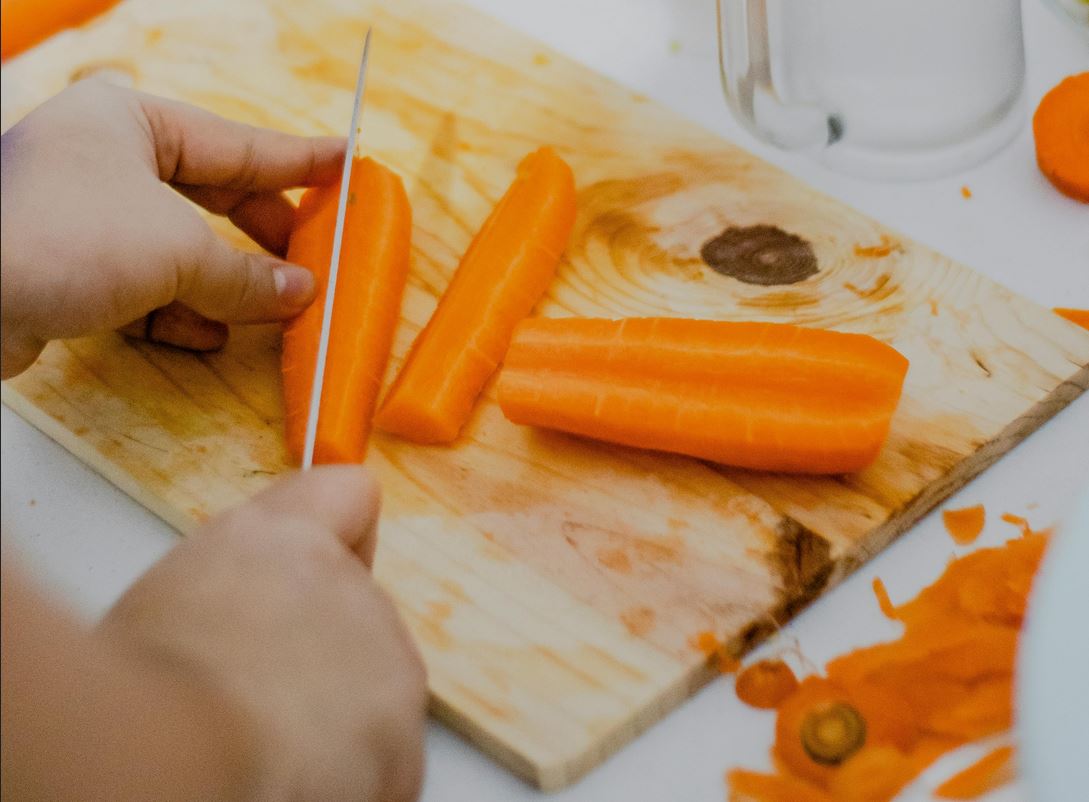
“Hello girls,” I call. A bead of blood blossoms on my skin. I run the tap, washing crimson down the sink. A murmur of response, footsteps retreating up the stairs. The light flickers in the kitchen. I think to follow them, eager to greet Livvie’s friends – but it’s better to meet teenagers armed with snacks. I cut the rest of the carrots carefully into sticks, out of time with that thomp thomp of my heart.
The Otago Daily Times’ headline glares at me from the counter, and I feel a twinge of guilt. The latest missing girl stares at me from the front page. Five, now. Most are from Columba Girls, Livvie’s school. The police don’t know what to do. After number three, the opinion columnists started flooding in: the town is haunted, they say. Books flying off shelves, doors slamming shut. Spectral figures looming near the girls’ houses. Livvie’s obsessed with the stories of ghosts. Their poor parents, I think, staring into the chilly brightness of the refrigerator. Hopefully the police will find them soon. Carrot sticks, dip, kiwifruit, apple wedges. Are they too old for fairy bread? I try to remember what I liked at her age.
I unwrap the loaf of bread and lift the margarine out of the fridge. Healthier than butter. My heart thrums a jagged rhythm I can’t interpret. Livvie’s first sleepover. I feel free and giddy – and weighted and anxious. All churning up inside. Gotta get this right. She’s an unpopular kid, I know. Always by herself, poking at dead bugs and pushing those big glasses up her nose. It’s my fault too, not trying hard enough to get her into dance or drama or gymnastics – something to get her talking to other girls. Other girls talking to her. Perhaps I should have given her a sibling. Why was she never interested in other girls, I wonder?
Fifteen. Soon she’d be a young woman. When she’d announced she wanted a sleepover I’d been caught off-guard. Agreed too quickly. Her face had soured and I couldn’t stop the guilt. You don’t think I can have friends, she’d said, flat affect. A statement. How does one refute a statement? Instead, I’d asked her more questions: what snacks did she want, what time would they be coming over, did she want me to pick up some movies from the video store? None, 5pm, no, the answers had come. They’d go to see a film at Rialto first, she said, pick up food on the way. Don’t disturb us, Mum.
Perhaps I’m wrong to let her have a sleepover; collecting a lot of girls in one place might be akin to tempting fate, I think, sprinkling the hundreds and thousands across the sliced bread. But Livvie has friends! She’s been so interested in witchcraft books lately, I wonder too late whether these girls are even friendship material. Should I have rung their parents, reassured them that Livvie might be odd, but she’s also sweet? Could’ve sought the same reassurance in return. I eye the food, nervous about meeting her friends. Is she at that age where parents are embarrassing?
I pause, listening to the reassuring chatter from upstairs. Livvie’s voice, still high-pitched and girlish, rises and falls with the fervour of a story. I’m surprised to find tears pricking at the corners of my eyes, my heart swelling with emotion. A twinge of guilt at feeling joy for my child when so many parents are worried about theirs. Collecting the plates of snacks and a bag of chips, I trod carefully up the stairs, savouring Livvie’s muffled voice through the walls. The temperature drops suddenly, and I shiver, anxious not to spill the food. It must be quite a story, there’s not a single peep from any of the other girls. I open the door.
My Livvie’s back is to me, her hands raised in oration. Around her are five whispery, ethereal forms. Candles drip wax onto the floor. I drop the tray, fairy bread and carrot sticks skittering away. Livvie turns.
“Mum,” she starts, the I-can-explain dying on her lips. My heart resumes beating; each beat pulsating thickly in my veins. I’m freezing. A pentagram charcoaled on the carpet, a ghost at each point, risen from thick locks of their hair.
“Did you do this?” my voice trembles: from fear or anger I do not know.
Girls. Their faces all paint the same picture, eyes widened into orbs, lips pressed shut, terror exposed. Apple wedges strewn across the floor. Five other girls.
“You wanted me to have friends, Mum,” – accusatory, whining. I stare at her.
Spectral; Livvie’s open curtains and lime walls visible through their too-skinny bodies. The full moon highlights the scene with grotesque silver. I recognise the ghosts from their headlines.
“I never… They didn’t like me. They didn’t… I… This was the only way… You don’t understand…”
My mouth opens and closes, useless. What can I possibly say? She did this to them, I realise, the shock striking like lightning. My hands shake. Bile rises in my throat. Livvie sighs.
“They never wanted to play,” she says, petulant, truth spilling like blood from a wound. “Everything they had to say was boring and I wanted friends that would do what I wanted to do and listen to what I wanted to say and play what I wanted to play.”
The ghosts look at her, their eyes pleading. Kiwifruit crushed into the carpet.
“But… but isn’t this what you wanted, Mum?” she smiles, fragile. My daughter. My Livvie. My eyes find the girls’ faces again, blood thick in my chest.
The ghosts’ lips aren’t pressed shut, they’re sewn.