I finally bit the bullet and signed up for Masterclass. It was great being able to hear from some of the most prominent writers and entertainers of our time—James Patterson, Dan Brown, Joyce Carol Oates, Judy Blume, Walter Mosley, Malcolm Gladwell, Salman Rushdie, and many more.
Whether novelists, screenwriters, journalists, or comedians, they all offered valuable insights on storytelling.
Here are the key takeaways and themes I learned from these masters:
1. Fiction vs. Nonfiction? It’s All Storytelling
One unexpected revelation: fiction and nonfiction writers follow the same storytelling principles. Whether you’re inventing a plot or recounting real events, the goal is the same, to craft a compelling narrative that keeps the reader turning pages.
2. Writers read
The majority of authors find that reading is essential, with Walter Mosley being the exception. His view is that everybody can tell a story. It’s built into us. If you tell a joke you are essentially telling a story. Gossip is really story telling. Still, most agree that reading fuels the craft. A lot of them call out poetry in particular.
3. Writing Habits: Be Ruthless with Routine
Write every day, even when you don’t want to.
Leave yourself a cliffhanger or a prompt for the next session. Dan Brown calls it “setting the table for breakfast.”
If you’re stuck, type “TBD” and move on. Momentum matters more than perfection in that moment.
4. The First Draft is Trash but that’s OK.
Don’t worry about making your first draft good, just make it exist. Expect to throw out a lot of what you write. That’s a normal part of the process.
5. Respect the Reader’s Time
Good writing is tight writing. Shorter is almost always better. Clarity and brevity show respect for your reader and force you to sharpen your ideas.
6. Storytelling is a Muscle
Like going to the gym, you get stronger by doing the reps. Writing regularly conditions your narrative instincts and builds your tolerance for discomfort, especially when facing the blank page.
It’s also interesting to note that many writers mention physical movement (like walking) helping to unlock creative breakthroughs.
7. What Drives a Story?
Keep an open question alive throughout the narrative. Ask yourself:
Who is my hero?
What do they want?
Why can’t they have it?
That tension is what drives the story and keeps the reader engaged.
8. Your Job Is to Entertain
Even literary giants like David Mamet stress this: if you’re not entertaining the reader, they’ll stop reading. Keep them engaged.
9. Dialogue Is Action
The best dialogue:
Reveals character
Sparks conflict
Offers surprises
Avoid dialogue where characters agree. Instead, make characters argue, push back, or reveal something new.
10. Build Your Villain First
Just like you can’t have a front without a back or dark without light, a strong antagonist shapes a strong protagonist. As one Masterclass teacher put it: “Villains define the hero.”
11. Less Is More (Characters Included)
Too many characters muddle the story. Keep your cast lean so the characters, and their desires, stays clear.
12. Endings: Surprise and Inevitability
Two tips stood out:
Brainstorm every possible ending, then pick the most outrageous one that still makes sense.
As David Mamet says: “The end should be surprising and inevitable.”
13. Rewriting Is Writing
No one nails it the first time. Revision is where the magic happens:
Read your work aloud
Let it sit for a few weeks
Be willing to cut ruthlessly
14. Feedback: Use It Wisely
Don’t send your manuscript to everyone at once. Send it to one trusted reader at a time. As you really only get one opportunity for their full attention for that particular story. Sequential readers also allows you to progressively make changes, so the story gets better each time you send it to someone for feedback.
Every writer in the Masterclass series had different styles, and voices but they all agreed that storytelling is craft and skill; the more you practice, the better you get.
So, set your table for tomorrow’s writing session. Get your reps in. And don’t be afraid to write badly. You can always rewrite it later.
Let me know what you think in the comments below. Have any of you signed up for Masterclass? If so, what was your experience and who were some of your favorites?
This week we have a wonderfully touching story by Laura McCorry.
Laura McCorry (she/her) is a writer, yoga teacher, and baking enthusiast who lives outside of Washington, DC. Her work has appeared in Poetry Quarterly. Connect with her at lauramccorry.com or on IG, @lauramccorrywrites
This piece has been [mistakenly] rejected by the following publications:
Analog Science Fiction and Fact
Kenyon Review
LCPL Short Story Contest
Intrepidus Ink
Haven Spec
When I asked her what she loves about this story this was her response:
The desire for more time with our loved ones is universal and it hits the hardest after loss. I really love the question in this piece–what amount of your own life would you give up in order to have another hour with someone who has died? I like that there’s no right or wrong answer. But I also like when magic work-arounds have limits and consequences because death is the one rule we all must obey.
Time is Relative
by Laura McCorry
The baby cries. I roll over, ready to ignore her before I remember Sal’s not here. He won’t change her diaper and bring her to me ever again. I stumble to her bassinet. The room is bathed in silvery shadows from the streetlight outside. The wind whips around the house and the oak tree’s bare knuckles rap against the window pane.
I hold Pearl close to my chest. It’s not supposed to be like this. She cries harder and cries escape my own mouth, a rip tide to her waves. Pearl screams while I change her diaper, screams while I wash, screams as I bring her back to bed with me. She only quiets when I feed her.
If I close my eyes, it feels like before. Pearl is nestled in the center. I can pretend our two bodies curve around hers. I can pretend there was no car crash, no knock on the door, no carousel blur of days I don’t want to remember, but do.
#
Someone is knocking at the door. I’m grumpy about being woken, even though it’s light outside. I pull on a robe, hurrying to get there before they wake Pearl. But it’s not a neighbor or one of the church ladies.
It’s a man in a grey suit who doesn’t take off his hat. He holds a tan suitcase horizontal to the ground and shakes down four collapsible legs.
“I’m not interested,” I say, already closing the door.
He opens the suitcase. Four rows of gleaming brass watches and jewelry catch the sunlight, but it’s the sign inside the lid that’s caught my attention: Time is Relative.
My biggest regret is that I didn’t meet Sal sooner. I spent so many years alone, or with the wrong person, which is worse. And Pearl was our miracle baby. Whenever I complained about those lost years, when we didn’t know each other, before we had Pearl, he always told me, “Time is relative. I’m here now, aren’t I?”
It feels like a sign.
There’s a gleam in the salesman’s eye when I open the door wide.
“Aha, for the young mother with sleepless nights.” He lifts a locket off the blue velvet and holds it up. “Put a picture of your little one on one side and read every upcoming scrape or illness on the other.”
I try to imagine Pearl running on the sidewalk and falling down. Pearl when she’s school-age, lying on the couch with a fever. But all I see is Pearl clutched in my arms in our dark room, crying as if she’ll never stop. And why should she? I shake my head, retreating.
The man holds up a finger. “No, I see now. It’s not the future that troubles you.”
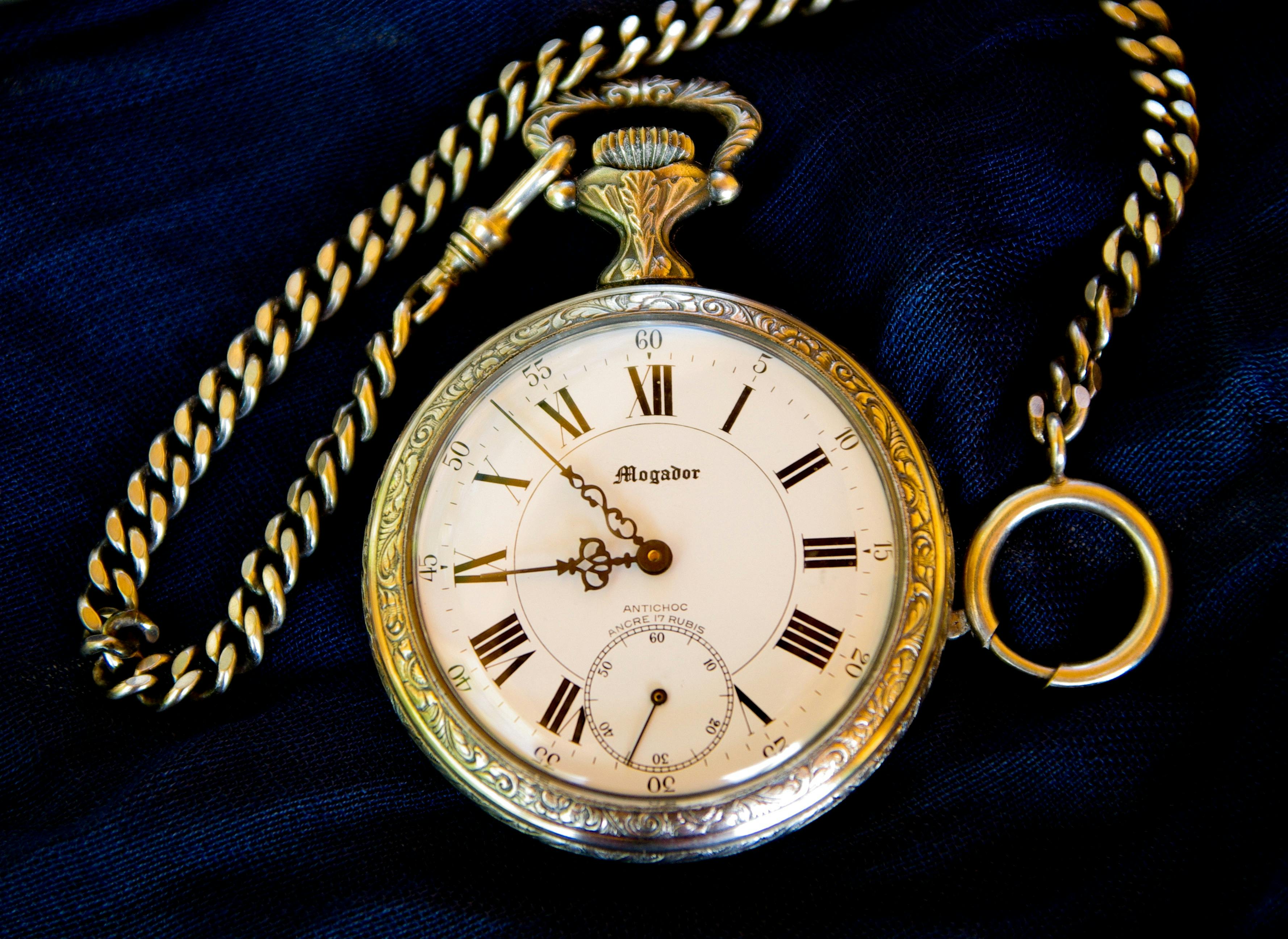
He picks up a long chain. At the end is a golden disc, encircled by a golden band. He flicks the disc and it spins freely inside the band. He stops it and slides his long fingernail along the edge to open a latch. It’s a pocket watch.
“For the lonely heart that wants more time,” he says, holding it out to me.
A bird calls from high in the tree. My eyes stay riveted on the watch. It sways at the end of the chain and I think maybe it pulls toward me. Then it’s in my hand.
“Now, this piece is special indeed.” His voice is honey over cooled magma. “It works just like a regular watch, see? And you never need to wind it.”
The metal backing feels warm in my palm, as if I’ve held it a long time already. As if it belongs in my hand.
The salesman leans forward and indicates a knob on the side. “But if you turn the hands backwards, you can bring back someone you’ve lost for a night.”
My fingers clench it tight, the metal biting into my skin.
“Why one night?” My heart gallops, ready for night even as the sun climbs higher.
“Well, you can have as many nights as you choose,” says the man. It’s hot, but he doesn’t remove his jacket and his brow is dry. A rivulet of sweat rolls down my neck into the too-thick robe I threw on over my breastmilk-stained shirt.
“What’s the catch?” I ask.
“The catch?” He raises both eyebrows, feigning innocence.
“Yeah, the bait and switch, the hidden cost.” I’m holding the watch but it can’t be real. It can’t be what he says it is.
“There’s no catch,” he says, almost laughing. “It’s an exchange.” He taps the sign, Time is Relative. “We can’t go around breaking the laws of physics.”
I narrow my eyes at him. I should put it back. Go inside and shut the door. I should pick up Pearl who is awake now, babbling in her crib. I don’t do any of that.
“You can wind it up to six hours backwards each night. Your loved one will come back to you for that many hours,” he explains.
The watch glints gold beneath my fingers. Pearl starts to cry, wondering where I am. She’s not desperate yet.
“In exchange,” he stresses the word, “you will lose a year off your own life.”
“A year each night?” I ask, calculating.
“A year for every hour,” he says, his voice a loosed arrow.
My heart falls like a stone, crashing against my ribs. It’s hard to breathe. Pearl is crying in earnest now. The man holds my gaze, pretending to wait for my answer, as if he doesn’t already know.
“I’ll take it,” I say. My hand closes around the watch and I hold it to my chest.
The man touches the brim of his hat and shuts the suitcase. I don’t wait to watch him leave.
#
Sal’s place is empty at the dinner table, the watch nestled on its chain on his placemat. Sometime today I became afraid of it. I don’t want to touch it, but I can’t tear my eyes away. Outside the window, the sky is a blaze of orange. Pearl isn’t eating anymore, just throwing her food on the floor.
Inevitability hangs in the air as if I am watching a movie about my own life. I’m waiting for darkness and wondering when it will be night—the question I should’ve asked. I settle Pearl for sleep, knowing she’ll be up again soon.
I walk away from her crib, holding the watch by the chain. The mattress sinks beneath me as I turn on Sal’s bedside lamp. I open the latch. My fingertips grasp the knob and I turn the minute hand backwards. Fifty-seven, fifty-eight, fifty-nine. I’m so careful not to go past the hour mark that my hands are sweating. Then I drop the watch onto the nightstand like a hot coal.
How long do I have to wait? Should I unlock the front door?
Then a weight settles next to me on the bed. I turn and fall against him. My hands on his face, in his hair. His mouth on mine, a magnetic pull I’m powerless to resist. And it’s the same as it’s been a thousand times before. And it’s new because I’m sobbing the whole time.
“It’s okay,” Sal says, his eyebrows drawn together.
He doesn’t know he died, I think.
He smooths back my hair. “It’s okay,” he says again. He always hated to see me cry. But it’s not okay and it’s never going to be okay. His words can’t change anything.
Pearl wakes with a hiccough and a cry. Sal goes to her and she settles on his shoulder. I take a picture with my phone even though it’s dark. Desperate to save something that can’t be saved. Then I go to them and wrap my arms around his waist, resting my head on Pearl’s small back, breathing in her clean scent, feeling the rise and fall of her breath.
It has to be enough. It will never be enough.
#
Sunlight streams through the window when I wake. There’s a delicious moment before I open my eyes when I’m aware of being well-rested for the first time in months. I stretch my legs under the covers, luxuriating in the swipe of cotton against my skin. My body feels lithe and strong, like it used to be before I had Pearl.
I reach for my phone and check the photos. But the last photo is of Pearl in a baby swing yesterday afternoon.
It’s so quiet. Too quiet.
I fling back the covers. The crib in the corner is empty. She just learned how to climb out of it last week. My heart thuds outside of my chest. Panic swells behind my eyes. There’s a noise in the kitchen and I run down the hall.
Pearl is sitting in the middle of the tiled floor. Her chubby feet are touching each other, knees bent for stability. She has a look of intense concentration on her face. Gold flashes against the ceiling. I clutch my chest, panting. She’s holding the watch and her tiny fingers are turning the knob backwards.
There are two books on the art and craft of writing that really resonated with me at the time I read them and have also stayed with me over the years. I have read many other writing advice books, but these two always come to mind whenever the topic of good books on writing happens to come up. (Okay, yes, that is fairly rare, but it does happen.)
On Writing by Stephen King
On Writingis part memoir, part writer’s manual. Since it’s written by King, you would think it would be about how to write horror, but it’s about the craft of storytelling as a whole.
Key Takeaways:
“Write with the door closed, rewrite with the door open.” King emphasizes that the first draft is for you and it doesn’t need to be pretty. The second draft is when you start thinking about the reader.
Cut 10% in revision. Concise writing is clear writing. He suggests trimming your drafts ruthlessly.
The toolbox metaphor. King encourages writers to build a mental “toolbox” of grammar, vocabulary, and style and to always keep adding to the toolbox.
Read a lot, write a lot. King reads constantly and writes daily. He shoots for six pages every day, which is a pace that left even George R.R. Martin stunned. Most writers are not quite that prolific.
Let the story drive the plot, rather than outlining everything. This is not for every writer and gets into the whole Pantser vs Plotter discussion (probably a good topic for another blog post). King is a Pantser, he creates the characters and follows them around. This may also be why I am not in love with his endings.
Adverbs and the passive voice, One specific item that stayed with me from On Writing was to eliminate the use of adverbs and the passive whenever possible.
How to Write Science Fiction and Fantasy by Orson Scott Card
Card’s book is a short, easy read, and one that I couldn’t put down.
Key Takeaways:
World-building starts with what must be true. Card argues that you don’t need to create a full encyclopedia before writing your story, you just need to know the parts that matter. The ripple effects of one change (say, faster-than-light travel) should shape your entire setting and culture. I really liked how he walked through his world-building technique. It was like I was right there with him as he drew out a map on a big sheet of paper, somewhat randomly placing the world objects, then came up with reasons for things to be the way they are and the implications behind them. I am being intentionally vague as to not give too much away.
Know your story’s “moral premise.” Even in genre fiction, your story has a core theme or question. Knowing it gives you a compass for plot, character, and tone. This is also somewhat controversial. Some would argue that the only purpose of fiction is to entertain. Others insist that fiction must have some purpose, often to reflect life and make us think. I probably lean more toward the entertainment side of the argument, but I also think that entertainment serves a purpose.
Milieu, character, and event stories. Card’s MICE (Milieu, Idea, Character, Event) model helps to identify story type, basically where it should start and end.
A Milieu story begins and ends with entering and exiting a world.
A Character story revolves around transformation.
Don’t be afraid to play within the genre but know the rules first. Card encourages innovation after understanding reader expectations. If you’re going to bend the rules, do it on purpose because you understand where the lines are to begin with.
The cost of magic was an interesting concept I hadn’t thought about prior to reading his book. It basically means that there must be some price for magic or characters essentially become gods.
Do these books on writing stand the test of time?
I am not sure if these books would have resonated with me the same way today as they did back when I initially read them, probably 20 years ago now. They were certainly right for me at the time, but I do think the advice is solid and still applicable. If you’re serious about writing speculative fiction, these two definitely deserve a place on your shelf.
Let me know what you think. Are there any books on writing that you found particularly useful or resonated with you?
-James
Note that I linked to where the books are available on Amazon, but you are better off hitting the library or trying eBay. Buying books from eBay and reselling them back is one of my favorite non-library ways to get books. I like the option of keeping it for a long time and not having to remember to return it.
I am honored to share that Lena’s story, The Wondrous Robot, is the first accepted submission for Breaking Into The Craft. Lena is an active member of the Horror Writers Association. A list of her work can be found on the Internet Speculative Fiction Database.
Lena Ng roams the dimensions of Toronto, Canada, and is a monster-hunting member of the Horror Writers Association. She has curiosities published in weighty tomes including Amazing Stories and Flame Tree’s Asian Ghost Stories and Weird Horror Stories. Her stories have been performed for podcasts such as Gallery of Curiosities, Creepy Pod, Utopia Science Fiction, Love Letters to Poe, and Horrifying Tales of Wonder. “Under an Autumn Moon” is her short story collection.
Her book, Under an Autumn Moon: Tales of Imagination, can be found on Amazon
Lena has an impressive list of places that [mistakenly] rejected the story. I very much admire her tenacity in finding a home for this piece!
Brothers Uber: the story was written in 2018 for the prompt of scifi retellings of fairy tales. It was inspired by Pinocchio/Velveteen Rabbit/movie Toy Story/movie AI
Factor 4
Daily Science Fiction
Metamorphosis
Syntax & Salt
El Chapo Review
Harbinger Press
Knicknackery
Shoreline of Infinity
Unsung Stories
Infinite Worlds – not an official rejection but to presume rejection if no reply>90 days so I didn’t include it originally in the count
Cloud Lake Literary
McCoy’s Monthly
Wondrous Real Magazine
Flashpoint SF
Apex
The Arkansas International
Grace & Victory
34 Orchard
Sans. Press
Orion’s Belt
Allegory
Etherea Magazine
Aniko Press
Tree and Stone
British Science Fiction Association BSFA.co.uk
Sprawl Magazine
Metastellar
Flame Tree Publishing
Baubles From Bones
The Orange and Bee
When asked “What do you love about this story?” She responded:
What I love about this story is the idea of a scifi premise told in a fairytale style. Until I saw the prompt, it didn’t occur to me that a futuristic story could be told in a traditional form. I also love the bittersweet ending. Some of my favourite fairy tales growing up were The Nightingale and the Rose/The Selfish Giant/The Happy Prince by Oscar Wilde, along with The Little Match Girl by Hans Christian Andersen; all of them are bittersweet. These were the stories that stuck with me, and I hope my story will stick with the reader.
The Wondrous Robot, by Lena Ng
There once was a robot and he was truly a wonder. He had stout, spring-action legs; he moved his arms with a soft, mechanical whirr; and the alloy of his body shone with a metallic glow. On Christmas eve, he had been hidden behind the tinseled tree, but at the break of dawn, the little boy, who had begged for an iBot all year, soon spotted him with a wide-eyed yelp.
Many other things were excitedly unwrapped from the joyous abundance under the tree: toy hover cars which zipped around the room; space hockey sticks with an anti-gravity puck; from a projector, a 3D hologram of the Blue Fairy fluttered through the pine branches of the tree, waving her slender silver wand.
What the robot wanted to say, what lay deep in his processor was “I hope to be your best friend.” But he wasn’t programmed to say this so he said, “I like ice cream.”
At first, the little boy, a rambunctious, sweet-faced kid named Ryan played with him every day. He pushed a switch to make the robot’s halogen eyes flash. He pressed the small red button on the robot’s back and the toy would dance a mechanical breakdance. He confided in the robot who replied with his programmed lines of “Let’s go on an adventure”,”Kids rule” and “We’re on a mission.”
Eventually, the robot was left plugged into a charger in the corner of the room. Even though he was fully charged, the little boy instead played space hockey with a neighbourhood boy, and not a second thought was given to his robotic friend. As the little boy played on the purple grass on the lawn, the little robot wished with all his circuits that he could join him.
The other toys—VirtuPets, dinotrucks, hatchisaurs—jealous when the robot was the favourite, openly ignored him. They had thought the robot had his time with the boy and now attention would be paid to them. But the attention spans of little boys are short and the next new toy was always on the horizon. Only the Blue Fairy would stop her fluttering around the room to speak to the robot. She had also felt the sting of being forgotten.
One day, as the Blue Fairy hovered overhead, the little robot watched wistfully as the little boy wrestled on the bedroom floor with his new puppy. They tumbled and turned and the puppy let out some high-pitched barks. After a breather, the little boy took the puppy out to the backyard. The robot’s head drooped when he heard the back door close. “Blue Fairy,” he said, “do you think the little boy would play with me if I were real?”
The Blue Fairy darted around him, examining all his angles. She said, “You are already real.”
The robot felt his processor race. “Not to the little boy. Not in a way that would have him love me.” The robot made a whirring sound which could have been a motorized version of a sigh. “If I could wish anything, I would wish I were real.”
The Blue Fairy waved her wand like an orchestra conductor. “Some day you will be real. As real as the puppy. As real as the little boy.” She had the power to grant wishes, as all fairies do, when the wish came from a true heart, even if it happened to be a microchipped one.
The robot had so many questions. “When will this happen? How would I know that I’m real?”
The Blue Fairy gracefully landed before him on satin-clad toes. “All real things dream. One day, you will do something so wondrous your head will fill with dreams. That’s how you will know you are real.”
Sadly, that night, the projector’s battery ran down and the Blue Fairy disappeared. The robot would have liked to discuss dreams and what it would be like to be real and be loved.
Late Saturday morning, when the little boy was sent to his room for a time-out, he discovered his robot again, still charging in the corner. The boy pushed the switch to make the robot’s eyes flash. He pressed the small red button on the robot’s back and the toy would dance a mechanical breakdance. He confided in the robot who replied with his programmed lines of “Let’s go on an adventure”,”Kids rule” and “We’re on a mission.” The boy and robot raced the hover cars around the room. The puppy barked and bowed and jumped all around them.
The robot shouldn’t feel, since he was made of wires, metal, and cable, but as a third generation model, when the robot saw the little boy smile, he felt a trembling in his circuits. When the little boy put his arms around him, the robot felt a rise in his internal temperature, in a pleasant way, and his core processing speed would slow so he wouldn’t overheat.
Later, the little boy took both the robot and puppy into the front yard. They raced the toy hover cars over the purple grass. But as little boys sometimes do not know the difference between make-believe and real, Ryan ran to see a real hover car, zipping on the superhighway in front in the house. The robot, however, understood the size difference between a toy and a car, and the little boy and a car, and rushed out to save his dear companion. Maybe for love, but robots…how could they love?
And there was a crushing of steel and the crying of a scared but otherwise uninjured child. The light in the robot’s eyes started to flicker, and the Blue Fairy appeared once more, wings translucent as sapphire. The robot looked but saw no projector. “How are you here?” the robot asked.
“I’m in your dreams,” replied the Blue Fairy.
“Then I’m finally real,” the robot cried out with joy, and under the bright moonlight of Io, Europa, Ganymede, and Callisto, the light in his halogen eyes was extinguished.
I remember the first time I received my assigned slush (story submissions) from the editor of Allegory. Twelve unread submissions, each hoping to land in the publication. It was exciting, daunting, and very eye-opening for me. Once into a routine of reading stories for a publication, you can really get a feel for which kinds of stories editors see too often and what makes one story stand out from the pile.
Here are some of the common problems I came across when reading slush:
Telling instead of showing
There is a ton of information on this out there already, but in essence, telling is useful for moving through information quickly, but at the potential cost of distancing the reader. Showing brings us into the story and paints a picture in detail.
The blurb I used when providing feedback went like this: Telling has its place. It works well for quickly covering a lot of ground, but it tends to distance the reader. We would much rather see the bouncing knee and infer the character is anxious as opposed to reading “Bob was anxious.”
A lack of conflict
Sometimes everything was fine for the character, too fine, actually. With no conflict, there’s no story. I think this can happen to a writer sometimes when they really like their character and don’t have the heart to put them through any hardship. But that hardship is needed to drive the story forward.
Scenes vs stories
This is where there is an often extensive description of the character and his/her world but nothing that resembles a story arc. The character is just hanging out at a bus stop, eating a sandwich, and waiting, and in the end, nothing has really changed (other than the sandwich is gone). Sometimes these scenes can even be beautifully written, but without a story arc, these pieces are not interesting enough to pass on to the main editor.
This one often occurs in conjunction with the lack of conflict problem.
Slow development
This is the one I saw the most. It’s when a story takes way too much time to get to the core conflict. For a 5000 word story, if I am past page three or four and don’t know what the conflict is about yet, I am probably going to pass. I also saw a lot of stories where the intro paragraph could have been omitted and the story would have been better for it. Not that the intros were necessarily bad, but often times it was unneeded. I feel like this probably happens a lot to the “Pantser” style of writer. The ones who hop in the chair, shift the keyboard into Drive, and start writing without an outline. If you operate this way it can take a bit to get the flow of the story headed in the right direction.
No ending
This one was also a frequent occurrence. Sometimes the story was really good and kept me going, but then just ended. The stories that were the most unfortunate were the ones that had a clear way to end, or several ways to end, but just stopped. In order for the reader to feel fulfilled with a story, things need to wrap up at the end in a satisfying way. The more unique and surprising the ending the better.
Downer endings
A lot of the stories coming through the slush pile end with a downer ending. It’s not that a downer ending is wrong or bad, but slush readers see a lot more of those than upbeat positive endings. You absolutely don’t have to write a happy ending but if you do, and it’s well done, your story will stand out for that alone.
Flow
Tiny issues, like awkward phrasing or inconsistent tone, can pull you right out of a story, even one with a great idea and is otherwise clear and well-paced.
One other secret I learned:
Feedback to Writers
As a slush reader, I decided early on that I wanted to offer personalized feedback whenever possible. Instead of sending the standard “not a fit for us at this time,” I made myself articulate why a story didn’t work for me.
That discipline really sharpened my editorial instincts for my own work. If you ever want to learn what makes a story effective, try forcing yourself to explain what did and didn’t work. The times you find this really challenging is when you are learning something new.
Here are a few insights I picked up about when a story is good:
If you find yourself thinking about a story you read hours or days after reading it, it has something special. A lot of times for me it was some concept the story covered (Sci-Fi nerd here). Sometimes it was a character or a character trait. I recall one story to this day where the monster had a pillow for a head. That kind of simple, clear, and unique, imagery is the sort of thing can make a story stick with a reader long after they finish it.
You shouldn’t have to work at reading or understanding a story. As soon as I have to reread a sentence to understand exactly what is happening, the story is starting to lose me. A few more of those and it’s a rejection. I liken it to a trip in the car. If the road is bumpy and you have to go around fallen trees and are always unsure of where you’re going, it’s not an enjoyable ride.
Another great sign is if you immediately want to tell someone else about the story. If you get done with a story and think “Oh, man, so-and-so would love this.” Try to take note of what made you feel that way. It’s not always easy to do, but the more you do the exercise of pulling apart a story to understand how the pieces fit together and work, the better you will get at writing a great one.
Reading slush to see the other side of short story publishing and choosing to provide authors with feedback accelerated my growth as a writer. If you’re serious about breaking into the craft, I recommend volunteering to read slush. There is a lot of need out there. You will probably be able to make a connection pretty quickly on your own, but email me if you want me to put you in touch with an editor in need.
When it comes to writing dialogue, one of the most overlooked yet fundamental elements is the dialogue tag. These are the little phrases that let the reader know who’s speaking, your basic he said, she said, and their many cousins. While often invisible to readers, dialogue tags can shape the rhythm and style of your writing. Used well, they become nearly imperceptible; used poorly, they bog down pacing.
Why Eliminate Tags When Readers Ignore Them?
There’s a common theory that simple tags like he said and she said are so familiar to readers, they fade into the background. I find that’s mostly true. These standard tags don’t add much flavor, but they also don’t seem to distract.
Still, the way you use or avoid tags can have a real impact on the density of your writing, or, in other words, how much meaning you pack into a small space. This is something I always aim for: cleaner, leaner writing that communicates more with fewer words. Tagging is an ideal place to apply that principle.
Reducing Tags with Context Clues
When only two characters are speaking, it’s often possible to eliminate tags entirely. If the rhythm is clear and the personalities distinct, readers can follow without constant reminders. That said, tags still serve a purpose, especially when a line could reasonably belong to either character. Clarity is king, always keep that in mind (don’t worry, I’ll mention that again because it’s that important).
Sometimes, you can imply who’s speaking with a line of action or description before the dialogue:
Example:
Maria leaned over the counter, squinting at the receipt. “This isn’t what I ordered.”
No need to write Maria said, we know it’s her. You can do this after the line, too:
Example:
“This isn’t what I ordered.” Maria leaned over the counter, squinting at the receipt.
In both cases, the dialogue is anchored by the action, creating a more dynamic feel than using a tag.
When There’s More Than Two
I recall learning early on, like back when I was crafting stories on my Apple II, that scenes with three or more characters, are tricky. Tags or identifiers become a lot more important for keeping characters straight. This is where you might need to use names more frequently, and where relying solely on action or tone isn’t always enough.
Example:
“We should wait until morning,” Jenna said. “No way. We go now,” Marcus said. Dave shifted uneasily. “I don’t think we’re ready.”
The key is clarity. Keeping prose tight, is great, but clarity should never be sacrificed. (2nd mention)
Let the Voice Do the Work
A well-drawn character can sometimes be identified just by their way of speaking. Vocabulary, rhythm, and tone can all signal who’s talking. This particularly holds true when readers are already familiar with the characters.
Example:
“Dude, you can’t possibly wear that.” “Why the hell not?” “Because it screams desperation, man.”
Even without tags, this mini-exchange might be clear if the voices are distinct—a haughty critic, a defensive teen, and a snarky best friend.
Still, this technique only works reliably when the characters are well-established and the dialogue is unmistakably in character. Otherwise, be kind to your reader and drop in a tag or cue.
Beware the Tom Swifty*
This brings us to one of the more interesting pitfalls: the Tom Swifty—a punny or awkward use of an adverb in a dialogue tag.
“I love you,” he said romantically. “That’s a terrible idea,” she said nervously. “We’re under attack!” he shouted loudly.
Then there’s the punny kind:
“I dropped my toothpaste,” Tom said crestfallen.
“I swallowed some food coloring,” Tom said dying inside.
“My pencil’s broken,” Tom said pointlessly.
“I’m no good at darts,” Tom said aimlessly.
“Let’s dig up the body,” Tom said gravely.
“They took out part of my brain,” Tom said absentmindedly.
Most of the time, these adverbs are redundant and often clunky. If the emotion is already clear from the dialogue or the scene, there’s no need to spell it out in the tag. Worse, it can also seem amateurish and this kind of groaner “funny” can take the reader out of the story. With that being said, Issac Asimov was known for including puns in his fiction.
Instead, convey emotion through the line itself or the character’s actions (this also touches on showing vs telling).
Better:
“I love you.” He touched her hand.
“That’s a terrible idea.” Her fingers tapped the table.
Less telling, more showing.
Efficiency Without Losing Emotion
The best dialogue tagging blends into the background, serving the story without drawing attention to itself. Use he said/she said when needed. Drop the tag entirely when you can anchor dialogue with action or voice. Avoid over-relying on adverbs (really, eliminate them altogether, if you can), and aim for clarity first and foremost (3rd mention).
As with most writing advice, these aren’t hard and fast rules but guidelines to keep in mind. The more efficiently you can convey who’s speaking, the more space you create for what matters most: why they are saying what they’re saying, and how it moves the story forward.
-James
*When they are done for humor alone, Tom Swifties can be rather entertaining. Check out Thomwall.com for some really fun examples of this.
** I would be remiss it I didn’t link to this song.
I’m approaching 200 submissions. It sounds like a lot, but I started in 2010, so that only averages to a little over 13 submissions per year.
Note that I am only counting acceptances where I got paid for my story and not places like CAB Theater that picked up one of my comedic pieces for free and performed it on stage. I didn’t get to cash in on that one, but I did get to sit in the audience while the actors performed my words, soaking it in as they got the biggest laugh of the night out of one of my jokes. And, honestly, that was way better than getting paid.
My acceptance rate is about 5.8%. While that isn’t quite stellar, it does seem to be better than averages reported by the Submission Grinder for many of the markets I stalk.
This gives you a feel of how difficult it can be to land a piece. Just looking at the odds for every 100 stories you submit you can expect to land less than two. There are some markets, like Anotherealm, and BSF Horizons that have nice fat acceptance rates of 12.5% and 33.33% respectively. But these appear to be the exceptions to the rule.
I would also be remiss if I didn’t mention Allegory, which has an acceptance rate of a little over 2% and UFO publishing (They are closed now, no acceptance rate is listed at the Grinder). I was a first reader for several years at both of those publications.
I have also noticed a dip in acceptance over my last 50 submissions or so. If I calculate everything preceding those 50, I have a nearly 8% acceptance rate. Either I am getting worse (entirely possible, if not likely) or the market for short fiction is getting tighter. For the benefit of my own morale, I am going to choose to believe it’s the latter.
So what can we do to hedge against the ever increasing odds?
We do the only thing that has ever worked: create more content and hone our skills along the way.
And continue to have a lot of patience.
From the odds I can only expect to land fewer than 2% of the stories I submit, but improving the quality of my writing should give me an edge.
Or we can take the Han Solo approach — Never tell me the odds!
Comment below to let me know what your submission journey has been like. I’d love to hear from other writers grinding it out.
Unbeknownst to me, my wife of 13 years went through my writing files and read a bunch of my stories. She made little notes at the end of some of the pieces — the kind of notes that non-writers tend to make like: “This is good hon, you should keep going” and “I’m not sure I like this one,” and my personal favorite “Do better with this one. Maybe start over?”
As much as we love it when people read our fiction, general feedback like that has little value outside of encouragement (or, in my case, discouragement). So I thought I would talk to her to get a better understanding of what she thought of my writing overall.
The main takeaway she had for me was that my writing was very “soulless.”
Soulless.
I can’t think of anything that can gut-punch, cut to the core, donkey kick to the back of the head, a writer any harder than telling them their writing is “soulless.”
I recall I felt like crying. I don’t remember if I did but even writing about it now makes me tear up a little so, yeah, I probably did.
I have a philosophy that when you get feedback from a reader, no matter how much you disagree with what they say — every reader is right from their own point of view.
That makes sense, right? Your perspective is colored by your own personal experience, so the stories you read will be colored that way as well. It’s actually kind of a fun and useful thought: every story is unique to each reader.
But soulless… really, hon?
I had to accept what she was saying to stay true to my philosophy. I had to look at my writing through her eyes and see what she was seeing. And scariest of all, I even had to peer inward.
Eventually I came to understand what she was getting at. My stories lacked both stakes and characters the reader cares about. Those two things are related by the way.
The inward part came later, when I finally understood why I was writing that way. It came down to me not being comfortable putting my characters into really difficult situations — which is kind of silly when you think about it. That’s what conflict is: the difficulty engine that drives a story. Conflict raises the stakes and makes you care about what happens to the characters. The bigger the challenge, the better the payoff.
I did see a slight bump in my acceptance rate after I put my main characters in tighter spots, but more importantly, the stories felt more alive and real.
I learned that acceptance letters may feed my need for validation, but loving what I write feeds my soul.
I saw somewhere that The New Yorker gets half a million unsolicited submissions per year. Let that sink in for a second.
Half a million.
That’s a serious slush pile.
But I did notice that famous people are constantly getting published in the magazine. This makes sense for The New Yorker. No matter how good the piece is, why take a risk on an unknown when you can tap celebrities whose names will draw in readership. We are all beholden to someone or something, publications need content, but they need readership first and foremost. And this strategy worked on me. I ordered some old issues of the magazine on Ebay and saw that Bob Odenkirk had a piece under their Shouts and Murmers section. Bob is a very funny actor and comedian. I loved him in Better Call Saul. His piece in The New Yorker, entitled A Biblical Rough Draft, was just OK though.
Don’t get me wrong, there were some incredibly funny phrases, like one part where he refers to biblical storytellers as those who “tromped from village in floppy sandals, swatting at flies, sipping beads of dew from the undersides of donkeys, and fighting dogs for scraps of meat.” That donkey thing—that’s my kind of humor. But overall, the piece was not nearly as funny as I would have expected.
I can’t help but think that Bob’s fame played a significant role in him landing that piece. If a complete unknown (like Yours Truly) had written the exact same words, I am sure it would have been rapidly rejected. We could rebel and shout “The world isn’t fair!” and “They should evaluate the story on its own merits, no matter who wrote it!” And while I do agree with the idealism of the latter, my belief is that the world is fair. Bob worked hard to obtain fame. Having an inside track to publication is one of the fruits of his labor. And can you blame the magazine for using the tactic of publishing the work of celebrities? Bob is a very safe bet. Prestigious literary publications, places like The New Yorker, The Atlantic, or The Onion have reputations that could be damaged if they publish writing from an unknown author and it turns out that person is a white supremacist, or a cannibal, or worse yet, a cannibal white supremacist racially-biased to eating only Caucasians.
Okay, so maybe “just get famous” isn’t practical advice. To be honest, if I had this completely figured out, you would have already heard of me before stumbling across this post.
So, what am I doing to stand out?
My strategy is to go wide and deep — but with quality! I am writing every day to generate content, working hard to refine it so that it stands out when it is eventually considered, and submitting all the time. Right now, I have ten stories out for consideration. I figure if my name starts to look familiar to the editors, they will know I am taking my writing seriously.
As a tactic I mentioned in a previous post, I am also targeting a specific market: Points In Case. I am tailoring my writing to fit that market. It will be interesting to see whether this strategy improves my acceptance rate.
I will keep you posted as to how well this works — at least until I get famous and don’t have to worry about silly things like having a “strategy” anymore.
Let me know in the comments below whether you have a strategy for standing out in today’s sea of competition. I am interested to hear your thoughts!
I’ve heard that doing the same thing over and over again and expecting a different result is the definition of insanity. For fiction writing there is truth to that, as you have to be a bit insane to pursue fiction writing with an expectation of getting paid to do it.
The saying has me thinking about changing my approach to see if I can a few more land sales.
My current process is:
Wait until inspiration strikes (if ever) and write a story
Find a market that the story might fit and submit
Get a rejection then GOTO step 2
A better approach might be to:
Target a market that suits me
Write something appropriate for the market and submit
Get a rejection and GOTO step 2
The new approach requires me to abandon that whimsical, spur-of-the-moment, writing that occurs when an idea for a story hits me. There is fantasy in my head that all of the great fiction authors operated by writing whatever the hell they felt like. It feels wrong to force myself to deal with the hand-cuffing constraints of catering to a specific market. My creative side wants its freedom, dammit!
But there is also an analytical side of me that likes this surgical approach — dissecting the stories they have bought, feeling through the structure, the language, looking for the fingerprints in the tales that made those first readers and editors salivate like Pavlov’s dogs.
So who is my victim target market?
I have picked out Points in Case. They do funny well and I do like me some funny. They publish funny lists and I feel like a funny list is a reasonable bar to hurdle; the word count is relatively low so my thinking is that I should be able to come up with list stories pretty quickly.
In practice, however, making a funny list is harder than it seems. As the individual “funny” items are added to the list, you start to question your ability to determine if something is funny or not. Sometimes things I think are funny are just weird, or worse yet, offensive.
I have already submitted one list story to P.I.C., which was promptly rejected. I currently have another one sitting with them that I like a lot better. Whether or not it gets accepted is up to the fiction gods at this point (and we know how finicky they can be) but, then again, that’s all part of the craft.
Have you tried writing to specific markets before? If so, let me know in the comments how that worked out for you.








 Breaking Into The Craft