Tag Archives: Struggling Writer

Why It’s Hard for Us to See Where Our Stories Go Wrong?

You’ve written a story. You’ve poured your heart into it. You’ve rewritten sentences, perfected metaphors, and shaped characters you care deeply about. You’re sure it’s good, hell, maybe it’s even great. Yeah, the big names will want this one. It’s probably worthy of The Atlantic or the New Yorker. This could even be the one that finally nails the Pushcart Prize.

Then the wind goes out of your sails when the first person to read your masterpiece points out how you spelled the name of your main character differently in two places in the opening paragraph. How could you have missed that? You must have read through the story a hundred times with all the rewrites. It’s embarrassing and aggravating.

And it’s one of the most fundamental truths in writing: it’s incredibly hard for us to see the flaws in our own work. Here’s why:

We’re Too Close to the Story

Writers live inside the world they’ve created. We know every motivation, backstory, and all the subplots. The backstory that isn’t on the page lives in our heads “rent free” as the kids say. We mentally fill in all of the things we know about the story as we read through it. Your brain fills in the gaps, smoothing over inconsistencies and connecting dots that were never actually drawn and not clear to other readers.

We’re Emotionally Invested

We writers form emotional bonds with our characters and often fall in love with select scenes and phrases. This emotional attachment can make us blind to, or cause us to push back against, needed changes. Cutting scenes and characters, also known as “Killing our darlings” as the saying goes, feels like a loss to us even though it usually makes a story stronger.

Sometimes we don’t really know the Story We’re Telling

We often begin writing with an idea but no clear theme. Or we have a theme but it gets lost in the logistics of plot development. The result is a story that meanders or contradicts itself. I also tend to see a lot of what I call “lopsided stories” where way too many words are spent on things that do not advance the plot or develop the character.

Hard Work Doesn’t Make It Good

We sometimes confuse “I worked hard on this” with “This is the best it can be.” But hard work doesn’t guarantee a polished end result. Rewriting, re-envisioning, and sometimes throwing everything out and rethinking it from the ground up, often lead to better storytelling.

Our Brains Want to Be Done

Writing is hard. Getting through that first draft is a triumph. So when we type “The End,” part of our brain wants it to be done. The desire to move on and submit makes us less critical of our work. We stop interrogating where the story doesn’t work.

So What Can You Do?

  • Time: Step away from your draft. A few weeks or even months can give you enough distance to see it with fresh eyes. Sometimes when I go through my “false starts” that I haven’t touched in years, I am surprised at what I see. It often feels like someone else wrote the words I am seeing. (and I mean that in both in a good and bad way).  This is the ideal kind of distance you want from your work, where you have forgotten about the story entirely and are coming at it completely fresh. Unfortunately that isn’t always practical.
  • Read your work out loud: A more immediate solution is reading your story out loud. In Steve Martin’s Masterclass he talked about how he reads his work to his cat. I will even record myself reading a story so I can play it back later and really listen. Hearing your story often reveals awkward pacing, unclear dialogue, or tonal shifts you might miss otherwise.
  • Re-outline: After the first draft, take the time to outline what you actually wrote. It often differs from your plan and can reveal plot holes. One trick I have learned, especially if if I have “pantsered” a story is to force chapter breaks and title those breaks in the story as though they were chapter headings. I do this even though I am mainly writing short stories, which don’t usually have chapter titles. It really helps me to see the plot progression and where I have sections that repeat information previously covered. It also really helps me to see where I can cut.
  • Get feedback from others: Other people have a fresh set of eyes and the advantage of knowing nothing about the story. No preconceived notions, no biases (other than these people are likely your friends so they might be softer on you than you need). Issues we tend to read past will stand out to them like a neon sign.  

Recognizing that we have literary blind spots is the first step toward better writing. Every great story was once a messy draft, written by someone who couldn’t see the flaws, until they eventually found a way to work through them, often by giving a story time and/or getting feedback from others.

-James
It’s possible I might not be that funny

After several submissions to places that publish funny stuff, and the corresponding rapid-fire rejections, I am starting to come to the realization that I might not be that funny.

I feel like there was a time when I was funny. Like, back in high school… maybe. But that was a long time ago and thinking back, it’s probably more likely people were just too polite to tell me that I was annoying.

Or it could be the soul-crushing life-sentence of working a regular eight-to-five job that took the wind out of the sails of the good ship Fun Times.  You would think an Engineer with a sense of humor would be a breath of fresh air for most companies, but in reality people just think you’re weird when you tell a joke while holding a schematic.

Or maybe I am weird. I’m a grown man with a Steam account who can quote Rick and Morty and I also built my own robot arm making parts via my 3D printer. Yes, that’s all cool stuff, but not when you’re old. And no, I’m not telling you my age, but for reference, I took my daughter to Open Sauce last year (a YouTube “maker” event) and I didn’t think I was that much over the average age until someone congratulated my daughter on getting her grandpa to come.

I used to go out of my way to be funny at work. I remember a time when I bought one of those monstrously oversized Valentine’s Day cards, signed it “Love, Richard” and left it for Tony our IT guy. Richard was our salesman that always reminded me of the desperate guy on Glenn Gary Glenn Ross who rambled on about the leads, which made the joke even funnier to me.  I think Richard was actually kind of pissed about the whole thing. That also made it funnier.

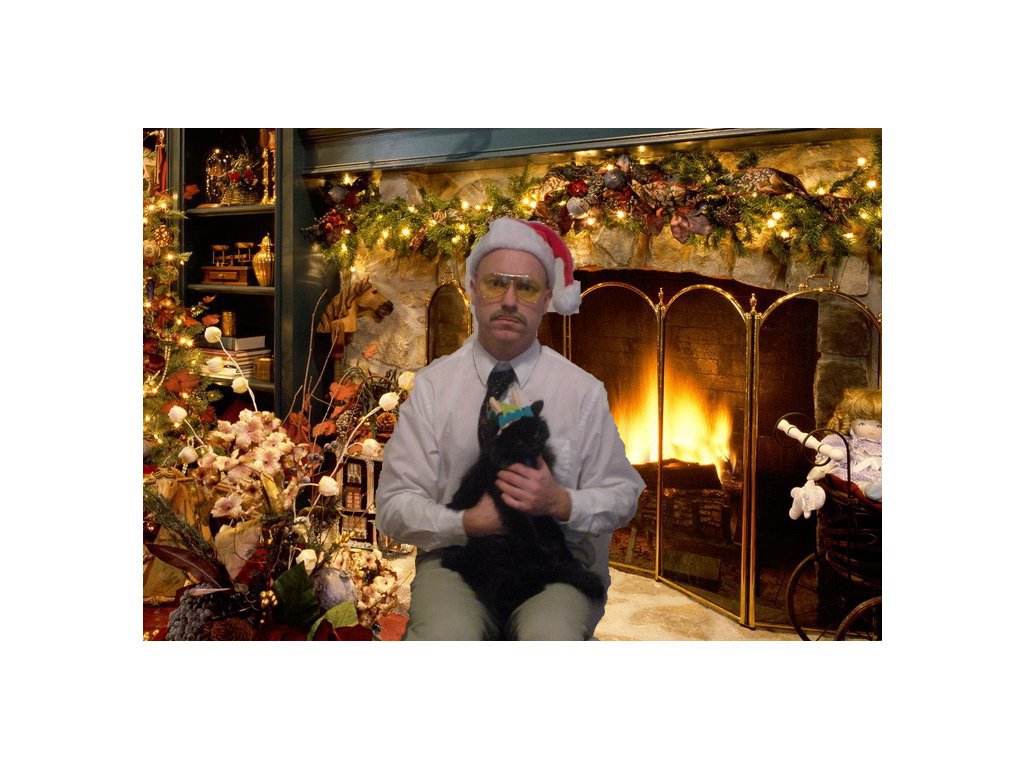
Or there was the time I sent out a Christmas card that was just a sad picture of me with my cat, where I wore shooter glasses and had on a fake mustache and intentionally did a bad job of photo-shopping in a background that was way too nice to be my house.  The day after people got the card in the mail, I received a standing ovation at work.  So, yes, that was funny. Okay, weird funny, but funny.  At least to everyone but my future wife. We were dating at the time, so I sent a card to her.  She didn’t think it was funny at all and later told me she was questioning going out with me after that.

And just when I am rethinking my ability to be funny, wouldn’t you know it, one of my humorous pieces gets picked up by Chortle: Things my lawnmower does better than me.

So the whole point of this is that everyone has doubts. We just need to keep pushing through and trust we are doing the right things. And if we find out we’re not, hey, at least we are learning something along the way.

Let me know what you think in the comments below.

-James


200 Submissions Later

Lessons from the Long Game of Getting Published

I’m approaching 200 submissions. It sounds like a lot, but I started in 2010, so that only averages to a little over 13 submissions per year.

Note that I am only counting acceptances where I got paid for my story and not places like CAB Theater that picked up one of my comedic pieces for free and performed it on stage.  I didn’t get to cash in on that one, but I did get to sit in the audience while the actors performed my words, soaking it in as they got the biggest laugh of the night out of one of my jokes. And, honestly, that was way better than getting paid.

My acceptance rate is about 5.8%. While that isn’t quite stellar, it does seem to be better than averages reported by the Submission Grinder for many of the markets I stalk.

This gives you a feel of how difficult it can be to land a piece. Just looking at the odds for every 100 stories you submit you can expect to land less than two. There are some markets, like Anotherealm, and BSF Horizons that have nice fat acceptance rates of 12.5% and 33.33% respectively. But these appear to be the exceptions to the rule.

I would also be remiss if I didn’t mention Allegory, which has an acceptance rate of a little over 2% and UFO publishing (They are closed now, no acceptance rate is listed at the Grinder). I was a first reader for several years at both of those publications.

 I have also noticed a dip in acceptance over my last 50 submissions or so. If I calculate everything preceding those 50, I have a nearly 8% acceptance rate.  Either I am getting worse (entirely possible, if not likely) or the market for short fiction is getting tighter. For the benefit of my own morale, I am going to choose to believe it’s the latter.

So what can we do to hedge against the ever increasing odds?

We do the only thing that has ever worked: create more content and hone our skills along the way.

And continue to have a lot of patience.   

From the odds I can only expect to land fewer than 2% of the stories I submit, but improving the quality of my writing should give me an edge.

Or we can take the Han Solo approach — Never tell me the odds!

Comment below to let me know what your submission journey has been like.  I’d love to hear from other writers grinding it out.

-James

Writing with soul

Unbeknownst to me, my wife of 13 years went through my writing files and read a bunch of my stories. She made little notes at the end of some of the pieces — the kind of notes that non-writers tend to make like: “This is good hon, you should keep going” and “I’m not sure I like this one,” and my personal favorite “Do better with this one. Maybe start over?”

As much as we love it when people read our fiction, general feedback like that has little value outside of encouragement (or, in my case, discouragement). So I thought I would talk to her to get a better understanding of what she thought of my writing overall. 

The main takeaway she had for me was that my writing was very “soulless.”

Soulless.

I can’t think of anything that can gut-punch, cut to the core, donkey kick to the back of the head, a writer any harder than telling them their writing is “soulless.”

I recall I felt like crying. I don’t remember if I did but even writing about it now makes me tear up a little so, yeah, I probably did.

I have a philosophy that when you get feedback from a reader, no matter how much you disagree with what they say — every reader is right from their own point of view.

That makes sense, right? Your perspective is colored by your own personal experience, so the stories you read will be colored that way as well. It’s actually kind of a fun and useful thought: every story is unique to each reader.

But soulless… really, hon?

I had to accept what she was saying to stay true to my philosophy. I had to look at my writing through her eyes and see what she was seeing. And scariest of all, I even had to peer inward.

Eventually I came to understand what she was getting at. My stories lacked both stakes and characters the reader cares about. Those two things are related by the way.

The inward part came later, when I finally understood why I was writing that way. It came down to me not being comfortable putting my characters into really difficult situations — which is kind of silly when you think about it. That’s what conflict is: the difficulty engine that drives a story. Conflict raises the stakes and makes you care about what happens to the characters. The bigger the challenge, the better the payoff.

I did see a slight bump in my acceptance rate after I put my main characters in tighter spots, but more importantly, the stories felt more alive and real.

I learned that acceptance letters may feed my need for validation, but loving what I write feeds my soul.

What do you do to add soul to your writing?

-James

So, I guess it’s been a while…

I intend to resume posting on a regular basis — right now a weekly cadence seems right to me, but I know how fast that kind of deadline can creep up on a person, so don’t hold me to it just yet.

I will add in more writing resources as I come across them. While I am using this blog to share my writing journey, I also intend to share the tools I find along the way.

Believe it or not I actually have been writing and have even landed a few more stories than what I have listed here. I will update my progress and make sure to let you know about any stories I happen to land in the future.  

Also, I have been thinking about setting up a site (or possibly using this one) to publish fiction from other authors.  There is an abundant of supply of short fiction and very little demand, so that might be a good way for me to do my part to help balance things out a bit. Who knows I might even be able to figure out a way to pay authors for their work.

Let me know your thoughts below — assuming there is anyone left reading this blog to have thoughts.

-James

Fate Forward

Fate Forward is a story I wrote about a private investigator type guy searching for a mysterious device. It’s later discovered that the device can manipulate luck. The story goes on to reveal how this man beats the odds to retrieve the device and his internal battle as to whether he should return it or use it improve his own station in life.

I submitted this 6700 word story to Asimov’s Science Fiction Exactly one month ago, 7/11/10, via their online form.  Here is the e-mail rejection I received today:

Thank you very much for letting us see "Fate Forward."  We appreciate your taking the time to send it in for our consideration.  Although it does not suit the needs of the magazine at this time, we wish you luck with placing it elsewhere.

Please excuse this form letter.  The volume of work has unfortunately made it impossible for us to respond to each submission individually, much as web

Sincerely,

Sheila Williams, Editor
Asimovb

Sheila, what kind of ending is “much as web”?  You must REALLY have a volume of work to end the e-mail so abruptly.

Did you find out the bacon was burning while typing and just hit the “send” button anyway?

The sad part is that the letter refers to itself as a “form” letter, so this is apparently what everybody who failed to place a story is getting.

I am not sure what “asimovb” means at the closing either. Perhaps some sort of secret code?  Maybe I made it to grade “b” in the rejection pile or something.

The part I did think was cute was how the letter wished me “luck” in placing it elsewhere. I am sure it’s just a coincidence, but the story I sent in revolved entirely around the concept of luck.

James