Category Archives: Writing Advice

Two Books that changed how I write

There are two books on the art and craft of writing that really resonated with me at the time I read them and have also stayed with me over the years. I have read many other writing advice books, but these two always come to mind whenever the topic of good books on writing happens to come up. (Okay, yes, that is fairly rare, but it does happen.)

On Writing by Stephen King

On Writing is part memoir, part writer’s manual. Since it’s written by King, you would think it would be about how to write horror, but it’s about the craft of storytelling as a whole.

Key Takeaways:

“Write with the door closed, rewrite with the door open.”
King emphasizes that the first draft is for you and it doesn’t need to be pretty. The second draft is when you start thinking about the reader.

Cut 10% in revision.
Concise writing is clear writing. He suggests trimming your drafts ruthlessly.

The toolbox metaphor.
King encourages writers to build a mental “toolbox” of grammar, vocabulary, and style and to always keep adding to the toolbox.

Read a lot, write a lot.
King reads constantly and writes daily.  He shoots for six pages every day, which is a pace that left even George R.R. Martin stunned. Most writers are not quite that prolific.

Let the story drive the plot, rather than outlining everything. This is not for every writer and gets into the whole Pantser vs Plotter discussion (probably a good topic for another blog post). King is a Pantser, he creates the characters and follows them around. This may also be why I am not in love with his endings.

Adverbs and the passive voice, One specific item that stayed with me from On Writing was to eliminate the use of adverbs and the passive whenever possible.

How to Write Science Fiction and Fantasy by Orson Scott Card

Card’s book is a short, easy read, and one that I couldn’t put down.

Key Takeaways:

World-building starts with what must be true.
Card argues that you don’t need to create a full encyclopedia before writing your story, you just need to know the parts that matter. The ripple effects of one change (say, faster-than-light travel) should shape your entire setting and culture. I really liked how he walked through his world-building technique.  It was like I was right there with him as he drew out a map on a big sheet of paper, somewhat randomly placing the world objects, then came up with reasons for things to be the way they are and the implications behind them. I am being intentionally vague as to not give too much away.

Know your story’s “moral premise.”
Even in genre fiction, your story has a core theme or question. Knowing it gives you a compass for plot, character, and tone. This is also somewhat controversial. Some would argue that the only purpose of fiction is to entertain. Others insist that fiction must have some purpose, often to reflect life and make us think.  I probably lean more toward the entertainment side of the argument, but I also think that entertainment serves a purpose.   

Milieu, character, and event stories.
Card’s MICE (Milieu, Idea, Character, Event) model helps to identify story type, basically where it should start and end.

  • A Milieu story begins and ends with entering and exiting a world.
  • A Character story revolves around transformation.

Don’t be afraid to play within the genre but know the rules first.
Card encourages innovation after understanding reader expectations. If you’re going to bend the rules, do it on purpose because you understand where the lines are to begin with.

The cost of magic was an interesting concept I hadn’t thought about prior to reading his book. It basically means that there must be some price for magic or characters essentially become gods.

Do these books on writing stand the test of time?

I am not sure if these books would have resonated with me the same way today as they did back when I initially read them, probably 20 years ago now.  They were certainly right for me at the time, but I do think the advice is solid and still applicable. If you’re serious about writing speculative fiction, these two definitely deserve a place on your shelf.

Let me know what you think. Are there any books on writing that you found particularly useful or resonated with you?

-James  

Note that I linked to where the books are available on Amazon, but you are better off hitting the library or trying eBay. Buying books from eBay and reselling them back is one of my favorite non-library ways to get books. I like the option of keeping it for a long time and not having to remember to return it.

How volunteering to read slush makes you a better writer

I remember the first time I received my assigned slush (story submissions) from the editor of Allegory. Twelve unread submissions, each hoping to land in the publication. It was exciting, daunting, and very eye-opening for me. Once into a routine of reading stories for a publication, you can really get a feel for which kinds of stories editors see too often and what makes one story stand out from the pile.

Here are some of the common problems I came across when reading slush:

Telling instead of showing

There is a ton of information on this out there already, but in essence, telling is useful for moving through information quickly, but at the potential cost of distancing the reader. Showing brings us into the story and paints a picture in detail.

The blurb I used when providing feedback went like this: Telling has its place. It works well for quickly covering a lot of ground, but it tends to distance the reader. We would much rather see the bouncing knee and infer the character is anxious as opposed to reading “Bob was anxious.”

A lack of conflict

Sometimes everything was fine for the character, too fine, actually. With no conflict, there’s no story. I think this can happen to a writer sometimes when they really like their character and don’t have the heart to put them through any hardship. But that hardship is needed to drive the story forward.

Scenes vs stories

This is where there is an often extensive description of the character and his/her world but nothing that resembles a story arc. The character is just hanging out at a bus stop, eating a sandwich, and waiting, and in the end, nothing has really changed (other than the sandwich is gone). Sometimes these scenes can even be beautifully written, but without a story arc, these pieces are not interesting enough to pass on to the main editor.

This one often occurs in conjunction with the lack of conflict problem.

Slow development

This is the one I saw the most. It’s when a story takes way too much time to get to the core conflict.  For a 5000 word story, if I am past page three or four and don’t know what the conflict is about yet, I am probably going to pass.  I also saw a lot of stories where the intro paragraph could have been omitted and the story would have been better for it. Not that the intros were necessarily bad, but often times it was unneeded.  I feel like this probably happens a lot to the “Pantser” style of writer. The ones who hop in the chair, shift the keyboard into Drive, and start writing without an outline. If you operate this way it can take a bit to get the flow of the story headed in the right direction.

No ending

This one was also a frequent occurrence. Sometimes the story was really good and kept me going, but then just ended. The stories that were the most unfortunate were the ones that had a clear way to end, or several ways to end, but just stopped. In order for the reader to feel fulfilled with a story, things need to wrap up at the end in a satisfying way.  The more unique and surprising the ending the better.

Downer endings

A lot of the stories coming through the slush pile end with a downer ending. It’s not that a downer ending is wrong or bad, but slush readers see a lot more of those than upbeat positive endings. You absolutely don’t have to write a happy ending but if you do, and it’s well done, your story will stand out for that alone.

Flow

Tiny issues, like awkward phrasing or inconsistent tone, can pull you right out of a story, even one with a great idea and is otherwise clear and well-paced.

One other secret I learned:

Feedback to Writers

As a slush reader, I decided early on that I wanted to offer personalized feedback whenever possible. Instead of sending the standard “not a fit for us at this time,” I made myself articulate why a story didn’t work for me.

That discipline really sharpened my editorial instincts for my own work. If you ever want to learn what makes a story effective, try forcing yourself to explain what did and didn’t work. The times you find this really challenging is when you are learning something new.

Here are a few insights I picked up about when a story is good:

  • If you find yourself thinking about a story you read hours or days after reading it, it has something special. A lot of times for me it was some concept the story covered (Sci-Fi nerd here). Sometimes it was a character or a character trait.  I recall one story to this day where the monster had a pillow for a head.  That kind of simple, clear, and unique, imagery is the sort of thing can make a story stick with a reader long after they finish it.
  • You shouldn’t have to work at reading or understanding a story.  As soon as I have to reread a sentence to understand exactly what is happening, the story is starting to lose me. A few more of those and it’s a rejection. I liken it to a trip in the car. If the road is bumpy and you have to go around fallen trees and are always unsure of where you’re going, it’s not an enjoyable ride.
  • Another great sign is if you immediately want to tell someone else about the story. If you get done with a story and think “Oh, man, so-and-so would love this.” Try to take note of what made you feel that way. It’s not always easy to do, but the more you do the exercise of pulling apart a story to understand how the pieces fit together and work, the better you will get at writing a great one.    

Reading slush to see the other side of short story publishing and choosing to provide authors with feedback accelerated my growth as a writer. If you’re serious about breaking into the craft, I recommend volunteering to read slush. There is a lot of need out there. You will probably be able to make a connection pretty quickly on your own, but email me if you want me to put you in touch with an editor in need.

-James

Tagging Dialogue: Making the Most of “Said”**

When it comes to writing dialogue, one of the most overlooked yet fundamental elements is the dialogue tag. These are the little phrases that let the reader know who’s speaking, your basic he said, she said, and their many cousins. While often invisible to readers, dialogue tags can shape the rhythm and style of your writing. Used well, they become nearly imperceptible; used poorly, they bog down pacing.

Why Eliminate Tags When Readers Ignore Them?

There’s a common theory that simple tags like he said and she said are so familiar to readers, they fade into the background. I find that’s mostly true. These standard tags don’t add much flavor, but they also don’t seem to distract.

Still, the way you use or avoid tags can have a real impact on the density of your writing, or, in other words, how much meaning you pack into a small space. This is something I always aim for: cleaner, leaner writing that communicates more with fewer words. Tagging is an ideal place to apply that principle.

Reducing Tags with Context Clues

When only two characters are speaking, it’s often possible to eliminate tags entirely. If the rhythm is clear and the personalities distinct, readers can follow without constant reminders. That said, tags still serve a purpose, especially when a line could reasonably belong to either character. Clarity is king, always keep that in mind (don’t worry, I’ll mention that again because it’s that important).

Sometimes, you can imply who’s speaking with a line of action or description before the dialogue:

Example:

Maria leaned over the counter, squinting at the receipt. “This isn’t what I ordered.”

No need to write Maria said, we know it’s her. You can do this after the line, too:

Example:

“This isn’t what I ordered.” Maria leaned over the counter, squinting at the receipt.

In both cases, the dialogue is anchored by the action, creating a more dynamic feel than using a tag.

When There’s More Than Two

I recall learning early on, like back when I was crafting stories on my Apple II, that scenes with three or more characters, are tricky. Tags or identifiers become a lot more important for keeping characters straight. This is where you might need to use names more frequently, and where relying solely on action or tone isn’t always enough.

Example:

“We should wait until morning,” Jenna said.
“No way. We go now,” Marcus said.
Dave shifted uneasily. “I don’t think we’re ready.”

The key is clarity. Keeping prose tight, is great, but clarity should never be sacrificed. (2nd mention)

Let the Voice Do the Work

A well-drawn character can sometimes be identified just by their way of speaking. Vocabulary, rhythm, and tone can all signal who’s talking. This particularly holds true when readers are already familiar with the characters.

Example:

“Dude, you can’t possibly wear that.”
“Why the hell not?”
“Because it screams desperation, man.”

Even without tags, this mini-exchange might be clear if the voices are distinct—a haughty critic, a defensive teen, and a snarky best friend.

Still, this technique only works reliably when the characters are well-established and the dialogue is unmistakably in character. Otherwise, be kind to your reader and drop in a tag or cue.

Beware the Tom Swifty*

This brings us to one of the more interesting pitfalls: the Tom Swifty—a punny or awkward use of an adverb in a dialogue tag.

“I love you,” he said romantically.
“That’s a terrible idea,” she said nervously.
“We’re under attack!” he shouted loudly.

Then there’s the punny kind:

“I dropped my toothpaste,” Tom said crestfallen.

“I swallowed some food coloring,” Tom said dying inside.

“My pencil’s broken,” Tom said pointlessly.

“I’m no good at darts,” Tom said aimlessly.

“Let’s dig up the body,” Tom said gravely.

“They took out part of my brain,” Tom said absentmindedly.

Most of the time, these adverbs are redundant and often clunky. If the emotion is already clear from the dialogue or the scene, there’s no need to spell it out in the tag. Worse, it can also seem amateurish and this kind of groaner “funny” can take the reader out of the story. With that being said, Issac Asimov was known for including puns in his fiction.

Instead, convey emotion through the line itself or the character’s actions (this also touches on showing vs telling).

Better:

“I love you.” He touched her hand.

“That’s a terrible idea.” Her fingers tapped the table.

Less telling, more showing.

Efficiency Without Losing Emotion

The best dialogue tagging blends into the background, serving the story without drawing attention to itself. Use he said/she said when needed. Drop the tag entirely when you can anchor dialogue with action or voice. Avoid over-relying on adverbs (really, eliminate them altogether, if you can), and aim for clarity first and foremost (3rd mention).

As with most writing advice, these aren’t hard and fast rules but guidelines to keep in mind. The more efficiently you can convey who’s speaking, the more space you create for what matters most: why they are saying what they’re saying, and how it moves the story forward.

-James


*When they are done for humor alone, Tom Swifties can be rather entertaining. Check out Thomwall.com for some really fun examples of this.

** I would be remiss it I didn’t link to this song.

Words to avoid when writing fiction

When I am reading slush there are a few words which indicate I may be dealing with a novice.  Admittedly, this may be my own misconception but I tend to see a correlation between the quality of the writing and the use of the list of words below:


Obsidian

This is often used as a material for a weapon, like sword of knife and particularly a magical weapon.  I believe the black glassy nature of the material stirs up darkly romantic notions about it in the author’s mind. In reality it is a terrible material to use for a weapon and almost impossible to mold.

The other use of this word tends to be a fancy synonym for “black”, or at best “shiny black”.

Suggested alternative: Black


Klaxon

I think it is the X sound that gives this word an allure.  It’s got a near onomatopoetic quality to it and even sounds kind of alien. I get why someone would be attracted to this word but to me it gets overused and often feels forced.

Suggested alternatives: Alarm, Horn, Buzzer, warning


Crimson

Often used to describe blood. In my opinion crimson is usually slightly off from the color of blood – not that I see a lot of blood, I actually try to avoid it.  Google the word and there tends to be a continuum of hues that constitute what could be called crimson.

Suggested alternatives: Red, Maroon


I suspect people want to use words that sound cool, to make their writing sound like good writing, but the use of these words tend to have the opposite effect on me.


Iridescent

This one is more of a maybe. It can be the best word to use for the situation, but I also often see it forced into prose to flower it up. I will also see it used where I think the author wants to indicate shimmering, which isn’t exactly correct.

Suggested alternative: Pearly, color-changing, or shimmering if that is what is intended.


Writing Process Tips

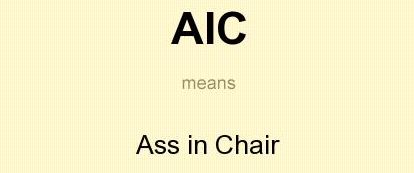
AIC.JPG


There is a huge “Ass In Chair” factor to writing. I don’t do it well myself. At home it is too easy to turn on TV or get distracted, etc.  I also fall victim to the mindset that I have to have an idea before I can sit down and write, yet the times I have sat down with no ideas and forced myself to write, something always got written. It’s like priming a pump.

I am not sure if you will find this useful or interesting, but I have written enough to sort of have a process to much of it now:

1. I use strike-through to cross out the parts I am considering removing, but haven’t committed to.

2. I keep notes inline in my story so I can get a feel for where I am going with it, or if I have an idea, etc. I section these off by using: <notes inline in story> I will even put in hyperlinks to information/sites that may be pertinent.

3. I tend to write in small chunks and do a lot of re-reading over the story to iron things out & get the flow of it.

4. I find that most of the time I will throw away the first part of what I have written.

5. I will often write the story out of order, particularly if I know how I want a certain part of it to go.

6. Many times I write sections I know are terrible in order to get the gist of it down. I recolor these on the successive passes.  I think of this as “writing through” the difficulty.

7. I always keep a browser open and in Google type  “define: word”  to quickly get the definition of word I want to use, but am not sure I know exactly. This also shows me synonyms which I will sometimes opt for.

8. I save several dated copies of a story as I write it. This is partially in case it ends up being corrupt or gets deleted, but also in case I don’t like where the current version is going and want to back track.  I have five old versions of my current work in progress.

9. I use both my desktop and my old laptop to write. I keep my writing folder in Dropbox which is shared between these devices, so the story is always up to date in both places.  I find I like to write on the laptop more than the desktop. I often write while standing in my kitchen. I think moving around helps the creative process.

10. A lot of what I do tends to be little tricks to get myself to write.  Like, I will say to myself that I am just going to write a short scene or paragraph — but that always leads to more.  If I am empty, I will often just read over an undone story. I always catch errors or will rewrite sections that don’t flow smoothly.  A lot of times just reading what I have of a story gives me the ramp up to continue on with it.

11. I spend a lot of driving time with the radio off thinking about stories. This is one of the most productive parts of my process because it usually gets me to a point where I want to get the idea written down.

12. I am subscribed to Grammarly.com ($60/year) which plugs into Word and flags grammatical problems with my stories. It’s much cheaper than an editor, but probably only 80% as effective.


Hopefully these tips help you, but if nothing else they may trigger you to think about the mini-systems and habits that could be useful for your process.


James A. Miller

Traversing the slush pile

The insight I have gained reading slush for Allegory has been amazing.   I already have a list of common mistakes from the story submissions I have read.

Here are things you shouldn’t do if you want me to move your story along for further consideration:

1. Telling instead of showing.

Telling:

Sarah liked Michael.

Showing:

Michael was in the hall. Sarah felt the same lightness in her stomach she had the first day he talked to her. If only he would come talk to her now.

Ok, so I am no romance writer, but hopefully you see the difference.  The first one is a report of what is going on. In the second example, we get to experience what she is feeling.

Telling is not inherently bad, unless you are going to write the whole story that way.  The strength of telling lies in its ability to cover a lot of ground quickly.  Showing typically can’t do that.

The strength of showing is the ability to immerse your reader in the world you have created.  It takes a lot more work, but the reader will enjoy the ride so much more.


2. Lack of clarity

There are too many stories that try to be cute and whimsical by hiding essential information so they can build suspense or use the lack of information for a surprise reveal.

Guess what? the protagonist is actually a ghost!

It’s even worse when syrupy sweet prose clogs up clarity so bad that sentences become barely understandable.  It takes a long time to get to the point where you can turn out high-brow literary prose (I can’t).  In my opinion, there are very few pros who can do it well. The best bet is to focus on clarity and brevity.  Tell me the story and don’t let your words get in the way.

3. It’s not a story.

There is this whole concept of a story arc that is often omitted. I want a story where there is conflict. This usually (but not always) involves a protagonist and  antagonist.   And in the end, I really love it when the protagonist wins by some method where he has grown in some way, or figured something out, or done something clever that I didn’t expect.   This all may sound a bit formulaic, but it works to keep a story interesting. It doesn’t always have to happen this way, but when the main character gets out of a scrape by just running away, or by defeats evil via sheer luck, I can’t help but feel a bit cheated.  I am also not a big fan of  slice-of-life type stories, unless the character is particularly interesting.  If they are just lying on the bed doing their nails, I am probably going to start fast forwarding until I get to something that piques my interest.  If I don’t see it in a few pages, I am going to click the little “x” to close the document.

4. Unrealistic character actions or dialogue

I usually see this when there is a need for something to happen with a plot point. A character will do something like murder another character for a very weak reason, like “they never liked them.”  If that were true to life, I should go on a gun-toting rampage because I have a whole lot of people I need to take out. I would start at the DMV and work my way through to every shitty waiter who has left me with an empty drink glass through my entire meal. Real life  just doesn’t work that way. Unfortunately.

I am also put off by anything unrealistic for the world the author has set up. If your story takes place 1000 years from now, and people are still using Facebook, you may not have the best grasp on how quickly technology can change.

If you absolutely insist that your character to do something atypical, all you have to do is give a sufficient reason or motivation for them to do so.  A God-fearing Nun won’t shoot someone, unless she is already questioning her beliefs, and her life is in danger.


 5. Not beginning at the right place.

I think a lot of pantser writers need a bit of a warm up before they get into a story. Most of the time this warm up can be cut completely without lessening the story.   Here is one of my examples of this:

Searching or creating, that’s all we really want. Even if we don’t know it, it’s what we are working for. We all want enough money for that new car, or new life, enough money to go someplace else, someplace new.

Three million seemed new enough for me, even if they were old bills.

Jen was driving, and I sat in the back. On each side of me were two duffel bags full of cash. There was another bag in the front seat with her, and one more sittin’ between my legs – that one had the guns.

If we were to cut everything before “Jen was driving” nothing critical is lost.

Other times I see stories where I have to go through several unnecessary pages before the plot or conflict becomes clear.  Most of the time these pages can be cut.

6. Not following the submission guidelines.

This is a no-brainer.  If you can’t take the time to read and apply the rules for submission to a publication, how can you expect the publication to take your story seriously?  I won’t penalize a story for improper formatting, or an undesirable font, but I can’t promise you that others won’t, so why even risk it?  My advice is to take the time to properly format one story for submission, then cut and paste other stories into that format for the next time around.

7. The handy plot point.

This occurs when an author needs something to happen, but is so in the middle of the flow of writing that they grab the first thing that comes to mind.  It’s similar to those times we use a steak knife to excitedly cut open a package we have been waiting for, because the knife is right there on the counter and the scissors is all the way inside the junk drawer. For example:

Sarah wasn’t wearing her glasses because she had lost them earlier that day.

If this is the first time in the story that I hear about Sarah’s lost glasses, or her poor eyesight, it will read like this was sloppily tacked on because the author needed a convenient reason.  If authors take the time to think about these seemingly insignificant parts of the story, they can use them to develop their characters much further.  If instead, Sarah choose to not wear her glasses because she thought they made her feel ugly, and we were told this in well in advance of the event that required her to have blurred vision, then it would seem as though the whole thing evolved naturally. It would also tell us how Sarah feels about the way she looks.

The above are just a few from my list of slush reader pet peeves. Please take these with a grain of salt as they may not hold true for other slush readers.


– James


Why word count matters when submitting a story

Word Count for stories

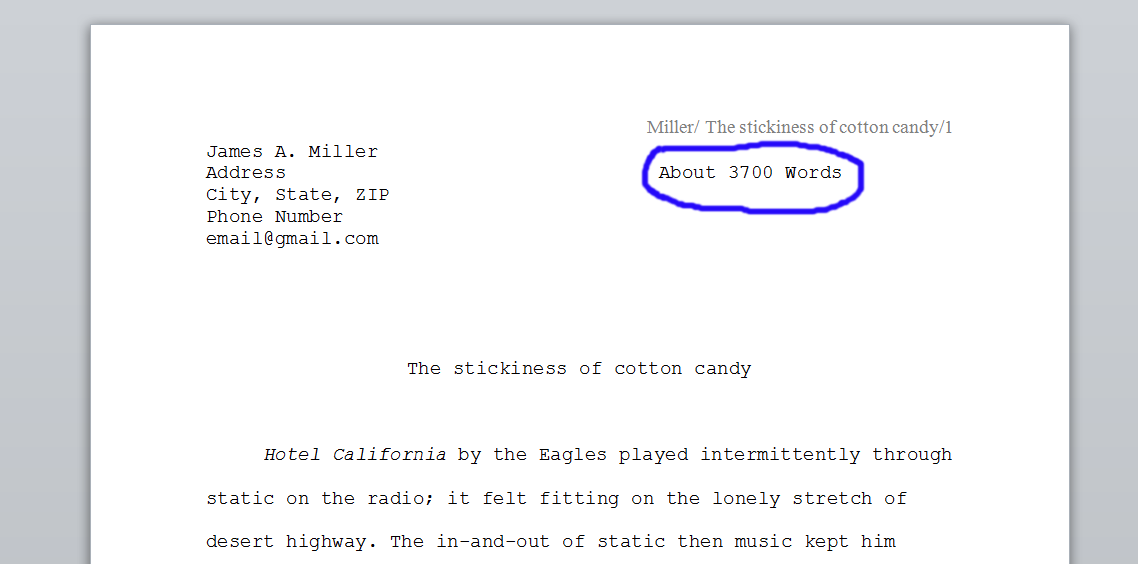
I used to think that putting the word count on a submission wasn’t that big of a deal, as you can look it up in Microsoft Word as soon as you have the document open.

Once I started read slush for an online e-zine, I realized why having the word count was important to Editors; they need to know how much time to set aside to read the story.

Having a word count on the upper part of the first page tells them this right away. If you have it on the cover page (or wherever their submission page asks for it) then you are probably fine.

Keeping track of writing submissions

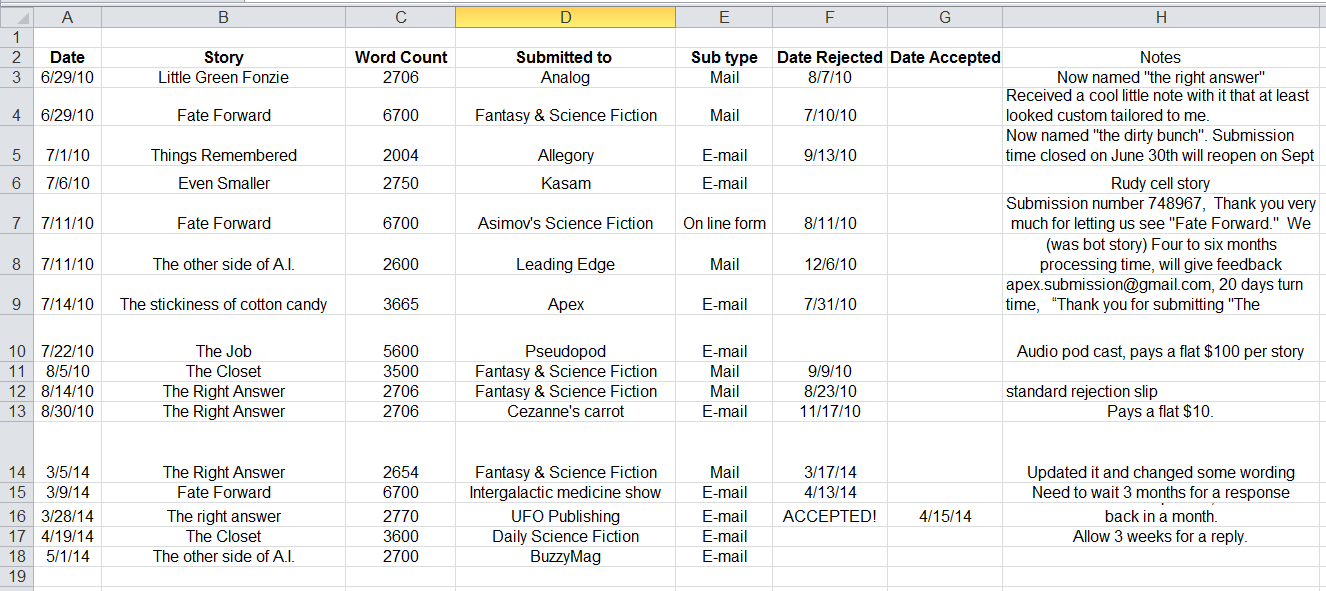
As soon as I began submitting two stories going at a time, I started losing track of when I had sent them, and to where. I am not sure what other writers do to keep track of submissions, but I made an Excel sheet for the task.

The main tab is a chronological list of the each submission.

Chronological writing submissions

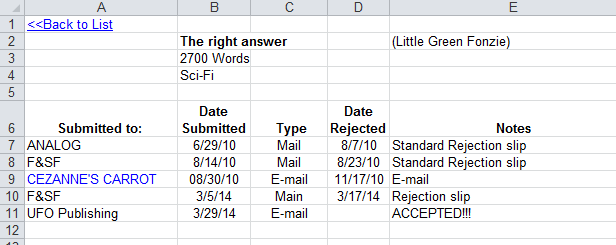
I also have tabs for each of the individual stories to see the chronological history of where they have been submitted.  I see on the tab below that I did submit this story to the same place twice, which is really a no-no, but it was after some editing, a name change to the story and after almost four years had elapsed. Unfortunately, they still didn’t like it.

Writing submissions by story


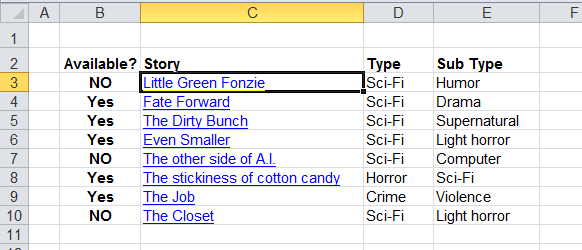
I have another tab  that automatically adjusts so I can tell from a quick glance which stories are available to be submitted. I am not sure if there is actually a “sub-type” category for writing. I just do that for my own reference, because, yes, sometimes I do forget what my own stories are about.

Stories that are able to be submitted

If this is something you feel may be useful, feel free to comment with your e-mail and I will send you the template.


-James