Category Archives: Uncategorized

Property Room

This week’s story comes to us from Henry McFarland. Henry is an economist, community activist, and part-time short story writer. He has published stories in Brain Games: Stories to Astonish, Page & Spine, Tree and Stone, After Dinner Conversation, Cosmorama, the Starship Sofa podcast, Andromeda Spaceways, Every Day Fiction, Bullet Points, The Colored Lens, and Lorelei Signal. He can be found on Facebook at https://www.facebook.com/henry.mcfarland.50 and on Blue Sky at hecon.bsky.social.

This story has been [mistakenly] rejected by:

  • Asimov’s Science Fiction
  • Escape Pod, F&SF
  • Galaxy’s Edge
  • Clarkesworld
  • Albedo One
  • Neo-Opsis
  • 87 Bedford, Kasma
  • The Colored Lens
  • Interzone
  • Starshipsofa.com
  • Mythaxis
  • Uncharted
  • Robots Past
  • Future Flame Tree Publishing

When I asked Henry what he loves about this story, this was his response (warning spoilers):

What I love about the story is that Tom changed his attitude towards Iris as he came to know her better. At the beginning, he believes that she is just an object used for contemptible purposes. At the end, he recognizes her as a thinking, feeling being, and as a truly honorable person. 


Property Room

By Henry McFarland

The door buzzer made Tom look up. Jason Fong led in a tall blonde wearing a halter top, miniskirt, and handcuffs. “Jason, what are you doing bringing a perp to the property room?”

Jason laughed. “Look again, Tom. She’s property.”

A closer look showed the blonde’s face and body were too perfectly proportioned, her skin too creamy and clear for a natural woman. A sexbot, Tom had read about those things.

The blonde’s eyes flashed, like an angry woman’s would. “I’m a sentient, thinking being!”

Jason sneered at her. “Shut up, Bolts!”

“My name’s Iris.”

“Yeah, and you talk too much.” Jason turned back to Tom. “It’s evidence for a hearing tomorrow. It’ll shut up once its batteries run down.”

Tom handed Jason a blank evidence tag and opened a log-in form on his computer. “So now sexbots are in Chicago?”

“Some sleazebag brought it from Vegas.”

The blonde shifted her weight a little, as if to pull back from them. “I’m not hurting anyone.”

“Hey Tom, it talks just like a human hooker. It’s against the law, Bolts.” Jason filled out the evidence tag, then gave it to Tom. “You decide where to stick it.”

Tom walked over to the blonde. The scent of jasmine perfume hung around her. He stuck the tag on the inside of her arm. Her flesh was hairless but soft and warm. They must have made it that way for the johns who used it.

Jason smirked at Iris. “Okay, it’s all yours. You gonna be a good doll, Bolts?”

“Iris.”

Jason took the cuffs off. Tom opened a gate in the fence of thick wire mesh that caged off the area with the evidence lockers. Iris held her head high as she walked through the gate. Tom remembered that look from his days as a street cop—a lot of people wanted to seem dignified as they were being locked up. Funny that a robot would too.  

Jason took off, and Tom went back processing files on his computer. He heard Iris say, “How long have you worked in property, Tom?”

“Call me Sergeant.”

“Okay, Sergeant.” She paused then said in a softer voice, “How long ago did your wife die?”

“Who told you my wife died?”

“No one. When you unlocked my cage, I saw a small callous on the ring finger of your left hand. You used to wear a wedding ring, but you stopped a little while ago. Not divorced, you still have that picture on your desk—the teenage girl with her must be your daughter.”

“She’s not a teenager anymore. I should put that picture away.”

“No, it’s good to remember.”

Tom didn’t want life lessons from a robot. “I’ve got work to do.”

“Then I’ll play some chess.”

“How? You don’t have a board or anyone to play with.”

“I don’t need a board, and I can section off part of my brain to be an opponent.”

“Have fun.” Tom processed more files. He was sick of this job—it made him feel like a clerk, not a cop. Instead of working with buddies at a precinct, he worked alone. Instead of helping people in trouble, he filled out forms.

He looked into the cage before he left for the day. Iris sat quietly on the floor. Its eyes were unfocused, but open. Its batteries must not have run down yet.

The silence of Tom’s house enveloped him as he ate a quick dinner. He stared at the walls and wondered what to do. He’d have to start getting out more, call some old pals, maybe join a club or something. Loneliness was bad for people.

Next morning he found that Iris had hung a small mirror on the wire mesh and was brushing her hair. “Where’d you get that brush?”

“I always have one, Sergeant, a girl’s got to look good.” She checked her handiwork in the mirror like Tanika getting ready for a date night. “All done.” Iris put the brush and mirror in a compartment in her side. “Did you have a nice evening?”

“Yeah, it was great. Who won at chess?”

“Alpha won the first, beta the next two. Then I read a novel—Moby Dick.”

“In one night?”

“My brain’s faster than yours.” Her tone was gently teasing.

“That book’s worth more time.”

“A great book for sure—when did you read it?”

“Doesn’t matter.” He abruptly turned from her and went over to his desk.

“Some reason you don’t want to tell me?”

“Tanika and I would read books together. That was the last one. I have work to do.”

“You must miss-”

“Work time.” He pretended to be immersed in his computer screen.

Jason came in with a hand truck and saw Iris standing by the door of the cage. “Its batteries should have conked out by now.”

Iris snorted. “You should know sitting around doesn’t use a lot of charge. I’ll walk to the hearing.”

Jason was back in a couple of hours. “Judge granted a continuance. You get to keep the doll for a few more days.”

Tom opened the cage, and Iris walked in, silent but still holding her head high. Jason must have seen Tom looking at her wrists. “No cuffs because I’ve found out more about these wonders. Their leg servos don’t allow much speed. Also, it’s programmed not to hit anyone and not to run away. Some freaks like to slap these things around. The developer programmed the doll to stay and take it, so the freaks get their money’s worth.”

The thought of Iris being abused made Tom’s stomach churn.  

Jason left and Tom looked at Iris sitting quietly in the cage. “How was court?”

Her nostrils flared, and her brow lowered. “I am not a thing, and sex with me is not masturbation.”

“We’re not the ones saying that—that’s your side.”

“They make money from me, but they’re not my side—not when their lawyers say that.”

She started walking back and forth in the cage—her lips turned down at the corners, fire showing in her eyes. She looked angry and unhappy, like a person betrayed. Her emotions couldn’t be real—she was a robot. Still he wanted to comfort her. “I’ve heard a lot in court I didn’t like, too. You have to forget it and move on.”

“Did they let you talk?”

“You mean testify, yeah sometimes. I hated it.”

“I can only sit there like I’m a doll, but at least I don’t have to sit on the floor like I do here.”

Next to Tom’s desk was a bench that nobody ever sat on. He pushed it into the cage. “Here, make yourself comfortable.”

“Thank you, Sergeant.”

A cop came in with a TV, evidence in a burglary. He filled out the evidence tag and rushed off. As Tom put the property in a locker, he smelled lilac. “Did you change your perfume?”

“With my auto-scent, I can change it when I want.”

“Change it back.” He locked the cage and went to his desk.

Iris stood at the wire. “Don’t you like lilac?”

“Change it.”

The next time he entered the cage, she smelled of jasmine. Her voice sounded gentle. “Sergeant, I changed the perfume.”

“Lilac’s what my wife Tanika used to wear.”

“I didn’t know. I’m sorry.”

He regretted getting angry with her—she couldn’t have known. “That’s OK. And call me Tom.”

“OK, Tom. Why aren’t you still a street cop?”

 “I got old. They gave me this job until I retire—3 months to go.”

“You must be looking forward to that.”

“Yeah, just relax and take life easy.” That’s what he told everybody. Really, he dreaded all those empty hours.

“Are you going to move or stay around here?”

“Probably stay here. Sarah, my daughter, lives in Los Angeles, and she’d like me to move out by her, but my whole life I lived in Chicago.” She got him talking about his boyhood, his neighborhood, and why he’d joined the force. Eventually, another cop came in with some confiscated drugs, and Tom helped him log it in. He realized that he’d been neglecting his paperwork, so he told Iris he couldn’t talk anymore.

Iris was still awake when his shift ended. How long could her batteries last? Tom pulled up last night’s footage from the surveillance camera that monitored the cage. He fast forwarded through about an hour of Iris’s sitting there placidly and slowed the tape when she looked around. She pulled a charger from under her skirt, then plugged one end into a socket on her hip and the other into a wall outlet.

Tom went over to the cage, “Okay, Iris. I figured out how your batteries last so long. Let’s have the charger.”

Iris came as close to him as she could. He smelled her perfume and saw the pleading in her eyes. She spoke in a soft voice, “Oh come on Tom, what’s a little electricity? Let me keep the charger. I hate going dark.”

“This room’s for property, you’re not supposed to be active.”

“I won’t hurt anything, I promise. Besides, it makes it easier for your friend to take me to court. Please Tom, going dark is nasty. My sight dims and gets blurry, and I get all slow until I stop. Don’t make me do that.”

Tom looked into her big blue eyes and caved. “OK, but remember you promised not to cause trouble. And keep the charger hidden. That’s just between us.”

She gave him a beautiful smile and thanked him profusely, the way his daughter did when he let her go to a concert.

Then she wanted another favor. “Tom, you have a TV in one of the lockers. Could you set it up, so I could watch something tonight?”

That surprised him. “Watch what?”

“The Stanley Cup finals, Blues playing the Rangers. I love the Blues. Come on Tom, I want to see my team win the cup.”

How could a robot be a hockey fan? Was she trying to pull something? “Why the Blues?”

“My favorite client in Vegas, the one who turned me on to hockey, was a big Blues fan. I started rooting for them too.”

“Some guy rented you to watch hockey with him?”

“He paid for an overnight visit, and the hockey was on. And yes, we did things after we watched it, but what do you care?” Her voice softened again. “I’m tired of reading and chess. What can it hurt to let me watch some TV?” Again she turned her big blue eyes on him.

The TV would stay in the cage, so there’d be no problem with custody of evidence. They didn’t bring property here at night and she hadn’t given him any trouble, so why not let her watch? Nobody else would know. The stolen TV was small, but she seemed happy when he showed her how to get the game through Wi-Fi. She was watching a pregame show when he left.

As he cooked dinner, Tom thought about what he’d do that evening. Might as well watch hockey, but he was tired of watching things at home alone. He didn’t like hanging out in bars much. Maybe he should watch with Iris. He could talk to her, even if it was only her programming.

Iris was yelling as he opened the door, “That’s slashing! Ref, are you asleep?” She seemed surprised to see him but only said, “It’s three minutes into the first period, no score yet.”

He was glad not to have to explain why he was there. The Rangers scored, and Iris was furious. “They let him in his favorite spot to shoot! Come on guys, play defense!”

Iris rode the refs more than most guys, and she gave the Blues more instructions than their coach did. Her running commentary made watching more fun. At the first interval, Tom suggested they watch the game on his desktop screen, which was much larger than the TV.

The Blues lost, but Iris refused to be discouraged. “We’ll get em next time!” She paused and looked at Tom. “Could I have a minute before you lock me up again?”

She walked over to the window without waiting for his response. He stood beside her as she gazed at the world outside. She sighed. “I get so sick of being cooped up. I wish I could get out.”

“I’ve got to keep you here.”

“I know, Tom.” She walked back into the cage. “Thanks for letting me look.”

He watched every game with her. During a commercial, she asked if he had any grandkids.

“Just one, a little boy, Joey, five years old.”

“Tell me about him.”

“Last time I was out there, I took Joey for a car ride—he loved it. He’s real smart too.”

“Sure he is.”

“I only see him sometimes. Sarah wouldn’t stay in Chicago.”

Iris put her arm around his shoulder. “She has to do things her own way, Tom.”

Tanika had said that too. “You mean be free?”

“Sure, you want to be free too.”

“There were times. . . But I always stayed.”

“You’ll have your chance soon.”

“Still I’ll miss the job.”

Tom kept thinking about what Iris had said. Did she need to be free too? She looked so longingly out the window. He’d never believed a robot could want freedom but maybe she did.

 Iris wore a mask of tragedy when the Rangers hoisted the cup. Tom smiled. “Hey, there’s next year.”

She sighed, “I don’t know where I’ll be next year, or if.”

He hadn’t thought about what they’d do to her. What could he say? He couldn’t tell her it would all be OK any more than he could have told that to Tanika. He’d told Tanika to have faith. Did that make sense for a robot? Finally, Iris spoke. “I can only wait and see what they decide—nothing I can say or do will matter.”

He touched her hand. “Don’t dwell on it. What will happen will happen.” He’d said that to Tanika once.

Iris shrugged. “Tom, could I access the web? Otherwise, I’ll get so bored.”

He gave her one of the tablets they used to log in property and showed her how the Wi-Fi connection worked. She was looking at cat videos when he left.

Jason Fong came to the property room the next day. “Hey, you’re not going to have your sex doll much longer. The sleazebag’s lawyer got him probation if he turns over his toy. Tuesday, I’ll take it to the scrap yard.”

Tom wanted to punch Jason in the middle of his smirk. “Yeah, thanks Jason, now if you don’t mind, I have stuff to do.”

Iris watched Jason go then said,. “I get disassembled and no one cares.”

“I care.”

Her voice softened. “Thanks, but what can you do? Worst thing is I’ll spend my last few days cooped up in this little cage, like property.”

That night, Tom thought about how Iris had looked out the window after every game. He couldn’t stop them from taking her, but he could let her go outside. If she were gone for part of a weekend, probably no one would notice. It was risky—he’d be in big trouble if he were caught. Getting fired for cause meant losing his pension. But even if they found out, they probably wouldn’t fire him as long as she came back. She was programmed not to hurt people, and she couldn’t run very fast. She probably wouldn’t try to escape.

He told her the plan the next morning. “Saturday you can have a day’s outing. A track in Wisconsin has old cars that you can drive yourself. It’s just a quick ride on the Metra. One thing though, if you’re not here Monday morning, I’ll take a heavy fall. You have to swear not to run out on me.”

“Won’t you get in trouble anyway? Cameras monitor the cage. They’ll see you letting me out.”

“The cameras will tape it, but no one will look at the tape unless they have a reason to, and they won’t.”

She hugged him, a short but tight hug. “See you Saturday.”

He brought Iris some of the old clothes that his daughter had left behind. Luckily, they fit. No one gave him or Iris a second look as they left headquarters. Iris spent the train trip to Wisconsin staring out the window—her first look at the scenery around Chicago.

The guy managing the track said it was nice to see him again, it had been a while. “Too long,” said Tom, “it’s good to be back.” He nodded to Iris. “This is my niece’s first time. Have you got a Camaro convertible?”

The guy said sure and had them fill out release forms on a computer terminal. Iris whispered, “What do I put in for a last name?”

“My name, O’Leary.

As they walked to the car, Iris asked “Do you come here a lot?”

“Used to, before Tanika got sick. She loved coming here. The cars are like they were when we were kids. You use pedals to make them start or stop and a wheel to steer them. I miss that kind of driving.”

“It’s safer now.”

“True, but controlling the machine, making it do what you want, there’s nothing like it.”

She gave him a funny look but didn’t say anything.

He drove the Camaro out of the parking lot. Some animatronic figures were waving goodbye. Iris sounded merry. “Look, my ancestors.”

“Like when I see the apes at the zoo.”

Iris put her head back and laughed.

Tom sped up to let Iris feel how the car hugged each curve. On a straightaway, he glanced over to see the wind blowing in her hair and a huge smile on her face. At the end of the ride, her cheeks flushed, and her eyes sparkled. “That was great, can we go around again?”

“Sure, I’d like to get a snack first though. Do you want something, I mean uh?” He was embarrassed that he’d offered her something to eat, but she just laughed and said her batteries were full, thanks anyway. After they ate, he took her for a ride in a Ferrari on the fast track. Iris threw her hands in the air and cheered as the speedometer hit one hundred miles per hour.

As the train back to Chicago pulled into the downtown station, Tom asked, “Iris would you like to have dinner with me?”

“I’d love to, but while a girl not eating a snack is watching her figure, a girl not eating dinner makes people wonder.”

“Come to my place. You can hang out while I cook something.”

Her eyes lit up and a grin spread across her face.

As Tom cooked his burger, Iris asked him who was the strangest person he’d met at work. He thought for a moment. “When I was a young cop, an old guy would come in every Sunday morning to report his car stolen. After the first time, we’d just drive him to his favorite bar. It was in the lot.”

She laughed aloud. “Didn’t you get mad?”

“Nah, when he was young, you had to drive the car yourself. You shouldn’t do that after a night in the bar, so he’d walk home. Habits don’t break easy.”

“See, another advantage of AI—you can ride home from a bar.”

“True, but didn’t you enjoy today?”

“Loved the speed—and the countryside. So much green—not like the reds and oranges in Nevada.”

“I’m going to see that western scenery when I retire. I’ll drive to LA to see Sarah and Joey but go the long way: Rushmore, Yellowstone, the Grand Canyon.”

“Still planning on coming back here?”

“My life’s been here, my home.” She was easy to talk to. Was that her programming? It didn’t feel that way.

They sat on the sofa after dinner and watched a vid. She put her hand on his. Her eyes twinkled. “What would you like to do now?”

Suddenly all his senses belonged to her, the warmth of her body, the smell of her perfume, the sight of her golden hair, perfect figure, long legs. She had been designed for great sex—designed. It didn’t seem right. “I can’t, it’s too soon, too soon after Tanika.”

“You were a good husband to her when she was alive.”

“It’s not right for me now.”

Her lips brushed his cheek. “I understand. I’d better go back. Less chance people will notice us late at night.”

All Sunday he thought of Iris. The idea of her being taken apart turned his stomach. She talked like a human, she acted human. She wasn’t just a thing. Consequences be damned, he’d help her escape.

He got to work early Monday. Iris usually came up to the wire to say hello, but this time she stayed on the bench. He put a bag at her feet. “That’s a change of clothes. I can’t let them destroy you. Get dressed. We’ll go west together.”

She fixed him with those big eyes. “Tom, you can’t do it. If you help me escape, they’ll fire you for cause, maybe even charge you with a crime. You’ll lose your pension. What will you live on?”

“I’ll still have social security, and some savings.”

She held up the tablet. “Tom, you use your office computer to access your financial records. I know how much money you have. You need your pension.”

“You weren’t supposed to look at that! Besides I can move in with my daughter, save money that way, do some private security work.”

“How much private security work can you get at your age, especially after you get fired for misconduct? Sarah’s a single mom. She needs the money you send her. What happens to her if you can’t do that anymore?”

Tom stood speechless. Iris took his left hand in hers. Her flesh had felt warm. Now it felt cold, like Tanika’s body near the end. Her face looked solemn, “Could you sit with me?”

He took a place on the bench and put his arm around her, unsure of what she was thinking. There was no perfume, no scent at all.

For a moment they sat in silence, then she said, “I can’t let you ruin your life for me.” She pulled up her left sleeve to reveal a black spot that looked like a mole and pressed it. “That started a sequence that wipes my memory, my programming and fuses my joints. They told me to do that before getting arrested. I wouldn’t do it for them, but for you… you were good to me.”

“Iris, no! Please don’t do this!”

“It’s too late, Tom. But it’s OK. You’ve given me happiness.”

There was a buzzing noise. Her eyes opened wide, then shut. She turned silent and motionless. Gone.

On the drive west, he often thought of her, and her sacrifice. Could he and Iris have been happy together, if they had let her live? He thought so.

She was so human, as human as anyone he ever knew.
Time is Relative

This week we have a wonderfully touching story by Laura McCorry.

Laura McCorry (she/her) is a writer, yoga teacher, and baking enthusiast who lives outside of Washington, DC. Her work has appeared in Poetry Quarterly. Connect with her at lauramccorry.com or on IG, @lauramccorrywrites

This piece has been [mistakenly] rejected by the following publications:

  • Analog Science Fiction and Fact
  • Kenyon Review
  • LCPL Short Story Contest
  • Intrepidus Ink
  • Haven Spec

When I asked her what she loves about this story this was her response:

The desire for more time with our loved ones is universal and it hits the hardest after loss. I really love the question in this piece–what amount of your own life would you give up in order to have another hour with someone who has died? I like that there’s no right or wrong answer. But I also like when magic work-arounds have limits and consequences because death is the one rule we all must obey.


Time is Relative

by Laura McCorry

The baby cries. I roll over, ready to ignore her before I remember Sal’s not here. He won’t change her diaper and bring her to me ever again. I stumble to her bassinet. The room is bathed in silvery shadows from the streetlight outside. The wind whips around the house and the oak tree’s bare knuckles rap against the window pane.

I hold Pearl close to my chest. It’s not supposed to be like this. She cries harder and cries escape my own mouth, a rip tide to her waves. Pearl screams while I change her diaper, screams while I wash, screams as I bring her back to bed with me. She only quiets when I feed her. 

If I close my eyes, it feels like before. Pearl is nestled in the center. I can pretend our two bodies curve around hers. I can pretend there was no car crash, no knock on the door, no carousel blur of days I don’t want to remember, but do.

#

Someone is knocking at the door. I’m grumpy about being woken, even though it’s light outside. I pull on a robe, hurrying to get there before they wake Pearl. But it’s not a neighbor or one of the church ladies. 

It’s a man in a grey suit who doesn’t take off his hat. He holds a tan suitcase horizontal to the ground and shakes down four collapsible legs.

“I’m not interested,” I say, already closing the door.

He opens the suitcase. Four rows of gleaming brass watches and jewelry catch the sunlight, but it’s the sign inside the lid that’s caught my attention: Time is Relative.

My biggest regret is that I didn’t meet Sal sooner. I spent so many years alone, or with the wrong person, which is worse. And Pearl was our miracle baby. Whenever I complained about those lost years, when we didn’t know each other, before we had Pearl, he always told me, “Time is relative. I’m here now, aren’t I?” 

It feels like a sign.

There’s a gleam in the salesman’s eye when I open the door wide.

“Aha, for the young mother with sleepless nights.” He lifts a locket off the blue velvet and holds it up. “Put a picture of your little one on one side and read every upcoming scrape or illness on the other.” 

I try to imagine Pearl running on the sidewalk and falling down. Pearl when she’s school-age, lying on the couch with a fever. But all I see is Pearl clutched in my arms in our dark room, crying as if she’ll never stop. And why should she? I shake my head, retreating.

The man holds up a finger. “No, I see now. It’s not the future that troubles you.” 

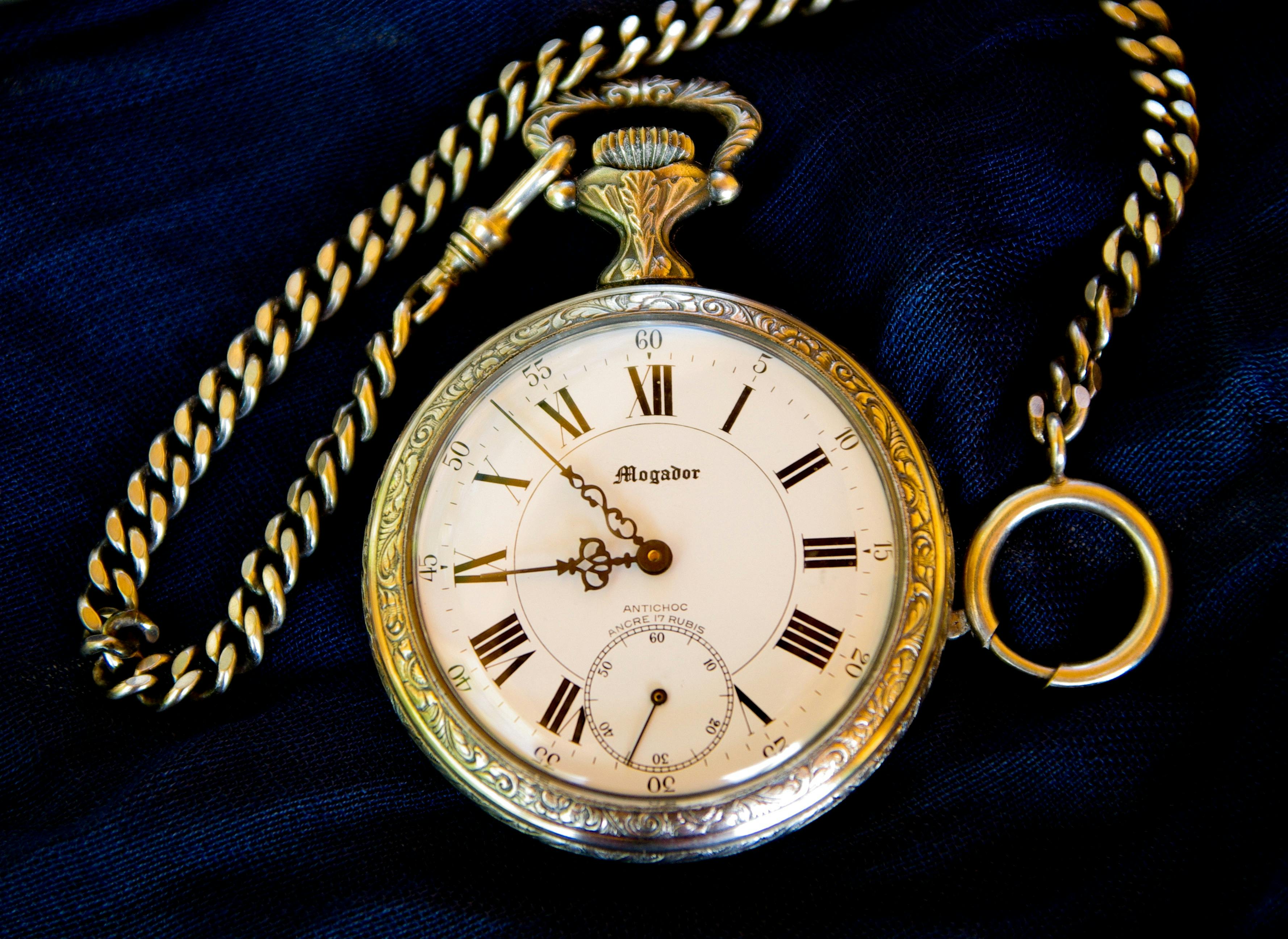
He picks up a long chain. At the end is a golden disc, encircled by a golden band. He flicks the disc and it spins freely inside the band. He stops it and slides his long fingernail along the edge to open a latch. It’s a pocket watch.

“For the lonely heart that wants more time,” he says, holding it out to me.

A bird calls from high in the tree. My eyes stay riveted on the watch. It sways at the end of the chain and I think maybe it pulls toward me. Then it’s in my hand.

“Now, this piece is special indeed.” His voice is honey over cooled magma. “It works just like a regular watch, see? And you never need to wind it.”

The metal backing feels warm in my palm, as if I’ve held it a long time already. As if it belongs in my hand.

The salesman leans forward and indicates a knob on the side. “But if you turn the hands backwards, you can bring back someone you’ve lost for a night.”

My fingers clench it tight, the metal biting into my skin.

“Why one night?” My heart gallops, ready for night even as the sun climbs higher.

“Well, you can have as many nights as you choose,” says the man. It’s hot, but he doesn’t remove his jacket and his brow is dry. A rivulet of sweat rolls down my neck into the too-thick robe I threw on over my breastmilk-stained shirt.

“What’s the catch?” I ask.

“The catch?” He raises both eyebrows, feigning innocence.

“Yeah, the bait and switch, the hidden cost.” I’m holding the watch but it can’t be real. It can’t be what he says it is.

“There’s no catch,” he says, almost laughing. “It’s an exchange.” He taps the sign, Time is Relative. “We can’t go around breaking the laws of physics.”

I narrow my eyes at him. I should put it back. Go inside and shut the door. I should pick up Pearl who is awake now, babbling in her crib. I don’t do any of that.

“You can wind it up to six hours backwards each night. Your loved one will come back to you for that many hours,” he explains.

The watch glints gold beneath my fingers. Pearl starts to cry, wondering where I am. She’s not desperate yet.

“In exchange,” he stresses the word, “you will lose a year off your own life.”

“A year each night?” I ask, calculating.

“A year for every hour,” he says, his voice a loosed arrow.

My heart falls like a stone, crashing against my ribs. It’s hard to breathe. Pearl is crying in earnest now. The man holds my gaze, pretending to wait for my answer, as if he doesn’t already know.

“I’ll take it,” I say. My hand closes around the watch and I hold it to my chest.

The man touches the brim of his hat and shuts the suitcase. I don’t wait to watch him leave.

#

Sal’s place is empty at the dinner table, the watch nestled on its chain on his placemat. Sometime today I became afraid of it. I don’t want to touch it, but I can’t tear my eyes away. Outside the window, the sky is a blaze of orange. Pearl isn’t eating anymore, just throwing her food on the floor. 

Inevitability hangs in the air as if I am watching a movie about my own life. I’m waiting for darkness and wondering when it will be night—the question I should’ve asked. I settle Pearl for sleep, knowing she’ll be up again soon.

I walk away from her crib, holding the watch by the chain. The mattress sinks beneath me as I turn on Sal’s bedside lamp. I open the latch. My fingertips grasp the knob and I turn the minute hand backwards. Fifty-seven, fifty-eight, fifty-nine. I’m so careful not to go past the hour mark that my hands are sweating. Then I drop the watch onto the nightstand like a hot coal. 

How long do I have to wait? Should I unlock the front door? 

Then a weight settles next to me on the bed. I turn and fall against him. My hands on his face, in his hair. His mouth on mine, a magnetic pull I’m powerless to resist. And it’s the same as it’s been a thousand times before. And it’s new because I’m sobbing the whole time.

“It’s okay,” Sal says, his eyebrows drawn together.

He doesn’t know he died, I think. 

He smooths back my hair. “It’s okay,” he says again. He always hated to see me cry. But it’s not okay and it’s never going to be okay. His words can’t change anything.

Pearl wakes with a hiccough and a cry. Sal goes to her and she settles on his shoulder. I take a picture with my phone even though it’s dark. Desperate to save something that can’t be saved. Then I go to them and wrap my arms around his waist, resting my head on Pearl’s small back, breathing in her clean scent, feeling the rise and fall of her breath. 

It has to be enough. It will never be enough.

#

Sunlight streams through the window when I wake. There’s a delicious moment before I open my eyes when I’m aware of being well-rested for the first time in months. I stretch my legs under the covers, luxuriating in the swipe of cotton against my skin. My body feels lithe and strong, like it used to be before I had Pearl.

I reach for my phone and check the photos. But the last photo is of Pearl in a baby swing yesterday afternoon.

It’s so quiet. Too quiet.

I fling back the covers. The crib in the corner is empty. She just learned how to climb out of it last week. My heart thuds outside of my chest. Panic swells behind my eyes. There’s a noise in the kitchen and I run down the hall. 

Pearl is sitting in the middle of the tiled floor. Her chubby feet are touching each other, knees bent for stability. She has a look of intense concentration on her face. Gold flashes against the ceiling. I clutch my chest, panting. She’s holding the watch and her tiny fingers are turning the knob backwards.

Can a fiction writer stand out in today’s sea of competition?

I saw somewhere that The New Yorker gets half a million unsolicited submissions per year. Let that sink in for a second.

 Half a million.

That’s a serious slush pile.

But I did notice that famous people are constantly getting published in the magazine.  This makes sense for The New Yorker. No matter how good the piece is, why take a risk on an unknown when you can tap celebrities whose names will draw in readership.  We are all beholden to someone or something, publications need content, but they need readership first and foremost.  And this strategy worked on me. I ordered some old issues of the magazine on Ebay and saw that Bob Odenkirk had a piece under their Shouts and Murmers section. Bob is a very funny actor and comedian. I loved him in Better Call Saul.  His piece in The New Yorker, entitled A Biblical Rough Draft, was just OK though. 

Don’t get me wrong, there were some incredibly funny phrases, like one part where he refers to biblical storytellers as those who “tromped from village in floppy sandals, swatting at flies, sipping beads of dew from the undersides of donkeys, and fighting dogs for scraps of meat.” That donkey thing—that’s my kind of humor. But overall, the piece was not nearly as funny as I would have expected. 

I can’t help but think that Bob’s fame played a significant role in him landing that piece. If a complete unknown (like Yours Truly) had written the exact same words, I am sure it would have been rapidly rejected.  We could rebel and shout “The world isn’t fair!” and “They should evaluate the story on its own merits, no matter who wrote it!”  And while I do agree with the idealism of the latter, my belief is that the world is fair. Bob worked hard to obtain fame. Having an inside track to publication is one of the fruits of his labor.  And can you blame the magazine for using the tactic of publishing the work of celebrities? Bob is a very safe bet. Prestigious literary publications, places like The New Yorker, The Atlantic, or The Onion have reputations that could be damaged if they publish writing from an unknown author and it turns out that person is a white supremacist, or a cannibal, or worse yet, a cannibal white supremacist racially-biased to eating only Caucasians.

Okay, so maybe “just get famous” isn’t practical advice. To be honest, if I had this completely figured out, you would have already heard of me before stumbling across this post.

So, what am I doing to stand out?

My strategy is to go wide and deep — but with quality! I am writing every day to generate content, working hard to refine it so that it stands out when it is eventually considered, and submitting all the time. Right now, I have ten stories out for consideration. I figure if my name starts to look familiar to the editors, they will know I am taking my writing seriously.

As a tactic I mentioned in a previous post, I am also targeting a specific market: Points In Case. I am tailoring my writing to fit that market. It will be interesting to see whether this strategy improves my acceptance rate.

I will keep you posted as to how well this works — at least until I get famous and don’t have to worry about silly things like having a “strategy” anymore.

Let me know in the comments below whether you have a strategy for standing out in today’s sea of competition. I am interested to hear your thoughts!

-James

So, I guess it’s been a while…

I intend to resume posting on a regular basis — right now a weekly cadence seems right to me, but I know how fast that kind of deadline can creep up on a person, so don’t hold me to it just yet.

I will add in more writing resources as I come across them. While I am using this blog to share my writing journey, I also intend to share the tools I find along the way.

Believe it or not I actually have been writing and have even landed a few more stories than what I have listed here. I will update my progress and make sure to let you know about any stories I happen to land in the future.  

Also, I have been thinking about setting up a site (or possibly using this one) to publish fiction from other authors.  There is an abundant of supply of short fiction and very little demand, so that might be a good way for me to do my part to help balance things out a bit. Who knows I might even be able to figure out a way to pay authors for their work.

Let me know your thoughts below — assuming there is anyone left reading this blog to have thoughts.

-James

Getting sucked in.

Rabbit hole

The internet does a great job of sucking you into its vast uncompromising realm of interesting crap.  Most of the time you end up wondering why you just spent eight hours looking at super cars when your driver’s license is suspended, but tonight I found posts that really spoke to me — the virtual equivalent of hitting a vein of gold. (I’m not sure if there even are gold veins in mining, but you get what I am going for here.)

Reading Ken Liu’s interview on Fantasy Scroll Magazine, I followed a link to Tobias Buckell’s post on Writer’s and pellets.  Considering my own adventure with parsing rejection letters, Tobias’s post really spoke to me.


Possibility


I received this sweet e-mail from Daily Science Fiction:

James,

We have good news and we have bad news. The good news is that 
your story has made our second round, rarified company that 
more than 90% of submissions do not reach. While half 
or more of our second round stories will not ultimately see 
publication under the DSF rocket, this story has reached the 
final go/no-go before launch.

The bad news--and I promised you some bad news--is that it 
will take us time to make that final decision. Expect an 
additional two weeks or so, but don't be surprised if it's 
a month from today. Thanks for your continued patience, and 
thanks for sending us this worthy submission.

 - Daily Science Fiction Staff


Blog Tour: #My Writing Process

I’ve been tagged by the immensely talented and utterly unstoppable Alex Shvartsman, Fiction writer extraordinaire. If it seems like I am kissing up to him, yes, I totally am. I feel I have to. He is the man who took my virginity, so I feel I have to thank him for that.

You should probably also know that I mean this is in a literary, as opposed to, literal sense.

You see, Alex is the first editor to purchase one of my fiction stories. In October, my story The right answer will appear in the UFO 3 Anthology of humorous Science Fiction

Alex is, so far, the only one who has published one of my stories. But like all aspiring writers, I hope to change that.

So what is this “tagging” I speak of? Well, according to Alex’s site, I need to answer some questions about my writing then, in turn, I get to pick two poor souls to do the same.

Here are the questions with my answers:

What am I working on?

I am currently writing a Sci-fi short about a female insurance investigator who goes to check on a suspected fraud claim. Since this is sci-fi, the claim is on a wrecked spacecraft and takes place at a repair station in space. While I enjoy the idea of the story, I find that it is proving to be more difficult than expected.  I usually crank out a short story draft in one sitting, then review it several times to give it some polish. This story, on the other hand, I have to pry out of my head  in constipated out-of-sequence chunks, making me question my process, ability, and general sanity.


How does my work differ from others in its genera?

Since I get a lot of rejection letters, I am guessing the answer to this question is that my stories differ because they are much worse than others in the genera. I am hoping to change that through a subtle increase in my work ethic and relentless dogmatic plagiarism.


Why do I write what I do?

I write because I like the idea of someone enjoying my stories.  It is also a challenge to myself, because if you have ever tried writing, you know you can bang out what you think is a masterpiece, only to find that nobody likes it– like, mom won’t even put it on the fridge kind of thing.  At first there is this idea that all those idiots you let read it don’t understand your craft, but then, you set it aside for few months, come back to read it to find out that the pacing is terrible, and you are tripping over all these sentences that used to seem buttery smooth, and that you somehow missed the fact that you accidentally changed the name of the main character from “Sven” to “Mike” and back again within the span of two pages.


How does my writing process work?

Hmmm… that question seems to assume I have a process.  I kind of liken it to guitar. People come over and see my guitar and they go “Oh, you play guitar?” and I go “I own a guitar, what I do with it cannot yet be called ‘playing’.”

I also own a computer and a word processing program.


This is the point in the post where I get to tag two other writers.

I am immediately tempted to tag Ty Drago of Allegory fame.  Ty is another person I am grateful to, as he is the first editor to publish my non-fiction writing.  I would also love to see his responses to these questions, but I know the man is working diligently on a book, so I won’t task him with it.

Instead, I call upon:

The Curious Farmer

and

The Book Mechanic

To follow in our footsteps and Blog their answers to the questions above.

– James


Getting Creative

Image


It’s not like riding a bike.

The creative juices just don’t flow as easily after you have been away for a while. The hamster wheel has a harder time turning and when it does there is this awful squeaking sound every time it goes around.

I have been going through my old idea pile. I am pleased with what I am finding, yet I am unable to pick up where I left off. It seems I am better at doing a rewrite of something finished, polishing the existing rather than creating anew.  Part of it is that the house now has four people in it instead of just me, but I know in my heart, most of it is of my own lack of volition.


Here are some sites with articles I enjoyed on how to get the creative juices flowing:

goinswriter.com

Just creative

how-to-write-a-novel.net


Renewal


Horse

For some reason I let four years slip by since my last Blog post. In that time all writing and submitting went on hiatus.  How could I let that happen?  Well here are some of the life changers that have been going on since that last post. Please do not construe these as excuses. I have no excuse.

1) I got married

2) I changed jobs

3) We had a baby

The good news is that I am back in the game and have, as of last month, already received two rejection letters.  I am in the process of reconstructing a few of my stories.  The one advantage of being away from your writing for that long is that it gives you a fresh perspective.

I am also excited because a story I submitted to UFO Publishing has advanced past the initial rounds. I received this via e-mail:

Hi James,
I’m writing to let you know that your story has made it past the initial reading by 3 randomly selected associate editors and is being advanced for further review to a full editorial board.
Please expect another e-mail from me in a few days, at which point we will either release the story back to you, or hold it in the “final consideration” pile until I’m ready to make final decisions, sometime in early to mid- April.
Thanks,
Alex


Even if it goes no further, it was exciting to know that a few strangers liked it enough to give it a thumbs up and move it up the ladder.

Now that I am getting back on the horse, my time away has also reminded of Mark Twain, who, at one point, put down The adventures of Huckleberry Finn and didn’t return to it until seven years later.  Please note that this “fact” is a faint recollection of something my 9th grade English teacher told us.  I am certain of the author, but hazy as to whether I have the right book. I also couldn’t find any reference to this lapse in writing anywhere online.

Back in high school seven years seemed like an eternity. It was forever to walk away and then come back to a story.  I now understand how easily that can happen. I have a batch of stories that I wrote back in 1991 on an apple II. They are complete crap. I get a real bittersweet visceral sensation when reading those. I enjoy seeing how creative I could be at times, but I am frightened by the naivety and illiteracy that twenty year old had at the time.

At least I am not as naive anymore.


Getting a bead on Stanley Schmidt

Getting a bead on Stan.

Stanley is the Editor of Analog Magazine.

As you may or may not know, I have been reading some of Stanley Schmidt’s work in order to get a feel for what he might like in a Sci-Fi story.   My theory is that all things being equal, learning about the man’s interest and style of writing could help me to tailor my stories toward something he has an interest in.

The biggest thing I have learned about Stanley is that he is really just looking for a good story.  My assumption is that there are a lot of those, so I need to hedge my chances by writing in a style and maybe even including content that will catch his fancy.

Here is what I have learned so far:

1) Stanley like music. He includes it as a trait of the Kyyra (Alien race) it in his book “The Sins of the Fathers”. Reading online about Stanley and Analog showed me that Analog magazine employees have also formed an informal band.

2) Stan loves to end a chapter with a hook or cliffhanger for the next chapter.

3) He does a lot of telling in his writing.  I am basing this on “The Sins of the fathers” which was written in 1975, so his writing style may have changed a bit since then.  But it’s good to know that he probably doesn’t consider telling ( as opposed to showing) as much of a mortal sin as some fiction aficionados do.

I had recently read Issac Asimov’s “Foundation” prior to reading Stan’s book. It could just be the temporal proximity of the two rattling around in my brain, but it seems that Stan’s writing style is very similar to Asimov. It made me think that  Asimov may be a mentor of sorts for him. There is also mention of a “Foundation “ in ‘Sins of the fathers” which seemed an awful lot like Stanley’s way of tipping his hat to Asimov.

4) Stanley has a degree of inefficiency in his writing. I think we all do, but the one sentence I really keyed off of was when he used a phrase that was something to the effect of  “He changed the subject”, then went on to show the changing of subject in the dialogue.  If you show the action happening, you really don’t need to tell about it beforehand.

What I gathered from this is that Stanley should be pretty forgiving if I inadvertently do something like that.

I am sure there is a lot more to learn about this man, but I am probably better off just working on perfecting the stories I have to tell, and not worrying so much about tailoring my stories to please one editor.

James