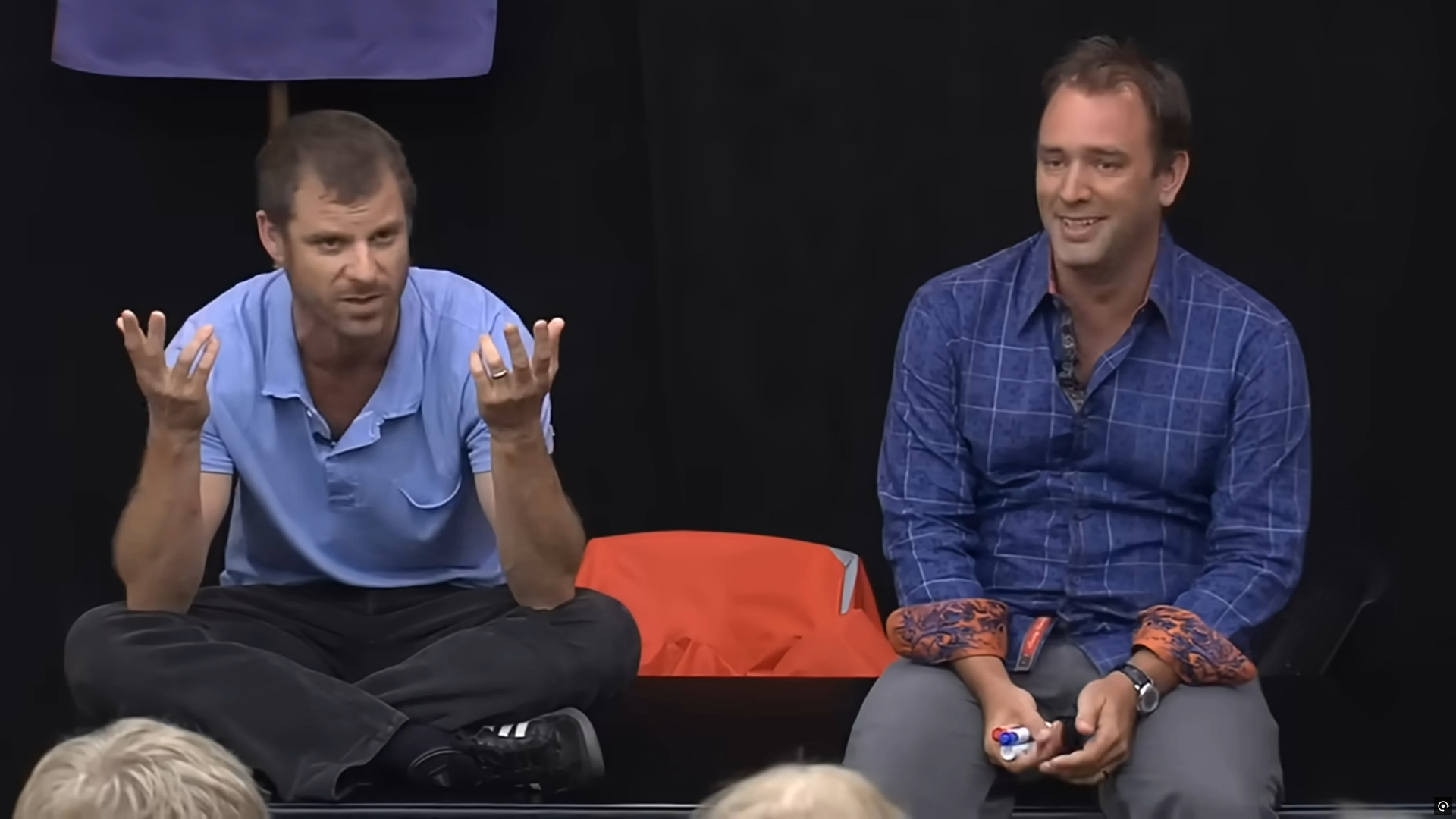
In this short clip, South Park creators Matt Stone and Trey Parker describe a simple way to examine the connections between story beats. If you can connect them with “and then,” you are on the wrong track. Instead, we should be able to connect our story beats with “but” or “therefore.”
I know it sounds too simple, but, in my experience, the most elegant and effective solutions usually are simple.
The problem with “and then”
Consider this brief outline:
A woman loses her job. And then she visits her brother. And then she finds a bag of money. And then she sees a dog that reminds her of her childhood pet. And then someone follows her home.
We know the order of events but they are not directly connected, making the structure feel disjointed or forced. Worse yet, we are likely introducing elements the reader doesn’t care about or need to know.
“Therefore” and “but” give each of the events consequences
Now let’s try it this way:
A woman loses her job. Therefore, she goes to her brother to ask for a loan. But her brother has disappeared, leaving a bag of money in his apartment. Therefore, she takes it, hoping to cover her rent while she searches for him. But the people watching his apartment see her leave with it and follow her home. We dropped the dog when this strategy showed that it did not help with plot progression.
“But” makes the plan harder
“Therefore” is a natural result of the previous beat. “But” introduces resistance and creates complications. Using this strategy ensures a linking of beats that escalates the situation. It helps to build the conflict needed to drive the story. “Therefore” and “but” are like stepping on the gas and accelerating the car. “And then” is like putting the car in neutral and coasting. The story is still moving forward, but it’s not nearly as engaging or exciting.
Use it to validate the structure
Revision is where the advice becomes especially useful.
Summarize your major story beats in one sentence each. Between them, ask:
- Does the next event happen because of what just occurred? (Therefore)
- Does it complicate a goal, expectation, or plan already in motion? (But)
If the only connection you can find is an “and then,” maybe a motivation needs to be clearer or two scenes should be in a different order. Or you might find you’ve written a wonderful scene that doesn’t affect anything around it.
I find myself in this situation when I go too far with a scene in order to “develop character.” This is because I have another rule where each sentence needs to either move the plot forward or develop character. I think that is a great rule, but the problem with the character development part is that it is easy to go off on elaborate descriptions and internal dialog and prevent the plot from developing as fast as it should. The Matt and Trey strategy prevents that and forces me to roll the character development into the action.
Changing the words won’t fix the story
Of course, you can’t repair an arbitrary sequence of beats by inserting “therefore” between the sentences.
“She lost her job; therefore, a spaceship landed” doesn’t connect. At the very least, there is a need for something between the beats that makes the progression natural and explains how those events connect.
The connection has to exist in, and because of, the events themselves. The reader should be able to feel the escalation as each beat happens.
-James


Have you found there is a certain rhythm that works best for this, like alternating between therefore and but? How many in a row is too many? Can a story be all therefores or all buts?
LikeLike